
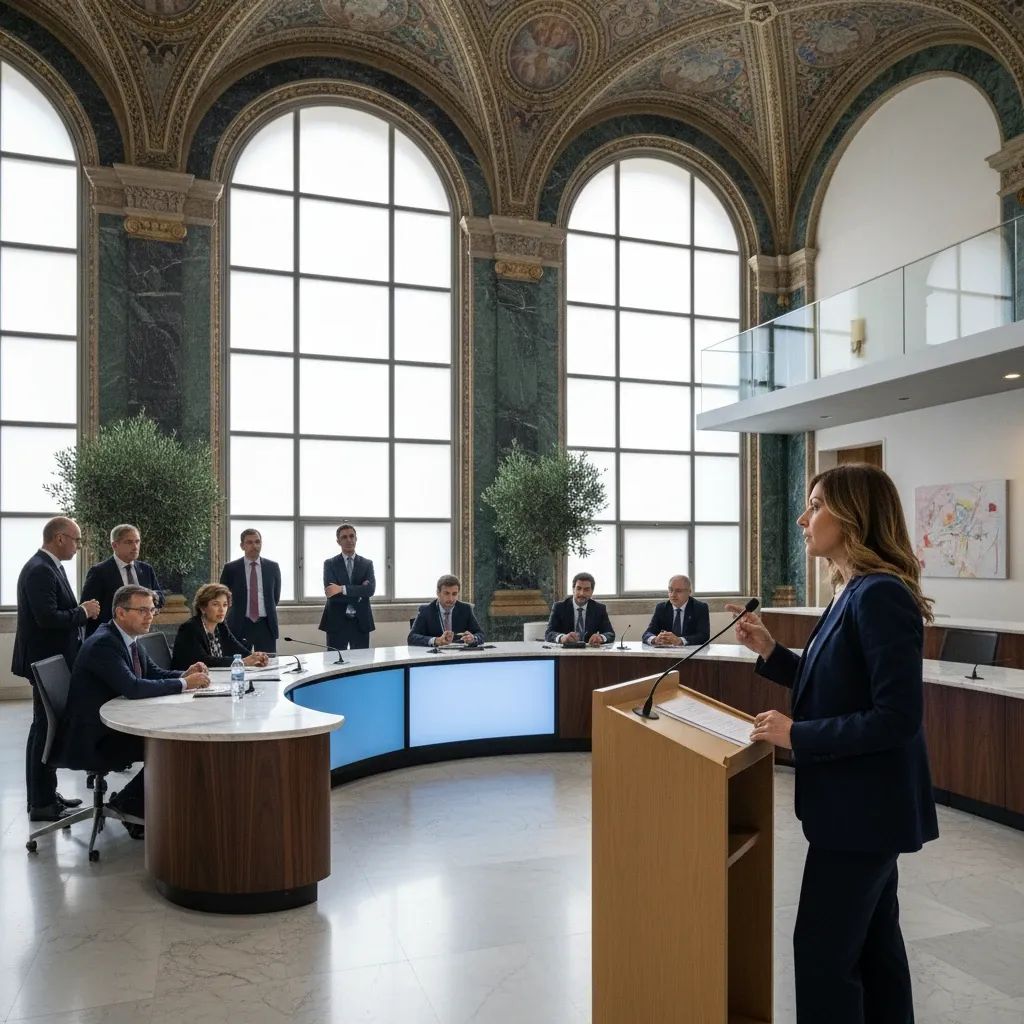
The mayor of Genova, Silvia Salis, has rejected the proposed primaries for selecting a unified opposition candidate in 2027, calling them "wrong" and "dangerously divisive." Yet she has become the focus of intense speculation that the leader, who has served for nearly a year in city hall, could become the centerpiece of a fractured center-left coalition struggling to mount a credible challenge to Prime Minister Giorgia Meloni. In a Vanity Fair interview, Salis noted that "once you've served as mayor, you're ready for anything"—a comment observers interpreted as openness to national candidacy, though she has repeatedly stressed her commitment to completing her municipal term.
Why This Matters
• National speculation: Commentators and coalition figures view Salis as a potential unifying leader, though she has not formally declared candidacy and has explicitly rejected the primaries process.
• Coalition friction: The Partito Democratico, Movimento 5 Stelle, and Alleanza Verdi e Sinistra remain divided on foreign policy and leadership selection, particularly over whether Italy should deploy naval assets to the Strait of Hormuz.
• Local governance model: Her mediation-heavy approach in Genova is being studied as a template for coalition management at the national level.
The Mayor Others See as a Symbol
Silvia Salis captured Genova's City Hall on 26 May 2025 with 51.6% of the vote, defeating center-right candidate Pietro Piciocchi in the first round—a rare feat in a region long dominated by conservative politics. Her coalition brought together the Partito Democratico, Movimento 5 Stelle, Alleanza Verdi e Sinistra, and a patchwork of civic lists including Azione, Italia Viva, and +Europa under the "Riformiamo Genova" banner.
The victory was hailed as proof that Italy's fragmented opposition could win when united behind a credible, nonpartisan figure. Salis, a political outsider with no prior party membership, embodied the "altro" (other) profile that analysts say could break the center-left's decade-long electoral drought.
In her Vanity Fair interview, Salis described the constant balancing act of municipal governance: "You won't always be able to do what you want. You'll have to find continuous compromises, mediate between political forces in the interest of the city. It's a difficult equilibrium to find." That statement, though framed in local terms, resonates nationally as the Italian center-left grapples with internal schisms over foreign deployments, economic policy, and the very structure of its leadership selection process.
Primary Disputes and the Question of Unity
Giuseppe Conte, leader of the Movimento 5 Stelle, has proposed primaries to select a unified opposition candidate for the 2027 general elections. Salis rejected the idea almost immediately after Conte floated it, calling primaries "wrong" and "dangerously divisive." Her reasoning: forcing coalition partners to compete publicly damages the cohesion needed to govern effectively.
Meanwhile, Ernesto Maria Ruffini, founder of the micro-party Più Uno, has said he would participate in primaries "if the rules are clear," adding with a wry nod to Salis's blonde hair, "I'm not blonde enough." When pressed on a potential head-to-head with the Genova mayor, Ruffini deferred, noting that Salis has repeatedly stated her commitment to finishing her municipal term.
The debate extends beyond process. A substantive policy rift has emerged over whether Italy should dispatch naval assets to the Strait of Hormuz to protect commercial shipping amid escalating regional tensions. This matters concretely for residents: approximately 20% of Italy's crude oil and significant portions of manufactured goods imports transit through the Strait. A decision to deploy naval forces, or to abstain, will shape Italy's standing within the European Union and NATO, influence bilateral relations with the United States, potentially affect Italian military deployments and defense budgets, and influence Italy's economy and energy security.
M5S and Alleanza Verdi e Sinistra insist any deployment must carry a United Nations mandate. The Partito Democratico has been more cautious, with foreign affairs chief Peppe Provenzano stating, "Let's not discuss conditions without the premise—and the premise is a peace agreement."
Yet not all PD voices agree. Senator Graziano Delrio, increasingly out of step with his party's secretariat, told Corriere della Sera that Italy should participate "even without the UN." Another reformist faction member quipped, "I wouldn't want the UN to be our Godot"—a reference to Samuel Beckett's play about waiting endlessly for someone who never arrives, suggesting frustration that the UN won't resolve the coalition's dilemma. One senior PD figure in the Transatlantico (the corridor where informal coalition negotiations occur in the Chamber of Deputies) insisted to reporters that "we will find a unified position for the broad coalition" (campo largo, as coalitions spanning center to left are called in Italian politics), though the timeline and substance remain murky.
What This Means for Residents
For people living in Italy, the Salis phenomenon carries two immediate implications. First, it demonstrates that municipal governance is increasingly viewed as a proving ground for national leadership—a shift from the traditional path through parliamentary party hierarchies. Second, the policy disputes within the center-left—particularly on foreign deployments that could affect Italy's economy, energy security, and military commitments—are unlikely to be resolved quickly, meaning voters should expect continued instability in opposition messaging through 2026 and into the 2027 campaign.
Italy's shipping and logistics sectors depend on open sea lanes for imports of energy and manufactured goods. How coalition partners resolve the Hormuz question will signal their readiness to govern and their ability to manage complex international relationships—a critical test for voters evaluating opposition credibility.
At the municipal level, Salis has prioritized transparency and unpopular but necessary decisions. She outlined her 2026 agenda in January: resolving the financial crisis at AMT (Genova's public transport company), overhauling Amiu (the city's waste management firm), increasing social spending, building new playgrounds and a major university campus, and decentralizing resources to neighborhood councils. She also launched a pilot program for affective and sexual education in municipal kindergartens—a move that drew both praise and criticism.
A Catholic, a Mother, and a Pragmatist
In the Vanity Fair profile, Salis offered a personal sketch that doubles as a political positioning statement: "I'm a mother, I'm Catholic, I'm married, I'm heterosexual—but I don't believe mine is the only model or that it's better than others. The municipality is secular, the administration is secular, the country is secular. And I say this as a Catholic."
The declaration is calculated. It signals to centrist and moderate voters that she shares their cultural background while reassuring progressive coalition partners that her governance will not privilege one lifestyle or family structure over another. It's also a subtle jab at Giorgia Meloni's government, which has emphasized traditional family values and restricted access to certain reproductive and parenting rights for LGBTQ+ families.
Salis went further, contrasting her political constraints with Meloni's freedom of maneuver: "The center-right electorate doesn't see coherence as its defining value. A center-left leader, for example, would never be forgiven the flip-flops of our Prime Minister." The comment references Meloni's shifts on issues ranging from European Union fiscal rules to migration policy—reversals that have drawn little blowback from her base.
Mediation as Strategy
Salis's approach to coalition management has been tested in real time. During a protest by workers from Genova's former Ilva steel plant, she intervened to "calm tempers" and delivered a message of "proximity, not opposition" to both police and laborers. She argued that industrial development and social justice must be balanced, rejecting the binary framing often imposed by more ideologically rigid partners.
She has also pushed back against national government criticism. When center-right parliamentarians blamed mayors for rising crime in large cities, Salis called it a "political attack by the government," noting that public security falls under national competence, not municipal authority, and demanded more resources and attention for urban areas.
An April 2026 opinion poll by Piepoli found that a majority of potential "campo largo" (broad coalition) voters view Salis as their preferred leader, lending empirical weight to the speculation that has surrounded her for months.
The Road Ahead
No formal announcement has been made. Salis maintains publicly that her focus is Genova, and her administration is barely a year old. But observers have noted a shift in her rhetoric. The Vanity Fair interview's central line—"once you've served as mayor, you're ready for anything"—was echoed in other April appearances, where she acknowledged she would "consider a candidacy for the 2027 political elections to lead the government" if the entire center-left rallied behind her, provided it occurred without a primary process she views as corrosive to coalition unity.
Whether that unity materializes remains the open question. The Partito Democratico, Movimento 5 Stelle, Alleanza Verdi e Sinistra, and smaller centrist formations continue to jostle over policy and process. Some see Salis as the glue; others worry that elevating a mayor with no national legislative experience risks repeating past mistakes.
For now, the Genova mayor's political stock is rising precisely because she has not declared. In a coalition starved for discipline and coherence, the leader who promises "continuous mediation" and "difficult equilibrium" may be the only one capable of holding the center-left together—if she decides the risk is worth it.


