
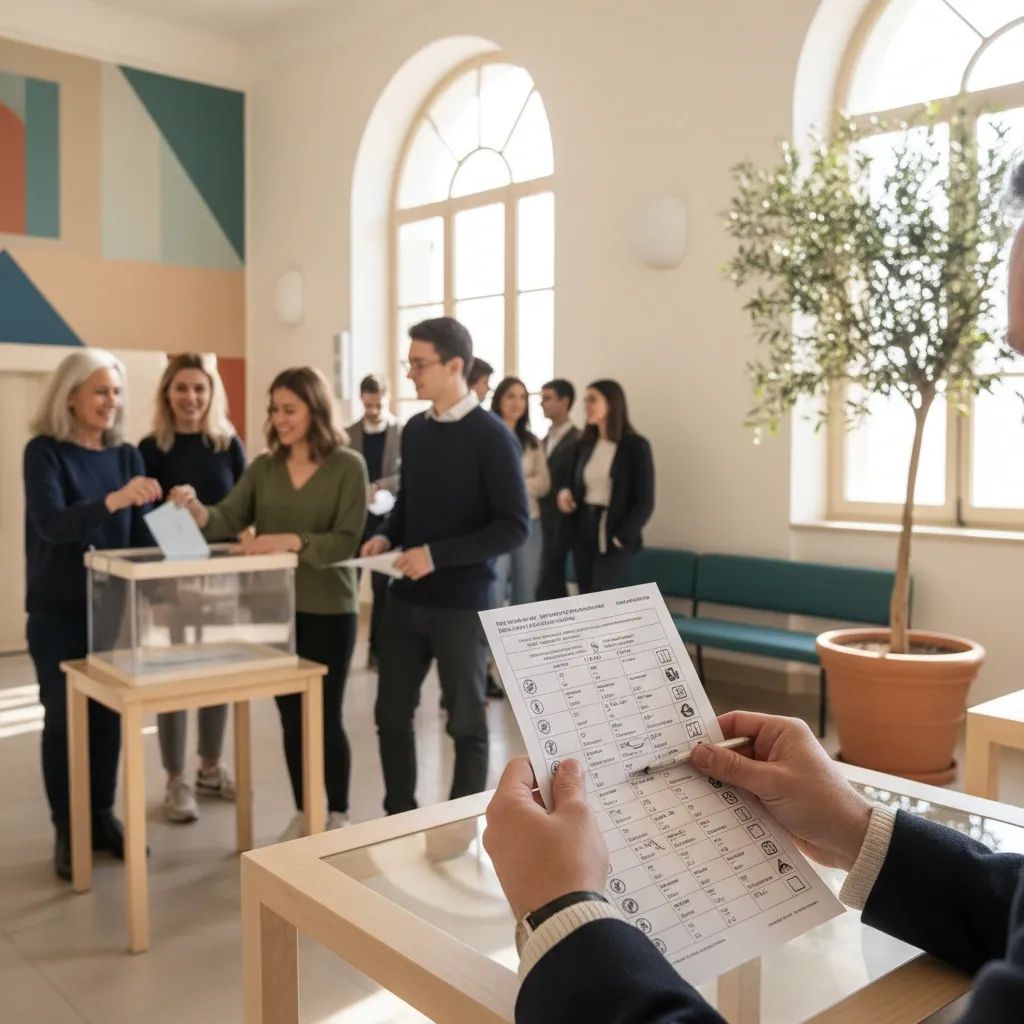
The Italian center-left coalition is fracturing over how—and when—to select its candidate to challenge Prime Minister Giorgia Meloni, with personalities clashing over the fundamental question of whether leaders should emerge from party primaries or backroom consensus.
Why This Matters
• Genoa Mayor Ilaria Salis has signaled openness to a premier candidacy if there's unanimous coalition support—but only outside the primary process.
• Polling data shows Salis ahead of Democratic Party (PD) Secretary Elly Schlein among center-left voters, complicating leadership dynamics.
• Deep programmatic divides on labor law, welfare, and foreign policy between the Movimento 5 Stelle (M5S), the PD, and Italia Viva threaten coalition viability.
• The debate is intensifying as autumn 2026 primaries loom, with national elections expected in spring 2027.
Salis Opens the Door—With Conditions
Ilaria Salis, the former Olympic hammer thrower who swept to victory as mayor of Genoa in 2025, told reporters this week she would "be lying" if she dismissed the possibility of leading Italy's opposition. Her condition? A unanimous request from the entire coalition, avoiding the divisive spectacle of competitive primaries.
International outlets including Bloomberg have already framed Salis as a potential "anti-Meloni"—a fresh face untainted by Rome's chronic infighting. Her appeal stems partly from timing: she assumed office in Genoa just as the government's referendum defeat on judicial reform reinvigorated the opposition's hopes.
Salis's stance, however, has drawn sharp reactions. Speaking at the M5S's Rome assembly, party president Giuseppe Conte warned that "talking about names and surnames today feeds personalism and division." Conte, who has championed a participatory program-building process through 100 open "democracy spaces," insists the coalition must first agree on policy, then choose a leader through open primaries.
The Primary Dilemma: Transparency or Triage?
Italia Viva leader Matteo Renzi waded into the controversy from his party's Rome event, urging Salis to reconsider primaries. "There's still a year. It's a long road," Renzi said, framing the process as inevitable. His party is rolling out the "Primarie delle Idee" (Primaries of Ideas), a web platform where citizens can submit policy proposals reviewed by academics and a steering committee featuring figures like Milan Mayor Beppe Sala.
Inside the PD, sentiment is hardening against the idea of a "federator" leader parachuted in from outside. Peppe Provenzano, a member of the PD secretariat, laid down the line: "The leader is indicated by the party that wins the most votes, or through primaries. Schlein has already said she's ready." The message was echoed in Naples, where the party's dominant internal faction gathered to strategize on content over celebrity. Even Dario Franceschini, initially rumored to back Salis, clarified his support for primaries as "the most inclusive and transparent tool."
Yet doubts persist. Andrea Orlando, another senior PD figure, expressed concern that "if the party isn't adequately mobilized, we risk struggling to meet the challenge." The unspoken fear: a low-turnout primary could empower fringe candidates or deepen factional splits just as the coalition needs cohesion.
What This Means for Residents
For Italians watching the opposition scramble for unity, the stakes are practical. The coalition that emerges—or fails to emerge—will determine whether there's a credible alternative to Meloni's government in 2027. Policy paralysis on issues like labor precarity, minimum wage legislation, and environmental commitments hangs in the balance.
If the center-left cannot reconcile its internal contradictions, voters face a binary choice: continuity under the current administration or a fragmented opposition unable to govern. The M5S's push for a €9-per-hour minimum wage and shorter workweeks clashes with Italia Viva's defense of the 2015 Jobs Act, which Renzi credits with creating employment. On foreign policy, the M5S's cautious stance on military aid to Ukraine—rooted in Article 11 of the Italian Constitution, which renounces war—contrasts sharply with Italia Viva's and the PD's Atlanticist positions.
These are not abstract disagreements. They translate to real-world outcomes: whether gig workers get legal protections, whether Italy maintains arms shipments to Kyiv, and whether the Next Generation EU funds flow toward green projects or business productivity incentives.
Polls Complicate the Narrative
Recent surveys deepen the leadership quandary. A Primocanale poll found that 54% of Ligurian center-left voters prefer Salis over Schlein, who trails at 34%. Nationally, BiDiMedia data suggest Salis would perform better than Schlein in a hypothetical matchup against Meloni. Even among the coalition's centrist flank—supporters of Casa Riformista, the Socialist Party, and +Europa—Salis leads.
The numbers reflect Schlein's rocky tenure as PD secretary. Some internal analyses describe her position as increasingly isolated, with more "anti-Elly" sentiment than enthusiastic backing. Salis, by contrast, enters the debate unburdened by Rome's factional baggage, her profile boosted by a successful debut in local governance and a prior career as vice president of Italy's Olympic Committee (CONI).
The Riformisti Flex Their Muscles
Renzi's "Primaries of Ideas" event underscored the influence of the coalition's liberal wing. Marianna Madia, Giorgio Gori, and Graziano Delrio—all PD reformists—took the stage, emphasizing the need to attract civic activists beyond party boundaries. "This is a space to go beyond party lines, to question our own affiliations," Madia argued.
Riccardo Magi, secretary of +Europa, took a swipe at Carlo Calenda's centrist project: "There's no room for a Third Pole." Meanwhile, Benedetto Della Vedova pressed the M5S on Ukraine, drawing applause for his harder line on defense. His closing remark captured the coalition's tension: "We're different from Gratteri and Landini, but we're seeking an alliance."
Renzi, ever the provocateur, framed the stakes dramatically: "If we as reformists launch ideas, we'll be decisive in helping the center-left win elections and preventing Ignazio La Russa from moving to the Quirinale." (La Russa, a right-wing firebrand, currently serves as Senate president and would be a constitutionally eligible presidential candidate.)
The Program-First Strategy
Conte's alternative to immediate leadership battles is NOVA 2026, a participatory platform inviting citizens to shape M5S policy priorities. He insists the coalition must define a shared program with clear strategic objectives before nominating anyone. "For us, the field is delimited by the program," he said.
The approach has merit in theory: by anchoring the coalition in policy, the hope is to avoid personality-driven fragmentation. In practice, however, the programmatic gaps between M5S, PD, and Italia Viva may prove unbridgeable. The M5S's opposition to including Renzi in any coalition—citing a lack of trust—remains a blunt fact.
Timing and Tactics
If general elections occur in spring 2027, as widely expected, the coalition's primary season would likely unfold in autumn 2026—just six months away. That timeline pressures all actors to either resolve differences swiftly or abandon the pretense of unity.
Former Prime Minister Romano Prodi has cautioned against rushing into primaries, warning that premature internal battles could hand Meloni a strategic advantage. Others counter that delaying the choice merely postpones inevitable conflict, risking a last-minute scramble that looks amateurish to voters.
The debate also reflects deeper questions about legitimacy. Should the largest party automatically provide the premier candidate, as the PD suggests? Or should an open primary—regardless of outcome—confer democratic legitimacy that transcends party calculus?
The Gender Factor
Both Salis and Schlein represent a generational and gender shift in Italian politics, where executive leadership has remained overwhelmingly male. Meloni's tenure as Italy's first female prime minister complicates the dynamic: the center-left's feminist credentials no longer guarantee automatic contrast.
Salis's biography—Olympic athlete, sports administrator, progressive mayor—offers a narrative arc distinct from Schlein's academic and activist roots. Polling suggests voters perceive Salis as more pragmatic and results-oriented, while Schlein carries the baggage of ideological purity tests within the PD's fractious base.
The Road Ahead
As Italy approaches summer, the coalition faces a choice: prioritize unity of purpose or clarity of leadership. The M5S, the PD, and the Riformisti each command distinct electoral bases and policy visions. Whether those visions can coexist in a governing coalition—or even a campaign platform—remains uncertain.
For residents, the spectacle of opposition infighting carries tangible costs. Every week spent debating primary rules is a week not spent challenging government policy on healthcare cuts, pension reforms, or tax increases. The risk is that voters, exhausted by procedural squabbles, conclude the center-left lacks the seriousness required to govern.
Salis's gambit—offering herself as a unifying figure while rejecting the legitimacy contest of primaries—may represent an attempt to square that circle. Whether the coalition's fractious components accept the offer will determine whether Italy's opposition can mount a credible challenge in 2027, or whether Meloni's path to a second term remains unobstructed.


