
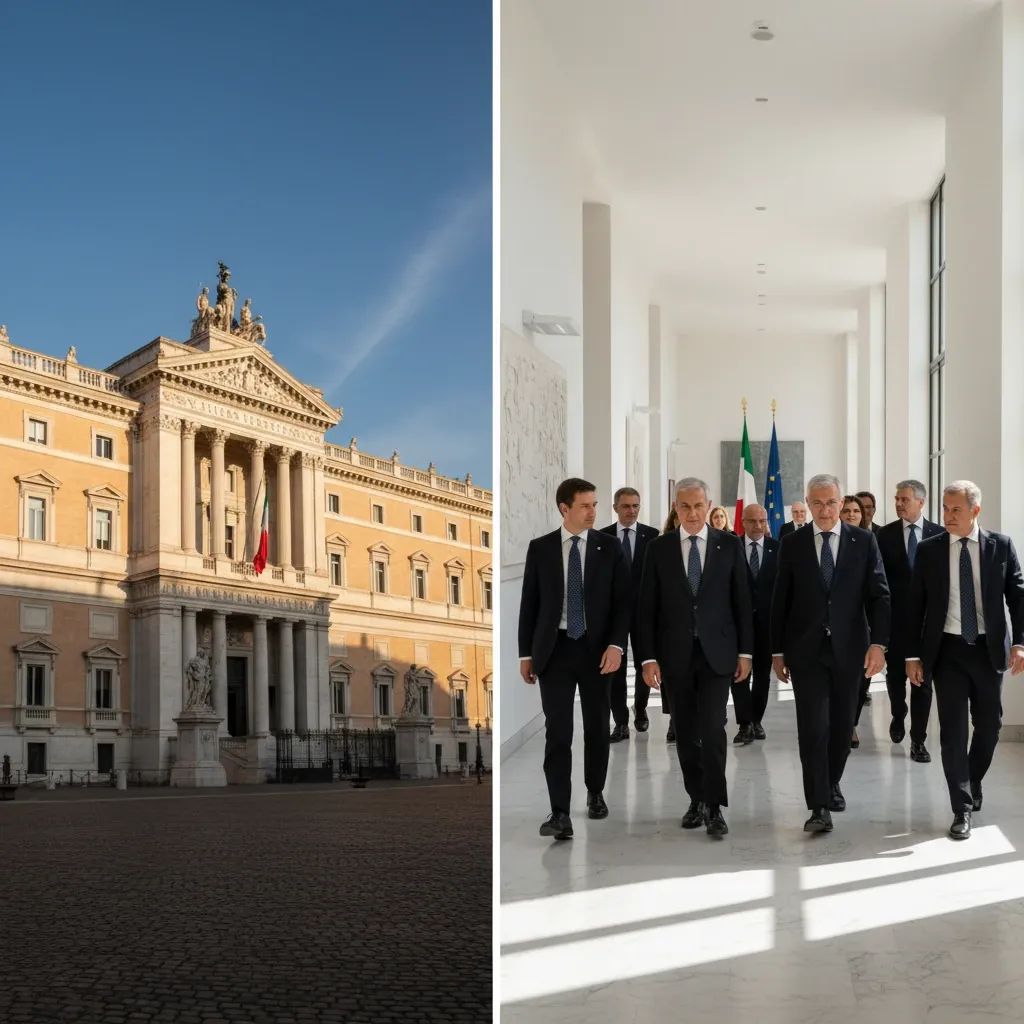
The Italian government has filled the politically sensitive tourism portfolio with a surprise speed, installing Gianmarco Mazzi—a veteran music and entertainment manager—as the nation's new Minister of Tourism following his predecessor's resignation. The appointment, formalized on April 3, 2026 at the Quirinale Palace with an oath before President Sergio Mattarella, positions the 66-year-old Verona native to oversee an industry worth over 14% of Italy's total employment—but also one confronting cascading headwinds from Middle East conflict fallout, spiraling travel costs, and overtourism backlash.
Why This Matters
• Continuity bet: Mazzi inherits the strategic roadmap from Daniela Santanchè, who departed March 25 amid prolonged political pressure, meaning no policy rupture is expected in the short term.
• Event-driven tourism push: With six Sanremo Festival directorships and a five-year tenure as CEO of the Arena di Verona (2017–2022), Mazzi may accelerate the fusion of major cultural spectacles with destination marketing.
• Ministry vacancies remain: The swift tourism fix leaves five other government roles unfilled, including a second Culture Ministry undersecretaryship vacated by Mazzi's own promotion—and speculation swirls that his ministerial stint could be a springboard toward a 2027 Verona mayoral candidacy.
From Arena Spotlights to Government Corridors
Mazzi's résumé reads less like a bureaucrat's CV and more like a backstage pass collection. Over four decades, he orchestrated tours and events for household names—Al Bano, Andrea Bocelli, Adriano Celentano—earning congratulations from the entertainment world that nearly drowned out standard institutional well-wishes. "With him, tourism will take flight like a great airplane," Al Bano declared, while Celentano posted a rare social-media endorsement: "Your steps along the tortuous path of politics will surely be just, because I know you."
That blend of cultural clout and organizational muscle won him the Culture Ministry undersecretaryship in 2022, where he steered the long-awaited Live Performance Code into law, renewed the 20-year-dormant collective bargaining agreement for symphony workers, and coordinated Italy's UNESCO candidacies—from lyric opera recognition to the current application for Italian cuisine (with TV presenter Antonella Clerici as ambassador) and the Nativity scene tradition. His exit now creates a second headache for Culture Minister Alessandro Giuli, who must plug a hole in a ministry that has churned through more leadership changes—one minister and two undersecretaries—than any other since Premier Giorgia Meloni took office in autumn 2022.
A Sector Under Multiple Pressures
The Italian tourism machine generated record numbers in recent years, yet operators warn the tailwinds are reversing. Geopolitical uncertainty—chiefly instability in the Middle East—has triggered an estimated €100 M in cancellations and rebookings for Italian travel agencies, according to industry tallies. Long-haul routes to Asia and Oceania face delays as airlines reroute around conflict zones, while Mediterranean neighbors (Egypt, Tunisia, Morocco) report softening demand. American visitors, a lucrative segment, grow wary of international travel amid elevated threat perceptions.
At the same time, inflation and fuel surges are squeezing household budgets. Many Italian families now opt for cheaper foreign destinations, reversing outbound-inbound balances. New levies compound the pain: Venice and other hotspots have rolled out visitor taxes; the European Union's ETIAS electronic authorization debuts in 2026, adding administrative friction and cost. Fuel prices, denominated in dollars and buffeted by commodity volatility, hit both airlines and package-tour margins, with the euro's weakness magnifying each barrel's bite.
Structural challenges layer on top. Overtourism concentrates 96% of visitors into just 4% of the national territory—Venice, Florence, Rome, the Amalfi Coast—generating resident resentment and regulatory crackdowns. Climate change reshapes summer patterns; heat waves push travelers toward shoulder seasons, straining an industry historically geared to July–August peaks. The accommodation base remains fragmented, with fewer luxury-brand hotels and international chains per capita than EU peers, while digital-skills gaps and generational turnover leave many operators ill-equipped for AI-driven booking engines and sustainability analytics.
What This Means for Operators and Travelers
Mazzi inherits the 2023–2027 Strategic Tourism Plan drafted under Santanchè, and he pledged to provide "maximum energy and continuity." That blueprint prioritizes three pillars:
Deseasonalization and geographic dispersion: Funneling tourists toward the 96% of Italy that sees sparse visitation—small communes, inland villages, minor islands—through event programming and digital discovery tools on the Tourism Digital Hub platform (Italia.it).
Sustainability and quality over quantity: Shifting metrics from headcount to per-capita spend, aligning investments with ESG criteria, and avoiding the social fractures that mass tourism can inflict on communities.
Business competitiveness and workforce conditions: Rolling out grants and low-interest financing for digitalization and green retrofits, coupled with a "new social pact" that cuts payroll taxes for tourism firms on the condition that savings flow to employees as higher wages or benefits.
For travelers, expect a continued push toward off-peak discounts, better-connected secondary destinations, and more robust online aggregation of boutique accommodations and experiential offerings. Businesses, meanwhile, should watch for application windows on sustainability and digital grants; the ministry's rhetoric suggests these funds will remain a priority even as Brussels tightens overall fiscal oversight.
Political Chess in the Veneto: 2027 Election Speculation
Media and political sources are circulating speculation about the 2027 Verona mayoral race, where Mazzi's profile as a Verona-rooted tourism minister could position him as a potential center-right candidate. The city—home to the iconic Arena and a symbolic prize in Veneto, long a Lega stronghold under regional president Luca Zaia—currently has center-left mayor Damiano Tommasi, a former footballer who won partly because of center-right disarray. However, Fratelli d'Italia has not formally committed to backing Mazzi, and public signals remain notably muted.
Ciro Maschio, FdI's provincial coordinator, stressed to reporters "keeping the squad united" without naming a candidate. Other center-right names in circulation include Giuseppe Riello (Confindustria Verona president) and Lega MEP Paolo Borchia, while Flavio Tosi—a former Lega figure now with Forza Italia—appears to have lost momentum despite early backing from Meloni and party leader Antonio Tajani. An election-day coincidence with national polls—both potentially scheduled for 2027, possibly consolidated into a spring super-vote—would amplify media attention and turnout dynamics if Mazzi emerges as an official candidate.
Mazzi's focus, for now, remains on the Villa Ada offices vacated by Santanchè on March 24; his first official ministry entry followed the April 3 appointment.
Broader Cabinet Shuffle Landscape
While the tourism slot is filled, five other government positions remain vacant. Augusta Montaruli (FdI) resigned as undersecretary for universities in February 2023 following a criminal conviction for misuse of regional-council funds. Vittorio Sgarbi, the acerbic art critic, left Culture in early 2024 after a protracted standoff over an allegedly stolen painting and conflict-of-interest accusations. More recently, Massimo Bitonci (Lega) decamped from the Enterprise Ministry in January to become an assessor in the Veneto regional government, and Giorgio Silli (Forza Italia) quit Foreign Affairs in February to lead the Istituto Italo–Latino Americano, an intergovernmental cooperation body. The sixth empty chair belonged to Andrea Delmastro (FdI), who resigned from the Justice Ministry after revelations about shareholdings linked to a figure associated with a Camorra clan; his portfolios have been redistributed to Andrea Ostellari (Lega) and vice-minister Francesco Paolo Sisto (FI), but the formal slot remains unfilled.
Health undersecretary Marcello Gemmato told reporters the Meloni government sees "no reshuffle on the horizon," adding that any optimization "is within the prerogative of the premier and the majority parties." He noted the current coalition already ranks as Italy's third-longest administration—closing in on the all-time record—and framed stability as the handmaiden of prosperity. Whether that stability holds through 2027 depends in part on Mazzi's ability to convert his Rolodex of celebrity endorsements into tangible relief for an industry caught between global turbulence and homegrown structural strain.
Culture Ministry's Revolving Door
Mazzi's departure leaves the Collegio Romano—the Culture Ministry's neoclassical headquarters—with only one undersecretaryship intact: Lucia Borgonzoni (Lega), who holds the cinema portfolio. Three of the four original appointments have now exited, the highest attrition rate across Meloni's entire cabinet. If the slot remains in FdI hands, speculation centers on Federico Mollicone, chair of the Chamber's Culture Commission and the party's national culture-and-innovation chief, though some insiders worry his assertive profile might clash with Minister Giuli. An alternative is Alessandro Amorese, Mollicone's deputy and FdI group leader on the same commission, who co-authored multiple legislative proposals but carries less political weight.
The replacement calculus is delicate: handing the post to Mollicone would trigger a new vote for the commission chairmanship, potentially upsetting carefully calibrated center-right power-sharing. Leaving it vacant risks signaling disarray in a ministry that was already buffeted by the summer 2024 exit of Gennaro Sangiuliano amid a scandal involving a social-media influencer and alleged misuse of official travel. Mazzi himself managed high-stakes files—UNESCO coordination, the live-performance code, symphony-worker contracts, and an offensive on tax-credit abuse in the film industry. His successor will need both technical chops and political finesse to maintain momentum on flagship projects, from the Italian cuisine UNESCO bid to the Italian Nativity candidacy.
Industry Reaction: Promises and Pressure
Trade groups issued the ritual chorus of praise, each embedding a policy wishlist. Bernabò Bocca, president of Federalberghi, pledged to support Mazzi "in the interest of the country, reinforcing the centrality of a sector employing over 4 M people." Manfred Pinzger, vice president of Confcommercio and head of Confturismo, expressed confidence Mazzi "will guide the sector with competence, responsibility, and listening to business concerns in a highly complex phase." Similar pledges arrived from Federturismo Confindustria, Assoturismo Confesercenti, tour-operator federations, spa associations, and hotel consortia—all emphasizing the open dialogue Santanchè maintained and expecting its continuation.
ENIT, the national tourism agency, doubled down with congratulations from both chair Alessandra Priante and managing director Ivana Jelinic. Meanwhile, Santanchè herself—whose tenure ended under a cloud of legal troubles unrelated to ministry performance—issued a gracious farewell: "Proud to have held this office and happy the work will be carried forward by a person like him. I am sure Minister Mazzi will continue to give momentum to a sector that, by breaking records and firsts, we have made central to Italy's socioeconomic well-being."
Whether Mazzi can translate backstage connections into boardroom credibility—and whether the government's "no reshuffle" mantra survives the next electoral cycle—will become clear as 2026 unfolds. For now, Italy's tourism portfolio has a fresh face with a familiar mandate: keep the visitors coming, spread them more evenly, and ensure the industry's prosperity doesn't erode the quality of life for the 60 M people who already call the peninsula home.


