
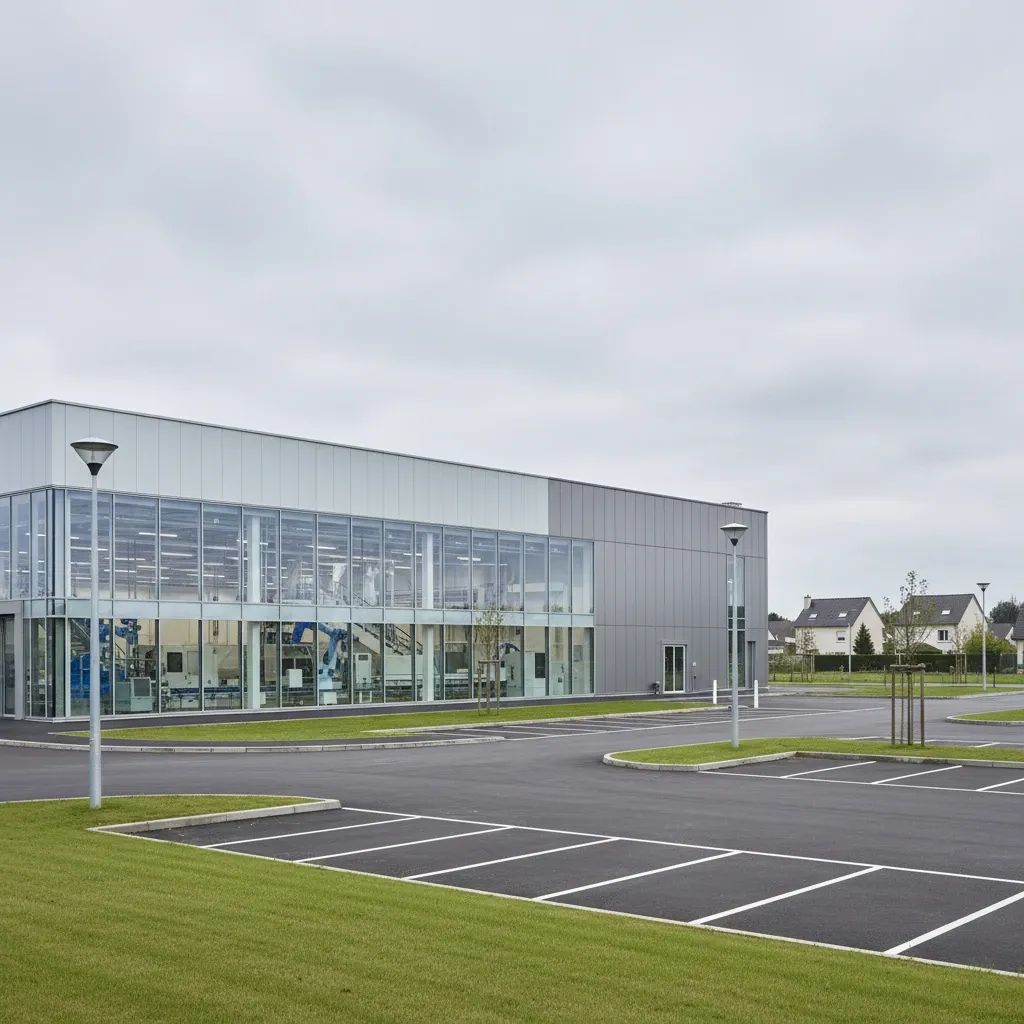
The Stellantis Group has confirmed it will halt automobile assembly at its historic Poissy plant near Paris by the end of 2028, marking the final collapse of car manufacturing in the Île-de-France region and underscoring a broader structural crisis gripping the French automotive sector. The Italian-French-American conglomerate will invest €100M to convert the facility into a components hub, but the move eliminates the last remaining vehicle production site in greater Paris—a symbolic defeat for an industry that once employed tens of thousands in the capital's industrial belt.
Why This Matters:
• Last Paris-area assembly plant closes: Poissy was the sole remaining car factory in Île-de-France, following shutdowns at Renault Boulogne-Billancourt (1992), PSA Aulnay-sous-Bois (2014), and Renault Flins (2022).
• Workforce transitions to components operations: From 1,925 workers on paper (1,580 active), the site will retain approximately 1,200 operai by 2030, managed through voluntary departures and retirements.
• French production collapses: National output has plummeted from 3.66M vehicles in 2004 to 1.35M in 2024, with Poissy accounting for just 13.5% of Stellantis France's 662,000 units in 2025.
• Reconversion, not closure: The facility will pivot to spare parts manufacturing, 3D printing for special series, vehicle retrofitting, and circular economy operations—fully operational by 2030.
The End of an Industrial Era
Opened in 1938, the Poissy factory once symbolized French industrial might. At its zenith in 1976, the plant employed 27,000 workers and churned out mass-market models for Peugeot, Citroën, and later Opel under the Stellantis umbrella. Today, it assembles the Opel Mokka and DS 3 (including electric variants), but output has cratered: production is forecast at 68,000 units in 2026 and 65,000 in 2027, down sharply from 145,800 in 2023.
The decision to end assembly reflects chronic overcapacity across Europe, exacerbated by sluggish electric vehicle uptake, rising Chinese competition, and France's steep labor costs. Stellantis operates 42 plants worldwide; post-Poissy, just 4 of its 11 French factories will produce finished vehicles: Mulhouse and Sochaux (east), Rennes (west), and Hordain (north, for commercial vans). France's share of Stellantis global production has withered accordingly.
The closure trajectory mirrors a regional pattern. Renault shuttered Boulogne-Billancourt on Paris's doorstep in 1992, followed by PSA's Aulnay-sous-Bois in 2014 and Renault Flins (15 km from Poissy) in 2022. Greater Paris, once a manufacturing epicenter, is now effectively devoid of large-scale car assembly. The Île-de-France press characterized the Poissy announcement as "the slow death of the French automobile," a phrase capturing both nostalgia and resignation.
What This Means for Workers and the Regional Economy
Stellantis has pledged no forced redundancies, relying instead on natural attrition and voluntary schemes. The workforce's average age—54 to 55 years—means many employees are nearing retirement, softening the immediate social blow. Still, the net reduction of roughly 725 positions (from 1,925 nominal roles to 1,200) represents a significant contraction in stable, unionized manufacturing jobs.
Union representatives have expressed strong concern about the transition. Jean-Pierre Mercier of SUD Solidaires called prior production stoppages "rehearsals for definitive closure," questioning Stellantis's rhetoric about a "difficult European market." Unions have demanded detailed guarantees on the skills-training programs and wage protections for displaced workers, arguing that components manufacturing typically requires fewer workers and offers fewer advancement opportunities than assembly operations. The government has indicated it will monitor the reconversion plan to ensure compliance with French labor and industrial policy objectives.
The €100M reconversion plan envisions four core activities by 2030:
Spare parts and aftermarket production: A third stamping press line, modernized welding, a new paint shop, and a motor assembly line transferred from Vesoul.
Circular economy operations: A disassembly line for reconditioning and reselling salvaged components.
Vehicle preparation and transformation: Special editions, competition cars, and fleet conversions for commercial clients.
3D printing: Prototyping and small-batch parts for R&D.
Management insists the site will retain a "permanent industrial future," but the absence of new model assignments post-2028—DS 3 E-Tense production shifts to Zaragoza, Spain, in 2027—underscores the strategic shift away from high-volume assembly. For the broader Île-de-France economy, the closure removes a key anchor employer. Service industries and logistics may absorb some displaced workers, but the loss of high-skill assembly jobs and the associated supplier ecosystem will leave a gap in regional GDP and tax receipts.
France's Automotive Freefall: Structural Causes
Poissy's demise is symptomatic of nationwide decline. French car production has shed 2.3M units in two decades, driven by relentless offshoring to lower-cost jurisdictions—Eastern Europe, Spain, Portugal, Turkey, and India. French manufacturers, historically dominant in the small-car segment, found those models unprofitable at domestic wage levels and migrated assembly southward and eastward.
High labor costs remain a core competitive disadvantage. French plants face stricter regulations, higher social charges, and more powerful unions than counterparts in Spain or Poland. Meanwhile, the EU's aggressive climate mandates—including the 2035 ban on new internal combustion engine sales—have accelerated a wrenching transition to electric vehicles (EVs). Infrastructure rollout lags, EV purchase prices remain elevated, and manufacturers struggle with battery supply chains and margin compression.
Chinese EV makers compound the pressure. Brands like BYD, NIO, and Geely offer competitively priced electric models, capturing European market share and forcing legacy producers to discount aggressively. Stellantis and Renault have lobbied Brussels to relax safety standards for smaller vehicles, hoping to field cheaper "city cars" that can compete with Asian imports—a tacit admission of cost-structure weakness.
Domestically, French sales have stagnated below pre-pandemic levels. To compensate for shrinking volumes, manufacturers have pivoted upmarket, selling larger, higher-margin SUVs and crossovers like the DS range. This strategy delivered record profits during the pandemic supply crunch but left factories like Poissy, geared for compact models, with insufficient work. Stellantis held the 2nd spot in European sales overall but underperformed market growth in recent quarters, ceding ground to Volkswagen and losing share to Renault in the French passenger-car segment (though Stellantis retains the lead when commercial vehicles are included).
The Italian Perspective: Why This Matters for Italian Residents
For residents and businesses in Italy, Poissy's closure carries significant implications. Stellantis, formed in 2021 through the merger of Fiat Chrysler and PSA, is Italian-headquartered and constitutes a critical pillar of the Italian manufacturing base. While France sheds automotive capacity, Italy has emerged as a relative stronghold within the Stellantis group. The company operates major plants in Turin (Mirafiori), Pomigliana (near Naples), Melfi, and Cassino, which collectively produce vehicles for Fiat, Jeep, and Alfa Romeo—maintaining more robust output than their French counterparts.
The Poissy shutdown exemplifies the north-south shift in European manufacturing: as Western European labor costs and regulations climb, production increasingly moves to Southern and Eastern Europe. Italy's automotive sector has partially benefited from this dynamic. Fiat's strategic pivot toward SUVs and electric vehicles, combined with Italian wage structures lower than France's and government support for green transition investments, has positioned Italian plants competitively within the Stellantis portfolio. Mirafiori's recent €200M investment in EV production underscores this strategic rebalancing.
For Italian workers and policymakers, the French experience illustrates both a cautionary tale and an opportunity: industrial decline is not inevitable if companies and governments align on investment in high-value manufacturing, workforce training, and technology adoption. Italy's success in retaining automotive jobs will depend on sustaining this competitive edge and continuing to attract capital allocation within the Stellantis group. The closure of Poissy, paradoxically, may reinforce the strategic importance of Italian facilities within Europe's automotive landscape.
Government Response and Industrial Policy
The French government has not issued a specific statement on Poissy's closure, but broader industrial policy offers context. The €100B "France Relance" recovery plan, launched in 2020, earmarked €30B for ecological transition and €35B for enterprise competitiveness, targeting 160,000 new jobs. Within that framework, €1.2B supports industrial decarbonization, and €1.6B over 15 years funds site-level emissions cuts.
Separately, Paris approved a €4B hydrogen program to build electrolyzer capacity and a doubling of annual electrification funding from €5.5B to €10B, aiming for energy independence and green tech leadership. These initiatives prioritize long-term structural transformation over short-term job preservation, reflecting a political calculation that France's industrial future lies in high-value, low-carbon sectors rather than volume car assembly.
For Poissy specifically, Stellantis's €100M reconversion aligns with this green-transition narrative, but unions argue the plan lacks detail and guarantees. The risk is that "components and recycling" becomes a euphemism for managed decline, with Poissy ultimately reduced to a satellite logistics node rather than a manufacturing powerhouse.
Outlook: Can French Carmaking Survive?
The trajectory is sobering. With Poissy's assembly lines going dark and production concentrated in four remaining Stellantis plants, France's automotive footprint continues to shrink relative to Germany, Spain, and Central Europe. The next generation of EV platforms will determine whether French factories secure new model assignments or face further consolidation.
Renault has fared somewhat better, retaining plants at Flins (now repurposed for circular economy activities) and Douai, but the group's total French output is also down. Both Stellantis and Renault face a strategic dilemma: invest heavily in high-cost French sites to stay politically palatable, or follow the logic of global supply chains and shift more work abroad.
For residents of Île-de-France, Poissy's closure is a psychological inflection point—proof that the region's manufacturing identity, already hollowed out over 30 years, may not return. The success of this transition will depend on whether the components hub can generate sustainable employment comparable to assembly operations. The coming years will reveal whether Stellantis's €100M reconversion investment represents genuine industrial renewal or a strategic repositioning that prioritizes other European locations for future growth.


