
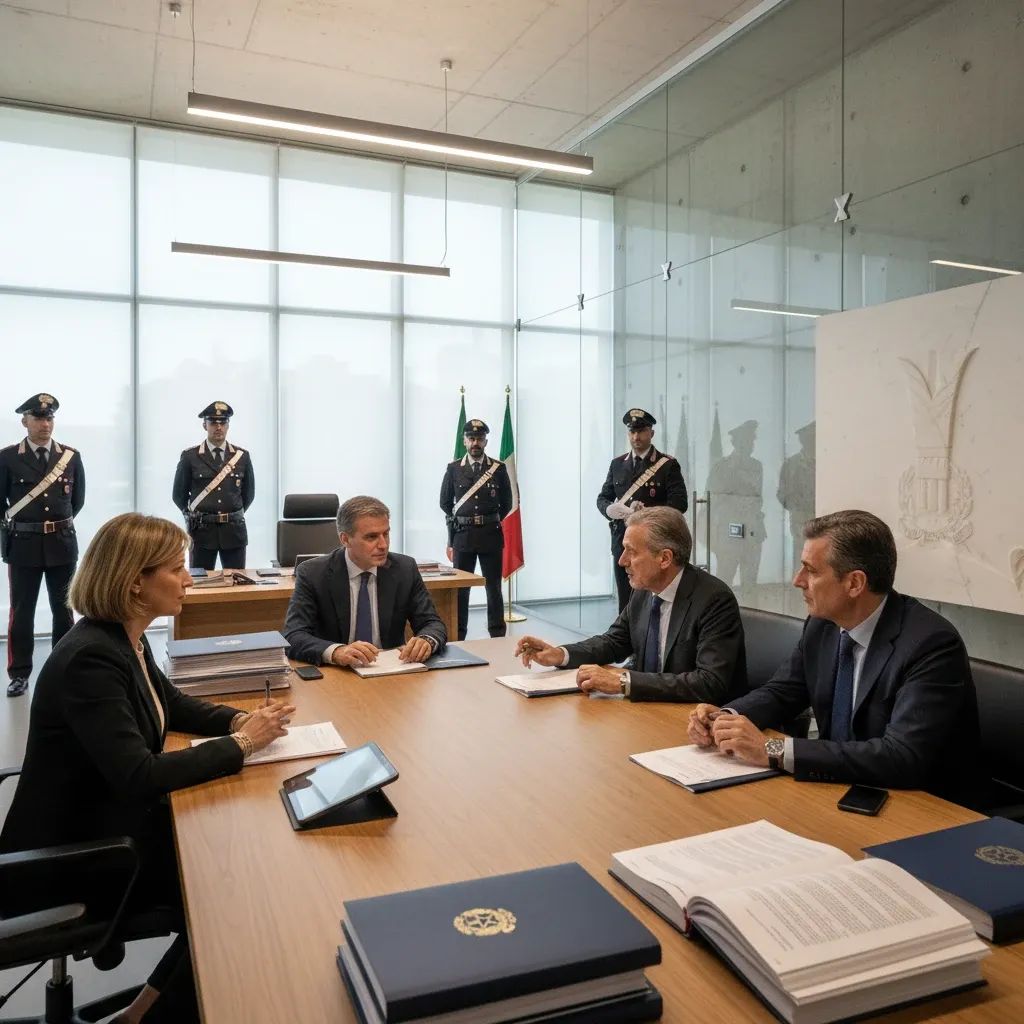
A senior Forza Italia senator now faces formal criminal investigation for alleged sexual violence, marking a test of whether Italy's judicial machinery can hold elected officials accountable when allegations arise inside parliamentary buildings. Francesco Silvestro, 55, who chairs the bicameral regional affairs commission, has been registered as a suspect by the Rome Public Prosecutor's Office, as has a carabiniere accused of attempting to intimidate the complainant. More than a year after the alleged incident in February 2025, the investigation has intensified during June 2026.
Why This Matters
• Judicial exposure: A 52-year-old wine entrepreneur has filed charges alleging Silvestro forced her into a non-consensual sexual act lasting 30–35 minutes in his San Luigi dei Francesi office in February 2025; prosecutors have begun compiling evidence for potential trial proceedings.
• Parliamentary self-scrutiny: Senate leadership has initiated parallel institutional inquiries that could result in censure or temporary suspension, independent of criminal verdict.
• Public backlash to senator's initial response: Silvestro's initial dismissal of accusations—characterizing himself as "handsome" and the complainant as "normal"—drew sharp criticism from opposition lawmakers and women's advocacy groups before he issued an apology.
How the Accusation Unfolded
The complainant, identified in court documents as V., describes an encounter in mid-February 2025 arranged ostensibly to discuss wine shipments for Silvestro's Capri residence. A carabiniere, identified as Antonio P. and a distant relative of the senator, served as intermediary. According to V.'s formal statement filed with prosecutors, Silvestro made what she characterizes as calculated remarks about alcohol lowering inhibitions, then used physical force—placing a small table against her body—to restrict her movement before committing the alleged assault on his office couch.
The 15-month interval between the alleged incident and the filing of charges reflects a pattern familiar to investigators handling sexual assault complaints: V. cited severe psychological aftermath requiring ongoing therapy, combined with what she describes as intimidation attempts by a Silvestro associate designed to dissuade legal action. Such delays, while creating evidentiary challenges for prosecutors, are not uncommon in Italian cases involving power imbalances between complainant and accused.
The Investigation's Legal Framework
Both Silvestro and Antonio P. received formal registration in the investigative register—an administrative procedure common in Italian criminal law that does not indicate guilt but rather initiates formal evidence gathering while protecting both parties' legal rights. This procedural step often causes confusion among residents unfamiliar with Italian law: it is neither an indictment nor a conviction, but rather activates defense rights, allows legal counsel immediate participation, and formally documents the investigation's scope. The Rome Public Prosecutor's Office will now conduct interrogations, gather witness testimony, and analyze evidence before deciding whether sufficient grounds exist to request trial proceedings.
Prosecutors indicated that both men could be summoned for questioning within weeks. Silvestro maintains categorical denial, stating he has received no formal investigative documents and suggesting, without providing specifics, the possibility of extortion. His initial public comments drew immediate fire from Democratic Party senators, who issued a joint statement characterizing his remarks as emblematic of entrenched patriarchal attitudes within Italy's political establishment.
The Parliamentary Dimension and Internal Accountability
The Senate President Ignazio La Russa separately activated the chamber's disciplinary apparatus, directing the Senate Questors—three senior lawmakers responsible for institutional conduct oversight—to investigate. This parallel track operates independently from criminal proceedings. The Senate Code of Conduct permits sanctions ranging from formal censure to temporary suspension (up to 10 days) for grave violations, though such penalties carry primarily reputational weight rather than legal consequence.
This dual-channel approach reflects a fundamental tension in Italian governance: determining where judicial authority ends and parliamentary self-regulation begins. Critics argue internal mechanisms lack enforcement muscle, particularly when political allies shield one another. Defenders maintain institutional separation prevents the executive from dominating the legislature through selective prosecution. In practice, the outcomes often depend on political party dynamics rather than evidence strength.
Silvestro's Shifted Position
Initially, Silvestro adopted a combative stance, minimizing the allegations and offering unsolicited commentary on physical appearance that prompted immediate backlash. Within 24 hours, his legal advisers had crafted a more cautious response: a written statement acknowledging that his language, while "colloquial" in intent, was inappropriate and "may have caused misunderstandings or offended sensibilities." Critically, he neither admitted wrongdoing nor amplified his earlier remarks. Instead, his revised position emphasized readiness to cooperate with investigators—a standard defensive posture when criminal exposure materializes.
Forza Italia, his parliamentary caucus, has avoided public positioning on whether he should resign from committee leadership pending investigation conclusion, suggesting internal party deliberation remains ongoing. Historically, Italian political parties demonstrate reluctance to distance themselves from members until conviction or overwhelming public pressure materializes.
Precedent and Recent Parliamentary Accountability Cases
Sexual misconduct allegations involving high-ranking officials intersect with broader governance challenges in Italy. Recent parliamentary accountability cases have prompted institutional scrutiny of workplace conduct standards and victim protection mechanisms. The current investigation arrives amid EU-wide attention to workplace harassment and violence prevention. Italy's ratification of the Istanbul Convention on combating violence against women legally obligates authorities to maintain robust investigative capacity and victim protection mechanisms—commitments that parliamentary-level scandals persistently test in practice.
Practical Implications for Professionals Engaging with Parliamentary Offices
For residents of Italy working in consulting, sales, business development, or related sectors—particularly those engaging with senior government officials—this case illuminates structural power dynamics that can complicate professional interactions. Wine entrepreneurs, procurement specialists, and other professionals who conduct business with parliamentary offices should be aware of appropriate meeting protocols: scheduling meetings in official chambers rather than private offices, bringing a colleague or witness when possible, maintaining detailed documentation of business discussions, and understanding complaint mechanisms available through the Senate administration or relevant labor authorities. V.'s experience underscores the importance of these precautions, especially when significant professional relationships or business opportunities depend on access to institutional decision-makers.
Victim Protections and Institutional Friction
Italian law provides anonymity provisions for sexual assault complainants, yet enforcement remains inconsistent. Media coverage and legal document leaks frequently compromise intended privacy, exposing complainants to secondary harm and potential witness intimidation. V.'s allegation that Silvestro's associate attempted intimidation underscores this vulnerability. The carabiniere's simultaneous investigation for "attempted private violence" (tentata violenza privata) carries maximum five-year prison exposure if conviction follows, though Italian courts rarely impose custody sentences for intimidation-category offenses absent violence escalation.
What Comes Next: Timeline and Uncertainty
Prosecutors typically require 3–6 months to complete preliminary investigation phases, though timelines frequently extend. Should evidence sufficiently satisfy prosecutorial threshold, the Rome Public Prosecutor's Office will request trial. Silvestro's defense counsel will submit counter-arguments challenging evidence quality and witness credibility. Italian trials, particularly those involving high-profile defendants with substantial legal resources, frequently consume 2–4 years from initial filing to definitive appellate conclusion. A final Court of Cassation verdict could extend timelines further.
Simultaneously, the Senate Questors will prepare findings for the Senate Presidency Council, which determines whether disciplinary measures proceed. Opposition lawmakers will likely press for Silvestro's removal from his committee leadership regardless of judicial outcome, transforming the investigation into a broader battle over parliamentary standards and accountability culture.
For the complaining party, the process offers formal justice mechanism but also prolonged exposure and uncertain resolution. The case's ultimate trajectory—conviction, acquittal, or settlement—will inform ongoing parliamentary reform discussions and shape political pressure for internal conduct code strengthening. Until resolution materializes, both the accused and accuser operate within a legal landscape characterized by procedural deliberation rather than swift closure.


