
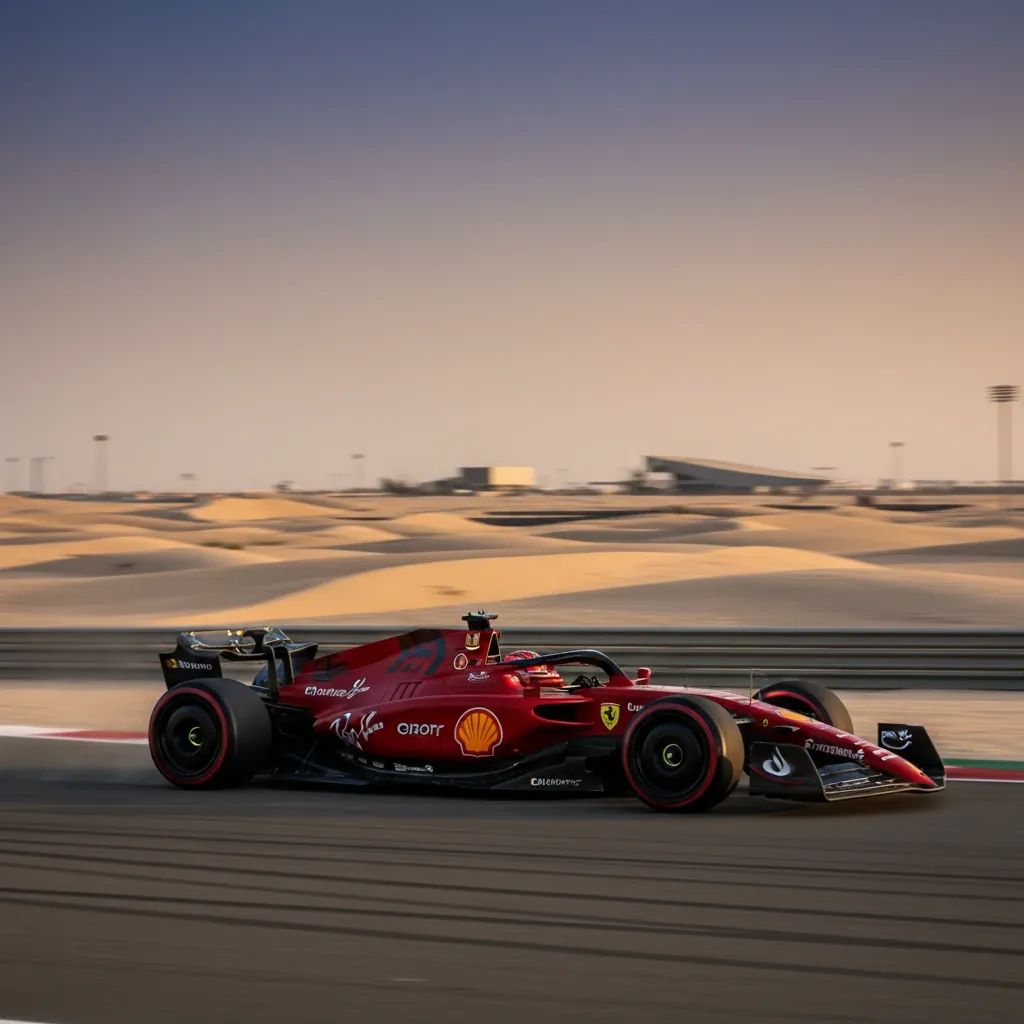
Ferrari's €550,000 electric gamble, the Luce, has triggered a sharp market rebuke—shares plunged as much as 7.2% in Milan trading—raising questions about whether the Maranello icon can electrify without alienating its loyalists or its investors.
Why This Matters
• Stock volatility: Ferrari shares (RACE) shed €21 per share in early trading, erasing roughly €1.3B in market capitalization within hours of the Rome unveiling.
• Price positioning: At €550,000, the Luce is among the world's most expensive EVs, dwarfing the Porsche Taycan Turbo S (€220,000) and rivaling only ultra-limited hypercars.
• First deliveries: Orders opened in March; customer handovers begin in October, with production capped by Ferrari's new e-building in Maranello.
• Strategic pivot: Ferrari has halved its 2030 EV target from 40% to 20% of total output, citing lukewarm demand in the luxury EV segment.
The Design Departure That Split Opinion
The Ferrari Centro Stile collaborated with LoveFrom, the design collective founded by former Apple chief designer Jony Ive and Marc Newson, to craft a vehicle that breaks radically with decades of Ferrari visual language. The result is a four-door, five-seat liftback that fuses shooting brake proportions with glass-heavy bodywork and aerodynamic "floating" wings—a far cry from the low-slung, two-seat thoroughbreds synonymous with the prancing horse badge.
Social media erupted in polarized camps. Enthusiasts praised the pragmatic spaciousness and sub-Cd drag coefficient—the lowest of any Ferrari road car—while purists decried what they labeled a "dishonor to the brand." One Milan-based trader told colleagues the Luce "looks more like what the Apple Car might have been than what a Ferrari should be."
Inside, Ive's fingerprints are unmistakable. The cabin eschews the oversized touchscreens that dominate rivals, instead featuring machined aluminum dials, mechanical toggles, and a 12.9-inch dual-layer OLED instrument cluster that merges analog tactility with digital functionality. The key itself is fashioned from Gorilla Glass with an E Ink display. Ferrari describes it as the most "considered and tactile" interior it has ever produced.
Engineering: 1,050 Horses, Four Motors, One Battery
Beneath the glass canopy sits a bespoke 880V platform—Ferrari's first—anchored by a 122 kWh in-house battery capable of 350 kW DC fast charging. Four permanent-magnet synchronous motors, one per wheel, combine to deliver 1,050 CV (1,035 metric horsepower) and 990 Nm of torque.
Performance figures echo Ferrari's combustion heritage: 0–100 km/h in 2.5 seconds, 0–200 km/h in 6.8 seconds, and a top speed exceeding 310 km/h. Yet the Luce tips the scales at 2,260 kg—making it the heaviest Ferrari ever built. Active suspension tuning and four-wheel independent steering aim to mask the bulk; Ferrari claims the car corners as if it weighs 400 kg less.
Range sits at 530 km (WLTP), translating to roughly 450 km under stricter EPA methodology—a figure that places it in the middle of the pack among luxury EVs. Porsche's Taycan Turbo S manages similar real-world range, while the Lucid Air Sapphire stretches past 650 km.
One engineering flourish targets the emotional vacuum often associated with EVs: rather than synthesizing engine noise, Ferrari's proprietary acoustic amplification system channels and magnifies the mechanical vibrations of the rear motors, creating what the company calls an "authentic roar." Early test drives have yet to confirm whether this approach satisfies enthusiasts conditioned to the wail of a naturally aspirated V12.
Why Investors Panicked
The 7.2% share price collapse on debut day reflects a confluence of investor anxieties, not just about the Luce itself, but about Ferrari's position in a decelerating luxury EV market.
1. Weak demand across the segment: Rivals Porsche, Lamborghini, and Aston Martin have all scaled back or postponed electric rollouts. Lamborghini's first EV, originally slated for 2025, has been pushed to 2028. Porsche reported a 15% year-on-year decline in Taycan sales during Q1 2026, citing softer appetite in China and the United States—two of Ferrari's largest markets.
2. Conservative guidance: Last October, Ferrari cut its 2030 EV mix from 40% to 20% of total production, with hybrids and internal combustion engines each accounting for 40%. The company's €9B revenue target for 2030 was judged "timid" by several Milan-based analysts, dampening sentiment well before the Luce reveal.
3. Tariff exposure: Looming U.S. import tariffs on European luxury goods—floated intermittently by Washington—could compress margins in North America, where Ferrari generates roughly a third of revenue.
4. Volume uncertainty: Ferrari has declined to disclose pre-order tallies. While feedback from VIP clients has been "very positive," and some depositors expressed eagerness to pay immediately, the company insists the Luce is a "statement model," not a volume play. Total Ferrari production hovers around 14,000 units annually; analysts estimate the Luce will account for fewer than 1,000 deliveries in its first full year.
5. Delivery slowdown: Ferrari reported a 4.4% drop in Q1 2026 deliveries, a data point that amplified caution even as operating margins held firm above 30%.
Impact on Residents and Italian Pride
Ferrari President John Elkann chose Rome for the unveiling with deliberate symbolism: on 25 May 1947, the Ferrari 125 S, piloted by Franco Cortese, secured the marque's first official victory at the Terme di Caracalla circuit. Elkann framed the Luce as "not only an homage to our past, but to our country: Italy."
The day after the public launch, Elkann, Vice President Piero Ferrari, and CEO Benedetto Vigna presented the Luce to Italian President Sergio Mattarella at the Quirinale Palace. "It was an honor to be received by President Mattarella," Elkann said in a statement. "This new model carries forward the values that make Ferrari immediately recognizable around the world—the result of passion, expertise, and commitment from all Ferrari people."
For Italians, the Luce represents a high-stakes test of whether a national icon can reinvent itself without sacrificing identity. The vehicle is designed, engineered, and assembled entirely in Maranello, with the battery pack developed in-house rather than sourced from Asian suppliers—a point of national industrial pride at a time when Europe's automotive sector faces existential pressure from Chinese EV manufacturers.
The new e-building in Maranello, inaugurated last year, houses both the assembly line and battery production, employing roughly 300 additional engineers and technicians. This investment underscores Ferrari's commitment to retaining high-value manufacturing jobs in Emilia-Romagna, a region economically intertwined with the Motor Valley cluster of supercar and motorsport firms.
What Buyers Get for Half a Million
At €550,000, the Luce is priced to preserve Ferrari's scarcity aura. For context, a Porsche Taycan Turbo S retails around €220,000, a Mercedes-Benz EQS at €140,000, and a BMW i7 near €150,000. Only limited-run hypercars like the Rimac Nevera (€2M) or Pininfarina Battista (€2.2M) exceed the Luce in sticker shock.
Prospective buyers gain a five-seat, four-door grand tourer capable of supercar acceleration, a trunk suitable for luggage, and the cachet of owning the first all-electric prancing horse. They sacrifice some of the aural theater of a combustion Ferrari and accept a curb weight that, while carefully managed, remains substantial.
Ferrari expects the Luce to attract a younger, digitally native clientele—buyers who may already own a Tesla or Lucid but desire the prestige and craftsmanship associated with Maranello. Whether that demographic materializes in sufficient numbers remains the open question shadowing the launch.
The Road Ahead: 60 Patents and a Cautious Strategy
Ferrari has filed over 60 new patents related to the Luce, covering everything from battery thermal management to the acoustic amplification system. CEO Vigna emphasizes the company's philosophy of "additive electrification"—maintaining parallel offerings of combustion, hybrid, and electric powertrains rather than forcing a wholesale transition.
The company's second EV, originally slated for 2026, has been postponed to at least 2028, a delay attributed to the same cautious demand outlook that prompted the 2030 target revision. Meanwhile, Ferrari continues to refresh its combustion and hybrid lineups, with the SF90 XX Stradale and 296 GTB selling briskly among traditional buyers.
Market observers note that Ferrari's limited production model insulates it from the volume pressures hammering mass-market EV makers. Even if the Luce sells modestly, it will not materially dent profitability; the real risk lies in brand perception. If the design and positioning alienate the core collector base without winning over new buyers, Ferrari's pricing power—its most valuable intangible asset—could erode.
Investor Takeaway: Volatility or Opportunity?
For shareholders, the debut-day selloff may prove either a buying opportunity or a harbinger of deeper challenges. Ferrari's operating margins remain best-in-class, its order book for combustion models extends well into 2027, and its balance sheet is fortress-strong.
Yet the Luce embodies strategic uncertainty. If the luxury EV market rebounds and the design finds its audience, Ferrari will have secured first-mover advantage in an under-served segment. If demand stagnates and the aesthetic misstep theory gains traction, the company may face years of questions about whether it sacrificed too much soul in pursuit of electrification.
For now, the market has rendered its verdict: caution. Whether that judgment holds or reverses will depend on October's delivery figures, real-world reviews, and the broader trajectory of Europe's luxury EV appetite—a narrative that has only just begun to unfold.


