
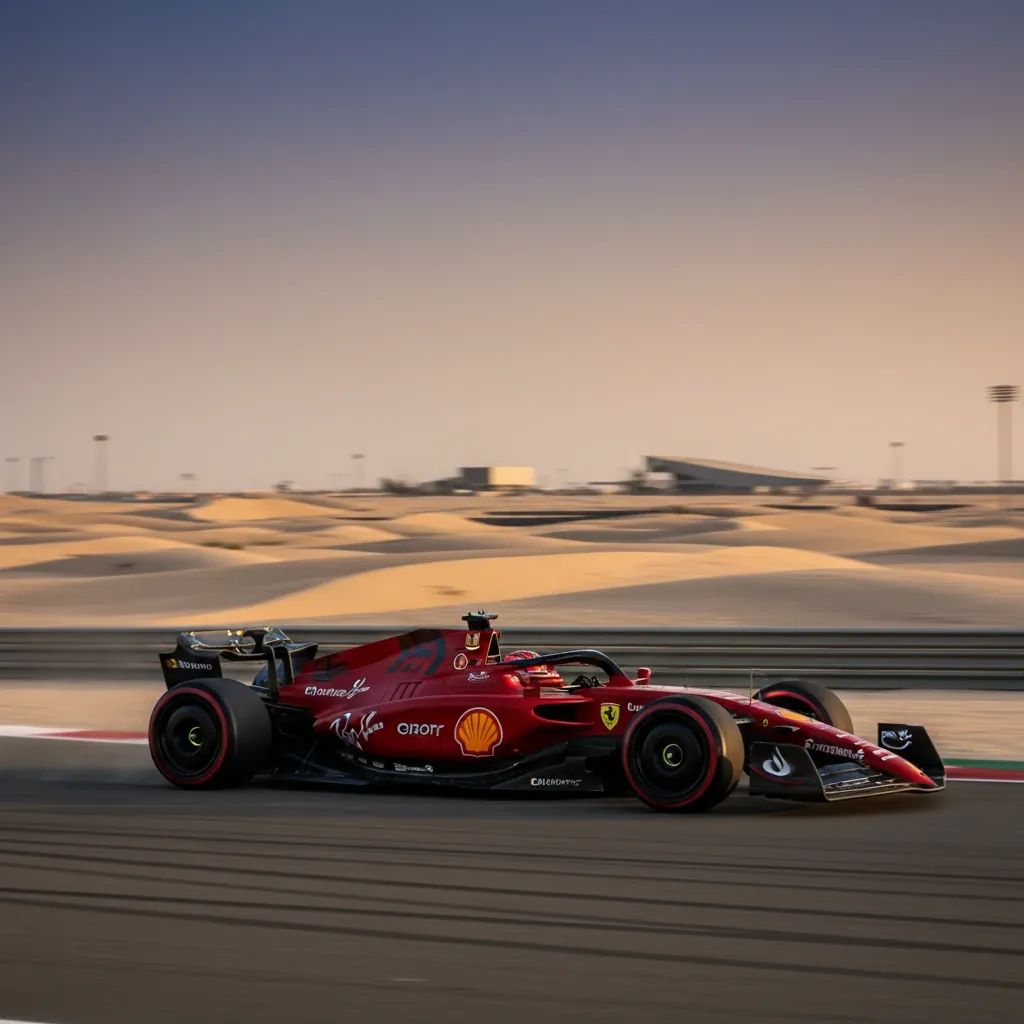
The Italy-based Scuderia Ferrari has clawed its way back into genuine championship contention at the halfway mark of the 2026 Formula 1 season, transforming what looked like a Mercedes walkover into a credible two-horse race thanks to relentless technical upgrades and unexpectedly strong drives from both Charles Leclerc and Lewis Hamilton.
Why This Matters
• Championship math shifts: Ferrari has cut Mercedes' constructor lead to 78 points with 11 of 22 races complete, making the second half a genuine battle.
• Hungaroring next: The Hungarian Grand Prix this weekend suits the SF-26's cornering strengths—Ferrari could claim another win.
• Hamilton's resurgence: The seven-time champion has scored points in 10 consecutive races for Ferrari, including the Spanish GP victory, adding crucial ballast to Leclerc's efforts.
Mercedes Still Holds the Edge—But Only Just
Nineteen-year-old Kimi Antonelli, driving for the Mercedes-AMG Petronas F1 Team, extended his drivers' championship lead to 45 points with a hard-fought victory at Spa-Francorchamps on Sunday. It marked his sixth win of the season and underscored Mercedes' dominance on power-sensitive circuits. Yet a closer examination of the Belgian GP reveals that Ferrari's SF-26 has found the consistency and race-day reliability it desperately lacked earlier in the year.
Leclerc pushed Antonelli to the final laps in Belgium, finishing second and—crucially—staying within striking distance of the Mercedes throughout the race. In previous seasons, such a scenario would have seen the Silver Arrows vanish into the distance. That Ferrari now has the speed to pressure Mercedes on a high-speed layout like Spa signals a fundamental shift in the competitive order.
Hamilton, meanwhile, salvaged fourth place despite a chaotic weekend that included a crash in FP3, a collision with teammate George Russell's Mercedes, a five-second time penalty, a near-miss in the pit lane, and visible damage to his SF-26. That he still brought the car home in the points—narrowly missing the podium due to the penalty—demonstrates both his racecraft and the underlying speed Ferrari has unlocked through aggressive development.
Technical Evolution: How Ferrari Closed the Gap
The 2026 season introduced sweeping regulatory changes: 50/50 hybrid power split between combustion and electric output, active aerodynamics replacing DRS, lighter chassis (770 kg minimum), narrower tires, and 100% sustainable fuels. Ferrari entered the year with a power unit deficit, particularly in battery deployment, which cost crucial tenths on straights like Spa's Kemmel.
But Maranello responded with a multi-pronged development campaign. At the Spanish Grand Prix, Ferrari debuted a comprehensive aero package—revised floor, bodywork, diffuser, and front wing—that immediately translated into Hamilton's breakthrough victory for the Scuderia. In Austria, a power unit upgrade arrived, part of Ferrari's qualification for Additional Development Usage Opportunity (ADUO), a regulatory mechanism allowing manufacturers trailing in performance to introduce extra updates. While the gains were incremental, they reflected steady progress on the dyno at Maranello, where engineers have tested "conceptual and structural differences" in turbo architecture and energy recovery.
Ferrari's push-rod suspension front and rear—a configuration the team hadn't run since 2011—has proven a revelation in slow- and medium-speed corners. The SF-26 is now considered the benchmark for cornering stability, a critical advantage heading to Budapest's Hungaroring, a circuit often described as "Monaco without walls" due to its tight, twisty layout where downforce and mechanical grip trump raw power.
Mercedes team principal Toto Wolff recently suggested Ferrari's development pace is unsustainable under the budget cap, hinting the Italian squad may soon exhaust its financial allowance. Whether or not that's true, Ferrari's "low-risk, reliable upgrades" strategy has yielded two victories in the last three races, closing what was once a yawning gap.
Hungaroring: Ferrari's Best Chance Yet?
The Hungarian Grand Prix at the Hungaroring represents Ferrari's strongest opportunity yet to claim a third victory. Qualifying will be paramount—overtaking is notoriously difficult on the 4.381 km circuit, meaning track position often determines the result. Leclerc's single-lap speed gives Ferrari a genuine shot at pole, while Hamilton's strategic acumen and tire management could prove decisive in a race likely to hinge on undercuts and pit-stop timing.
Leclerc, ever cautious, warned against complacency. "We're aware the Ferrari will adapt better to the Hungaroring than Spa," he said after Belgium, "but we also thought we were favorites in Monaco... and we left empty-handed. Still, we'll do everything to be ready if the opportunity to win presents itself." That reference to Monaco—where Ferrari dominated practice but failed to convert—reflects a team still scarred by recent disappointments but now armed with a car capable of delivering.
Hamilton, meanwhile, has strung together a remarkable run of form. After a difficult 2025 debut season with Ferrari, the Briton has maximized every upgrade package, scoring 10 consecutive points finishes including the Spanish triumph. His ability to extract performance from a damaged car in Belgium—where he navigated a five-second penalty, bodywork damage, and a brush with disaster in the pits—exemplifies the "old lion" mentality that keeps him in the hunt at age 41.
What This Means for Italian Tifosi
Ferrari's resurgence has reignited passion among Italian motorsport fans. Sunday's Belgian GP drew 1.55 M viewers on Sky Italia (15.3% share) and another 1.33 M on TV8's delayed broadcast (12.8%), testament to the Tifosi's enduring faith even during leaner years. With Hamilton now firing on all cylinders and Leclerc consistently on the podium, Ferrari has genuine mathematical hope of overhauling Mercedes in the constructors' standings—provided reliability holds and development continues at the current breakneck pace.
The next four races—Hungary, followed by Spa, Monza, and Singapore—offer varied challenges. Hungary and Singapore favor Ferrari's high-downforce package; Monza, Ferrari's home race, will test whether the power unit upgrades have truly closed the straight-line deficit. Mercedes remains the favorite, but the margin has shrunk from "dominant" to "narrow advantage."
Russell's Troubles Help Ferrari's Constructor Bid
While Antonelli's dominance in the drivers' championship looks increasingly secure, George Russell's early retirement in Belgium—his second DNF in three races—has inadvertently opened the door for Ferrari in the constructors' battle. Russell's inconsistency means Mercedes is leaning heavily on Antonelli's brilliance, while Ferrari benefits from both drivers scoring heavily. Hamilton now sits second in the drivers' standings, 45 points behind Antonelli but ahead of Russell, a testament to his late-career consistency.
Ferrari's challenge is clear: keep both cars in the points, maximize opportunities on high-downforce circuits, and hope Mercedes stumbles. With 11 races remaining and a 78-point deficit, it's a tall order—but no longer the mathematical impossibility it seemed in April.
The Road Ahead
The Hungaroring on Sunday will provide the first real test of Ferrari's cornering prowess against Mercedes' all-around speed. A Leclerc or Hamilton victory would cut the gap further and pile psychological pressure on Antonelli and Mercedes heading into the summer break. A defeat, conversely, could see the deficit balloon beyond recovery.
Ferrari team principal Fred Vasseur has publicly contested a last-minute FIA rule change on race starts—alleging it neutered a clever Ferrari power unit design advantage—but the team has channeled frustration into relentless development. The SF-26, once dismissed as a power-deficient also-ran, has evolved into a genuine race winner. Whether it can sustain that evolution through the second half of the season will define Ferrari's 2026 campaign—and determine whether Italian fans dare to dream of a first constructors' title since 2008.
For now, the numbers are simple: 11 races down, 11 to go, and Ferrari back in the fight.


