
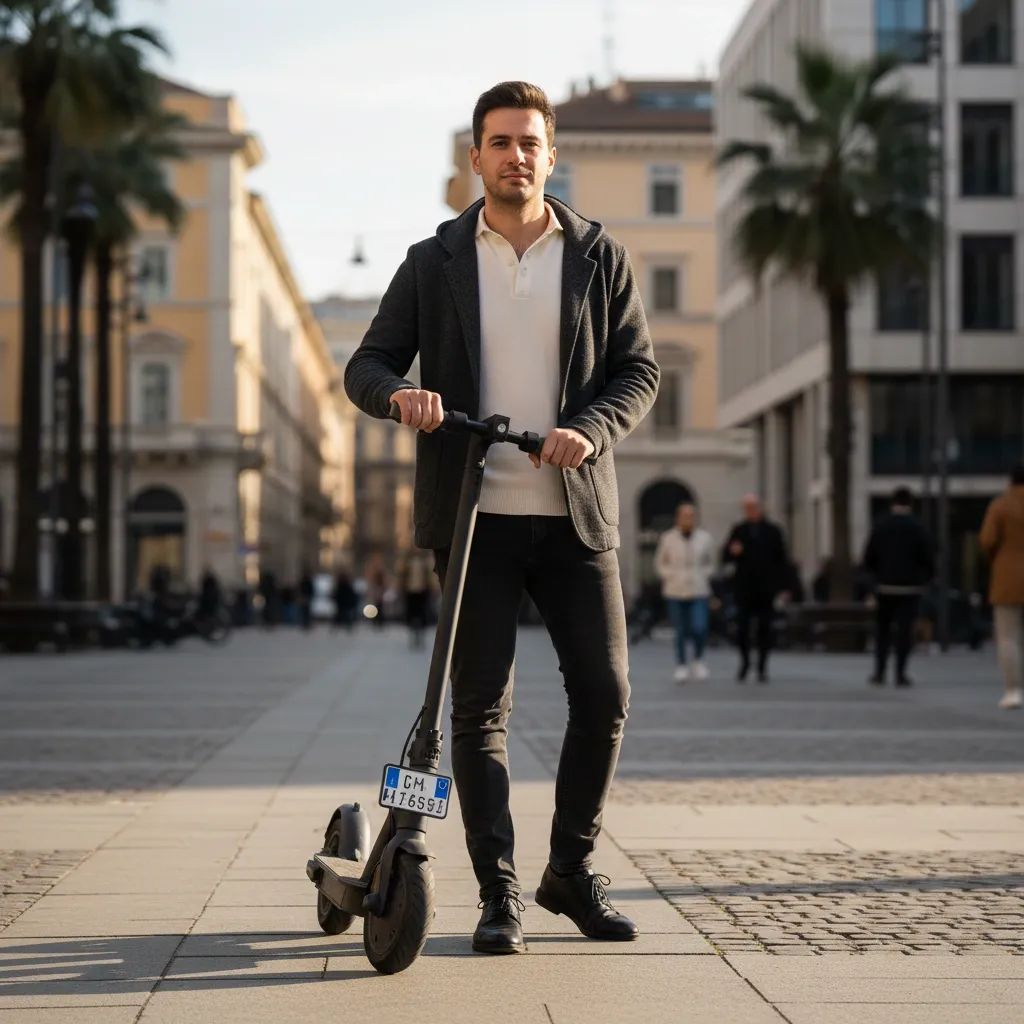
Italy's mandatory insurance requirement for electric scooters takes effect July 17, extending RC (civil liability) coverage to an estimated 1 million private owners who now face fines of €100 to €400 and vehicle seizure if they ride uninsured. While commercial sharing operators already comply, early evidence suggests widespread non-compliance among individual users—a gap that could leave both riders and victims financially exposed.
Why This Matters:
• Deadline is July 17, 2026: All electric scooter owners must carry RC civil liability insurance or risk administrative penalties.
• Fines range from €100 to €400, plus administrative seizure of the scooter if caught riding uninsured.
• Personal financial liability: Without coverage, riders involved in accidents must personally compensate victims for all damages—medical bills, lost wages, property repair—out of pocket.
• Targhino required first: The digital identification plate (€33 fee) must be obtained before any insurer will issue a valid policy. This requirement came into effect on May 16, 2026—two months before the insurance deadline.
How the Law Took Shape
Italy's Ministry of Infrastructure and Transport and the Ministry of Enterprises and Made in Italy (MIMIT) originally scheduled the RC mandate for May 16, 2026, but postponed it by two months after ANIA (the national insurers' association) flagged technical bottlenecks: database integration, policy issuance platforms, and claims workflows needed more time. The final date—July 17—was set through Law 177/2024, which amended the Codice della Strada (Highway Code) to bring electric scooters explicitly under Article 2054 of the Civil Code, the same liability framework governing cars and motorcycles.
The measure arrives in tandem with two earlier obligations: a helmet requirement (in force since December 14, 2024, for all riders regardless of age) and a digital identification plate, or targhino (mandatory from May 16, 2026). The targhino costs roughly €33 and is obtained through the government's Portale dell'Automobilista or licensed automotive agencies. Without that plate, no insurer can tie a policy to a specific vehicle—and without both, riders remain illegal.
Compliance Gap Among Private Owners
Commercial sharing platforms—Lime, Bird, Dott, and others represented by their industry consortium—insist they have been fully insured and compliant since day one. "We are the only authorized, monitored, and insured segment from the start," operators told reporters this week, noting that they have recorded zero fatal crashes since November 2021, when mandatory 20 km/h speed governors (introduced by Forza Italia MP Riccardo Rosso's legislation) were enforced via on-board software. They argue that lawmakers reacted to accidents involving privately owned scooters yet imposed the administrative burden equally on an already regulated sector.
The real uncertainty surrounds the roughly 1 million Italians who own private e-scooters. Early street observations and industry estimates suggest most have yet to obtain the targhino or purchase insurance. Helmet use—now 1.5 years into enforcement—remains spotty in Rome, Milan, and Florence. The digital plate, operational for less than two months, is rarely visible on scooters parked in city centers. And as of this weekend, no official compliance statistics have been released by the Italy Ministry of the Interior regarding fines or seizures under the new rules.
What This Means for Residents
If you own a private electric scooter, here is what you must do before riding after July 17:
Obtain the targhino: Visit the Portale dell'Automobilista, enter your scooter's make, model, and serial number, pay approximately €33, and receive a unique alphanumeric code to affix to the vehicle. This was required starting May 16, 2026, so you should have already obtained it.
Buy an RC policy: Standard household or umbrella liability policies will not suffice; the policy must be scooter-specific and linked to your targhino. Premiums vary by age, city, and coverage limits, but early quotes suggest annual costs between €50 and €120 for basic civil liability.
Keep proof on hand: While there is no physical sticker requirement for the insurance (as with cars), digital proof via smartphone or a printed certificate is advisable in case of roadside checks.
Wear a helmet: The December 2024 law mandates head protection for all ages; fines for non-compliance run parallel to insurance penalties.
If you are involved in a crash without coverage, you bear full financial responsibility for injuries or property damage to third parties. Medical expenses for serious injuries can easily exceed €50,000, and vehicle repair or replacement costs add to the total. The Fondo di Garanzia per le Vittime della Strada (Victims' Road Fund) will step in for injured parties when the at-fault rider is uninsured, but the fund then pursues reimbursement from the rider, potentially through wage garnishment or asset liens.
If you rent a scooter from a sharing service, you are already covered under the operator's fleet policy and need take no additional action.
Safety Data and the Policy Rationale
Between 2020 and mid-June 2026, electric scooters were implicated in 97 fatalities across Italy. In 2025, deaths reached 21. Through mid-2026, six deaths have been recorded. While precise breakdowns distinguishing private versus shared-fleet accidents for 2025–2026 are not yet available, historical data from January 2023 showed shared scooters—subject to mandatory speed limits, maintenance schedules, and GPS tracking—had 80% fewer incidents than private units. Sharing operators attribute this to software-enforced governors (capping speed at 20 km/h citywide, 6 km/h in pedestrian zones), daily vehicle inspections, and rider education prompts in mobile apps.
Private scooters, by contrast, often exceed legal speed limits through aftermarket modifications, lack routine safety checks, and are ridden by users unfamiliar with traffic regulations. The new insurance and identification requirements aim to close that gap by creating financial deterrents, enabling law enforcement to trace offenders, and ensuring victims have access to compensation regardless of whether the at-fault rider carries cash reserves.
Enforcement and Market Response
The Polizia di Stato (State Police) and municipal traffic units have not yet published enforcement statistics—neither for helmet violations since December 2024 nor for targhino compliance since May. Anecdotal evidence from Rome and Milan suggests street-level checks remain infrequent. However, the arrival of the insurance mandate increases the stakes: administrative seizure now accompanies fines, and seized scooters are held until proof of coverage and targhino is provided, with daily impound fees accruing.
The regulatory tightening has already reshaped the market. Sales of private e-scooters fell 30% to 50% in the six months following the December 2024 helmet law, while shared-scooter rentals dropped 30% in major cities. Retailers report that prospective buyers are deterred by the cumulative cost—€300 to €600 for a basic scooter, €33 for the targhino, €50 to €120 annually for insurance, plus a helmet (€25 to €80)—and by the perception that enforcement is lax, creating a disincentive for voluntary compliance.
Broader Mobility Context
The scooter insurance deadline coincides with a challenging week for Italy's transport networks. From Sunday, July 5, through July 10, train service in and out of Florence will be suspended due to major track upgrades, prompting Tuscany Governor Eugenio Giani to declare a regional transport emergency and advise employers to allow remote work. Meanwhile, 15 separate strikes have hit the aviation sector in the first seven months of 2026—more than two per month—affecting EasyJet, ENAV (Italy's air navigation provider), and ground-handling contractors. The latest stoppage, scheduled for Monday, respects legally mandated service windows (07:00–10:00 and 18:00–21:00) but is expected to disrupt tens of thousands of passengers.
Separately, the government announced that FiberCop, the fiber-optic joint venture between TIM and KKR, has been awarded €712.5 million by Invitalia, the state investment agency, to deploy gigabit-speed fixed networks across 477,000 addresses in seven geographic zones by 2030. This grant covers up to 70% of eligible costs under the National Connectivity Fund (Fondo Nazionale per la Connettività), an initiative led by the Prime Minister's Office Department for Digital Transformation. The project targets minimum guaranteed speeds of 1 Gbit/s download and 200 Mbit/s upload, even during peak hours, in areas currently underserved by high-capacity broadband.
What Happens Next
Over the coming weeks, enforcement agencies are expected to release baseline data on targhino issuance and initial insurance compliance rates. Insurers, in turn, will refine premium models as claims experience accumulates. For now, the message to private scooter owners is unambiguous: riding uninsured after July 17 exposes you to immediate fines, seizure, and potentially catastrophic personal liability. Whether the law's deterrent effect will be strong enough—or enforcement visible enough—to drive mass compliance remains an open question.


