
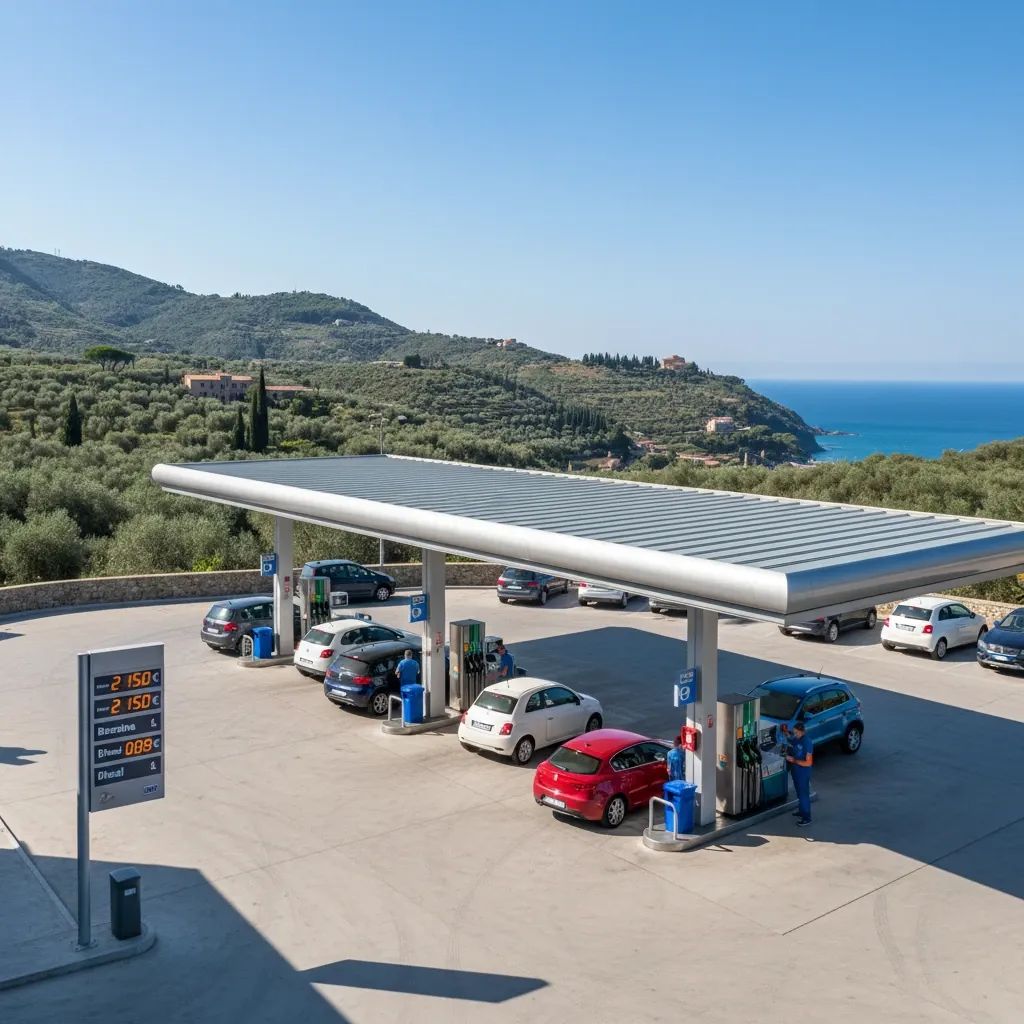
The Italy Ministry of Business and Made in Italy (Mimit) has recorded modest fuel price decreases at the pump this week, with gasoline at €1.783 per liter and diesel at €2.160 per liter in self-service mode (unmanned stations) across national roads—a welcome relief after several days of sustained increases. The figures signal a pause in volatility tied to Middle Eastern geopolitical tensions and Italy's structural tax realignment on fuel.
What's Driving the News
• Diesel continues to exceed gasoline in most regions due to a €0.0405 per liter excise tax shift enacted in the 2026 Budget Law, which reduced gasoline taxes while raising diesel duties as part of a fiscal rebalancing.
• Motorway drivers pay a premium: Self-service gasoline averages €1.815/L on highways, while diesel reaches €2.191/L—adding significant cost for frequent travelers.
• Weekly context: These prices represent a modest 6-21 thousandths reduction from Friday, but remain elevated compared to pre-March levels due to escalating crude oil prices linked to Iran-U.S. tensions.
• Crude oil sensitivity: Current Brent prices near $105 per barrel create ongoing upside risk; further geopolitical disruption could push prices higher.
The Fiscal Rebalancing Behind Diesel's Higher Cost
Italy's long-standing tax advantage for diesel—a legacy of industrial and transport lobbying—ended this year. The 2026 Finance Law mandated convergence of excise duties: gasoline taxes dropped roughly 4 cents per liter, while diesel duties climbed by the same margin. Combined with a 22% VAT layered on top of excise (creating a "tax on tax" effect), the fiscal component now exceeds 50% of pump prices.
Diesel's cost structure also reflects supply-demand fundamentals. Europe's refining capacity remains constrained, and diesel serves broader applications—freight, agriculture, residential heating—making it more sensitive to seasonal demand spikes and crude oil shortages. The Mimit observatory noted that diesel inventories tightened faster than gasoline during recent crude rallies, amplifying retail price pressure.
Italy's excise rates—€0.728/L for gasoline and €0.62/L for diesel—remain among the highest in the European Union, a consequence of decades of emergency levies (originally funding post-war reconstruction, natural disasters, and military operations) consolidated into a permanent tax structure in 1995.
Current Prices Across Italy's Network
A note on terminology for expat drivers: "Self-service" (self-service stations) refers to unmanned fuel stations where you pay by card or cash at the pump; "serviced" stations employ attendants and typically charge 3-5 cents more per liter.
Data compiled by Staffetta Quotidiana, an energy sector monitor, and the Mimit observatory align closely. As of Monday morning, self-service prices on the national road network stand at:
• Gasoline: €1.783/L (down 6 thousandths from Friday)
• Diesel: €2.160/L (down 21 thousandths from Friday)
• LPG: €0.795/L (up 2 thousandths)
• Methane (CNG): €1.605/kg (down 1 thousandth)
On the motorway network, prices are higher:
• Gasoline: €1.815/L (down 8 thousandths)
• Diesel: €2.191/L (down 13 thousandths)
• LPG: €0.897/L (up 3 thousandths)
• Methane: €1.585/kg (up 7 thousandths)
The Mimit figures track a 40-day upward spiral that began in late February, driven by escalating hostilities involving the United States, Israel, and Iran, which pushed Brent crude above $105 per barrel by mid-April. The modest relief recorded over the past week reflects adjustments by major oil companies to international crude softening, though consumer advocates note the cuts are modest relative to accumulated increases.
The Geopolitical Context
Italy's fuel market remains tethered to developments in the Persian Gulf. The Strait of Hormuz, through which roughly 20% of global oil supply transits, has been a flashpoint since renewed clashes between Iran and Western-backed forces intensified in March. Industry analysts warn that further escalation could disrupt supply; major investment banks have noted worst-case scenarios in which Brent reaches $130–$150 per barrel.
OPEC+ production quotas have tightened in response to weaker-than-expected non-OPEC output growth, reinforcing a supply-constrained outlook. Meanwhile, the euro-dollar exchange rate adds another layer of uncertainty: a weaker euro amplifies the cost of dollar-denominated crude imports, even if barrel prices hold steady.
What This Means for Italian Households and Businesses
Fuel cost changes at the pump directly impact household transport budgets and small business operations. According to consumer group Codacons, the sustained price increases since March have meaningfully strained logistics, agriculture, and tourism businesses, which operate on thin margins and cannot easily pass fuel costs to customers.
The Chamber of Commerce of Milan has reported that haulage firms are experiencing pressure from elevated fuel line items, compounding challenges from labor shortages and regulatory compliance costs.
Electric vehicle adoption offers an alternative but remains limited outside major urban centers due to charging infrastructure gaps. The Italy Infrastructure Ministry has pledged to expand the fast-charging network by 30% before year-end, but implementation lags in rural and mountainous areas where fuel dependency is highest.
Policy Options Under Consideration
The Italy Cabinet is reportedly evaluating mechanisms to address fuel price volatility, including temporary excise adjustments during price spikes. The government extended a diesel excise reduction through May 1, but Treasury officials caution that prolonged relief would strain public accounts already constrained by pension obligations and debt servicing.
A Mimit task force launched in March to monitor pricing among fuel distributors continues its work, though findings have not yet been published.
Alternative Fuels
For drivers of LPG-powered vehicles, prices remain relatively stable, averaging €0.795/L on national roads and €0.897/L on motorways. Methane (CNG) pricing is governed by regional distribution frameworks and ARERA (Italy's energy regulator). Public fast-charging for electric vehicles averages €0.50–€0.70 per kWh, translating to roughly €15–€20 for a full charge on a mid-sized EV—equivalent to approximately 300–400 km of range depending on vehicle model and driving conditions.
Outlook: Cautious Wait-and-See
The stabilization observed in mid-April provides temporary relief but faces ongoing headwinds. Market observers emphasize that durability depends on Middle Eastern de-escalation, steady OPEC+ output, and currency stability. Refiners may face maintenance shutdowns in late spring, potentially tightening supply as summer tourism demand accelerates.
For now, Italian drivers face a market in uneasy equilibrium—lower than the March peaks, but structurally elevated by tax policy, geopolitical risk, and a refining sector operating near capacity. Those planning travel or fleet operations should monitor crude oil developments closely, as policy tools for rapid intervention remain limited.


