
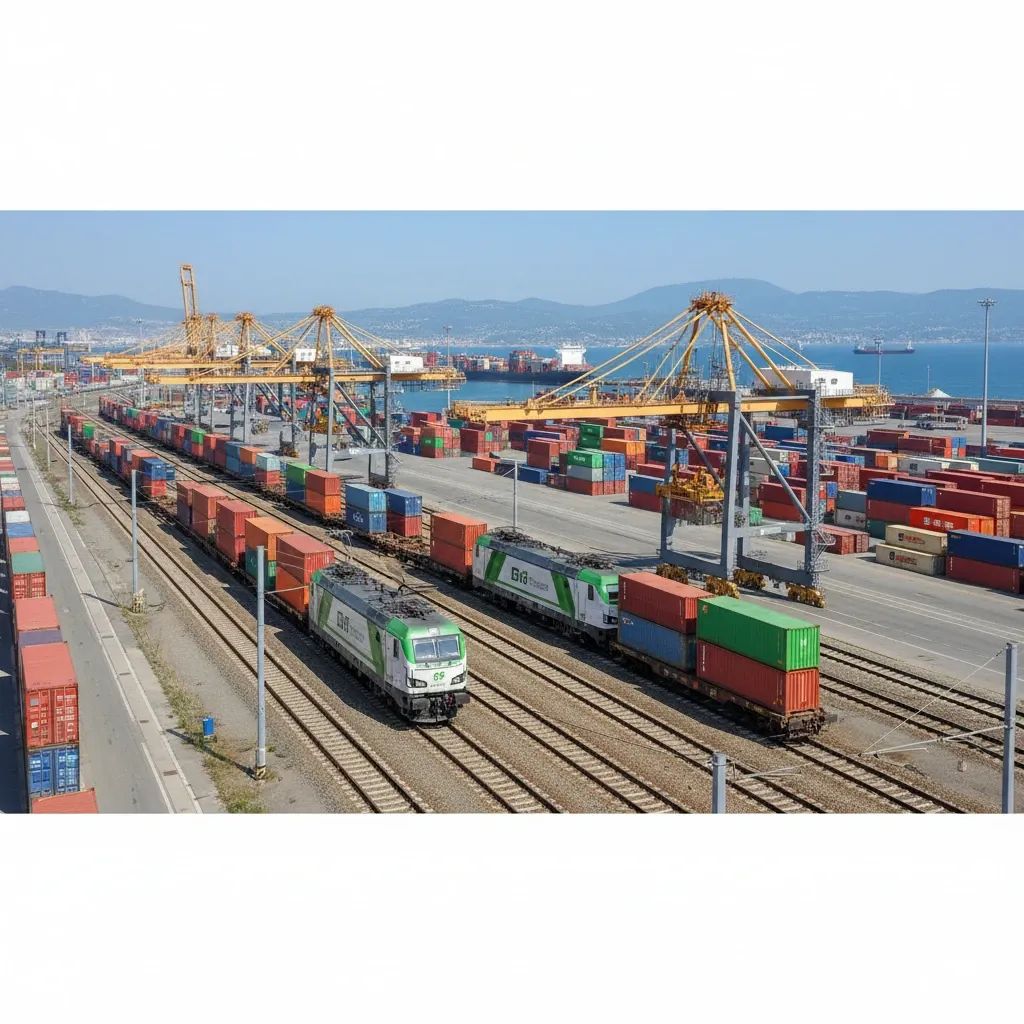
The Port Authority of the Eastern Ligurian Sea has successfully installed a 42-meter railway bridge at Marina di Carrara, a critical infrastructure upgrade that promises to reshape how freight moves through this Tuscan port and reduce the burden of heavy truck traffic on surrounding neighborhoods.
Why This Matters:
• Reduced urban congestion: All freight traffic—both rail and road—will funnel through a single eastern access gate by summer 2027, relieving Viale Da Verrazzano of heavy vehicle flows
• Rail expansion timeline: The new railway line connecting the port to the Tyrrhenian railway network goes live in September 2026
• Total investment: The project is part of a €37M comprehensive plan for waterfront redevelopment and logistics optimization
Strategic Shift in Port Operations
The freshly positioned bridge represents more than a simple replacement. It anchors a fundamental reorganization of how Marina di Carrara handles cargo, shifting the port's operational center of gravity eastward. Once the new rail connection becomes operational in autumn 2026, authorities will demolish the old bridge, clearing space for a modern road access system and a pedestrian-cycling path that forms part of the Ciclovia Tirrenica, a coastal bike route under development along Italy's western shore.
Bruno Pisano, president of the Eastern Ligurian Sea Port System Authority, emphasized the dual benefit: "This is an important work for efficiency and operability, but also for improving the integration between port and city." The statement came during the official presentation alongside representatives from the Municipality of Carrara and the Harbour Master's Office.
Breaking Down the €37M Investment
The railway bridge itself accounts for €1.9M of the total budget, but it serves as the linchpin for a cascade of related infrastructure improvements:
• €16.1M allocated for the new eastern gate, including roads and rail tracks
• €3.5M dedicated to maritime works and site remediation
• €1.5M earmarked for demolition of obsolete structures
• €14M reserved for an adjacent logistics development zone (referred to as "Ambito 2")
Additional features include tree-lined avenues and a dedicated pedestrian-cycle bridge, designed to soften the industrial character of the port perimeter and reconnect it to residential areas.
What This Means for Carrara Residents
For anyone living near Marina di Carrara or commuting through the area, the transformation will be tangible. Currently, trucks hauling marble blocks, steel products, and industrial components crisscross Viale Da Verrazzano, creating bottlenecks and safety concerns. The new eastern gate will concentrate all freight entry and exit at one controlled point, similar to the redevelopment already underway at Viale Colombo.
This consolidation directly addresses a long-standing friction point: the routing of heavy vehicles through residential streets. By moving the logistical burden away from the urban core, the project aims to free up road capacity for local traffic, improve air quality, and reclaim public spaces for pedestrian use.
The cycle-pedestrian pathway planned as part of the project is not merely decorative. It ties into the broader Ciclovia Tirrenica initiative, which seeks to create a continuous coastal cycling route stretching from Liguria down through Tuscany. For residents and tourists alike, this means safer, more appealing non-motorized transport options along the waterfront.
Rail vs. Road: The Italian Context
Marina di Carrara's pivot toward rail connectivity reflects a national trend. Major Italian ports—Trieste, Genova, Gioia Tauro, Livorno, Ravenna, Naples, and Venice—are all investing heavily in so-called "last mile" rail infrastructure, the final stretch connecting port terminals to the national rail network.
Trieste leads the pack, with 54% of container traffic moving by rail in 2024, one of the highest shares in Europe. Genova and Savona-Vado, by contrast, sit at around 13%, but both are targeting significant increases through a €190M program to upgrade rail assets. Rete Ferroviaria Italiana (RFI), the national rail infrastructure manager, has committed over €530M to connect Tuscan and Emilia-Romagna ports with European freight corridors.
The economic rationale is compelling: integrated road-rail logistics can cut supply chain costs by 10–20%, improve delivery predictability, and reduce CO₂ emissions compared to long-haul trucking. For manufacturers and exporters in the marble-rich Apuan Alps hinterland, faster and more reliable port connections translate directly into competitiveness on international markets.
Approval Bottlenecks and the Port Master Plan
While the bridge installation marks visible progress, the broader Port Master Plan (Piano Regolatore Portuale) remains in bureaucratic limbo. Adopted unanimously by the Port System Authority's Management Committee, the plan has passed Strategic Environmental Assessment (VAS) review—a critical milestone completed in August 2024 by the Ministry of Environment and Energy Security in coordination with the Ministry of Culture.
Public comment periods closed in December 2023, and the plan now sits with a technical committee at the Ministry of Infrastructure and Transport, overseen by the Superior Council of Public Works. Pisano has indicated that this review process could conclude sometime in 2026, clearing the way for a second wave of investments, including dredging operations and wharf expansions.
Without final approval of the master plan, major capital projects remain on hold. The current €37M package falls under the old regulatory framework, representing the maximum feasible investment before the new plan takes effect. Port officials and local stakeholders are pressing for expedited approval to maintain momentum and capitalize on EU funding windows tied to TEN-T (Trans-European Transport Networks) corridor integration.
Operational Timeline and Next Steps
Here's how the rollout is expected to unfold:
September 2026: New railway line becomes fully operational
Late 2026: Demolition of old railway bridge begins
First half of 2027: Construction of new road access and cycle-pedestrian path
Summer 2027: Complete activation of the eastern access gate, consolidating all freight flows
End of 2027: Completion of the first investment phase under the old port master plan
Once the eastern gate is fully functional, Baker Hughes—a major industrial player with a manufacturing facility nearby—will route its oversized modules through the consolidated access point, streamlining logistics for one of the port's anchor tenants.
Wider Implications for Tuscan Logistics
Marina di Carrara sits on the Tyrrhenian railway corridor, a vital north-south artery connecting Liguria, Tuscany, and Lazio. Enhanced rail connectivity here doesn't just benefit the port; it strengthens the entire regional logistics network, linking marble quarries, steel mills, and shipyards to European markets.
The port's transformation also dovetails with efforts to manage hydraulic safety around the Carrione River, which flows near the port. By consolidating infrastructure and redeveloping brownfield sites, authorities aim to reduce flood risk while upgrading freight capacity—a dual mandate typical of coastal Italian cities balancing industrial heritage with modern environmental standards.
Comparative European Positioning
While Marina di Carrara won't rival the scale of Genoa or Trieste, the investment signals ambition to secure a niche as a specialized freight hub serving Tuscany's industrial base. The €37M outlay is modest compared to the hundreds of millions flowing into larger ports, but proportionally significant for a mid-sized facility.
European freight trends favor ports that can offer seamless rail handoffs and rapid customs clearance. The EU Green Deal and carbon pricing mechanisms are making long-haul trucking progressively less attractive, accelerating the modal shift toward rail. Ports that complete "last mile" rail upgrades now stand to capture disproportionate traffic growth over the next decade.
For residents and businesses in Carrara, the stakes are clear: better infrastructure means more stable employment, cleaner air, and a more livable urban environment. Whether the Port Master Plan approval lands on schedule in 2026 will determine how quickly that vision materializes.


