
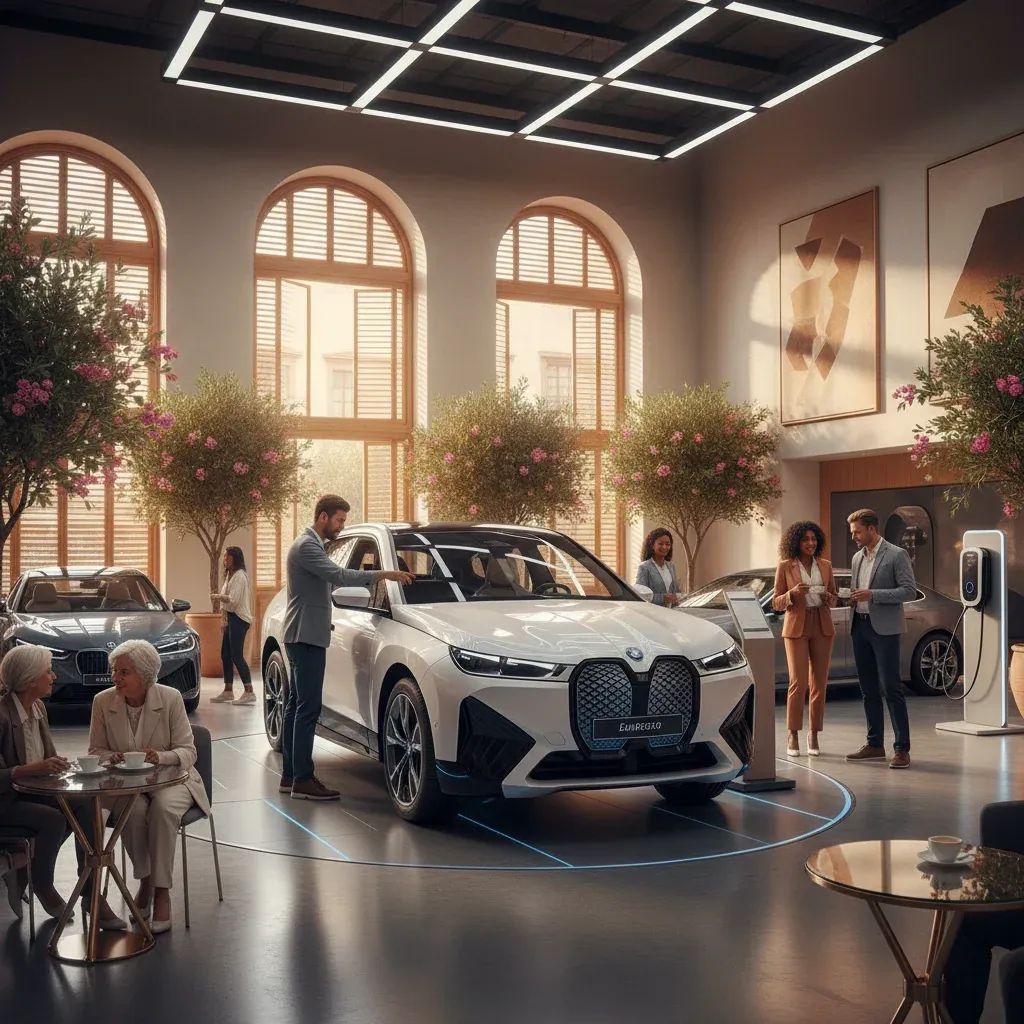
The BMW Group has delivered 565,748 vehicles globally in the first quarter of 2026, marking a 3.5% decline from the same period last year. But while the company struggled across its largest markets, BMW Italia bucked the global trend with a remarkable 9.9% sales surge—a bright spot that underscores diverging fortunes across world markets.
Italy Defies Global Slowdown
For those living in Italy, the takeaway is clear: BMW's local performance remains robust. BMW Italia reported a 9.9% sales increase in Q1 2026, significantly outpacing the global decline. This growth reflects European buyers' appetite for BMW's latest models and, crucially, Italy's stable policy environment for electrification. Unlike China's volatile market or the United States' abrupt elimination of EV tax credits, Italy and the broader EU maintain consistent emissions regulations and incentive frameworks that support the transition to electric vehicles without sudden reversals. This continuity has made BMW's European operations, particularly in Italy, a refuge against global headwinds.
Why This Matters
• China's double-digit drop: BMW's sales in China fell 10% to 144,000 units, the third consecutive year of decline exceeding 10%, driven by aggressive local electric vehicle brands.
• U.S. electrified vehicle sales collapse: Battery-electric and plug-in hybrid deliveries in the United States plunged 50% year-on-year after federal EV tax credits were eliminated in late 2025.
• Europe holds firm: Sales across Europe rose 3%, with Germany alone surging 10.7% to 68,022 vehicles—offsetting much of the damage elsewhere.
• iX3 orders exceed 50,000: Despite the EV sales slump, pre-orders for BMW's new electric SUV signal potential recovery as the Neue Klasse platform rolls out.
What This Means for Italian Residents
BMW's challenges in China and America could ultimately benefit Italian buyers. The company is pivoting toward a new production and battery strategy centered on the Neue Klasse platform, designed to achieve 40-50% lower battery costs compared to current models. This cost reduction directly translates to more competitive pricing for electric vehicles sold in Italy starting in 2027.
The timing matters: BMW's iX3 SUV—already attracting over 50,000 pre-orders—will arrive in European showrooms in late 2026, followed by other Neue Klasse models. These vehicles promise better range, faster charging speeds, and lower lifetime costs than today's models. For Italian consumers accustomed to EU-subsidized EV purchases, the arrival of competitively priced electric options could accelerate the shift from combustion engines while keeping BMW competitive against rivals like Mercedes and Audi.
Additionally, BMW is investing heavily in localized supply chains. A new battery assembly facility in South Carolina and battery cell production in Florence, South Carolina, will reduce shipping costs and delivery times for European vehicles. The net effect: Italian buyers may see faster showroom availability and potentially lower prices as production efficiencies take hold.
However, one caveat exists. If tariff pressures on European exports to the U.S. persist—which currently weigh on BMW's profits by roughly 1.25 percentage points—the company may recoup costs by modestly raising prices in less competitive markets, including Europe. Currency fluctuations could also play a role; if the euro weakens relative to the dollar, European pricing may adjust upward.
Global Context: Regional Performance and Competitive Positioning
While BMW Italia thrived, the global picture reveals stark regional divides. In Europe overall, deliveries climbed to 236,422 units, a 3% increase, providing critical support as BMW's two largest overseas markets contracted sharply.
China's Challenge: China, BMW's single biggest market, recorded a 10% decline to 144,000 vehicles, extending a downward trend begun in 2024. Homegrown rivals like Nio, Xiaomi EV, and Huawei-backed Aito have seized market share through advanced connectivity, competitive pricing, and software-driven experiences that resonate with younger buyers. BMW's traditional premium positioning has proven less persuasive in a market increasingly defined by digital features and value rather than legacy brand prestige.
U.S. Struggles: In the United States, total BMW Group sales fell 4.3% to 90,492 units. The steepest damage came from electrified models: battery-electric and plug-in hybrid sales collapsed by 50%, falling to just 9,856 units. The Trump administration's elimination of federal EV tax credits in autumn 2025 removed incentives of up to $7,500 per vehicle, effectively freezing EV demand. High interest rates and broader economic uncertainty further discouraged purchases among even luxury buyers.
Competitive Standing: Against German rivals, BMW held ground. Mercedes-Benz reported a steeper 6% global decline, and Audi faced the worst outcome, with U.S. sales plummeting 30%—the first sub-30,000 quarter since 2012. BMW's 3.5% global decline is relatively moderate in this context.
Brand Performance: MINI Shines, Premium Segment Softens
Within the BMW Group, performance diverged sharply by brand. MINI posted a 5.9% gain to 68,427 units—its fifth consecutive quarter of growth—driven by its compact urban positioning and relative affordability. The core BMW brand delivered 496,050 vehicles, down 4.6%. Rolls-Royce sales slipped 8% to 1,271 units, signaling that ultra-luxury demand is cooling.
Battery-electric vehicles (BEVs) across the group fell 20.1% to 87,500 units globally. Yet Europe tells a different story: fully electric vehicle orders surged approximately 40% year-on-year, driven by anticipation of new models like the iX3 and the forthcoming Neue Klasse platform. In China and the U.S., however, BEV demand cratered—reflecting industry-wide headwinds rather than BMW-specific failures.
Strategy Shift: Neue Klasse as the Recovery Engine
BMW's response centers on the Neue Klasse platform—a redesigned electric architecture integrating sixth-generation batteries, advanced software, and localized production. The platform's first models, including the iX3 SUV and a reimagined i3, are slated for China in summer 2026 and the U.S. in the third quarter. Pre-orders for the iX3 have already exceeded 50,000 units.
Neue Klasse vehicles will feature batteries with up to 40-50% lower costs, enabling BMW to target price parity with combustion engines—a critical threshold in markets where EV subsidies have vanished. In China, BMW has slashed prices across much of its lineup by over 20% and is producing a long-wheelbase iX3 variant tailored to local tastes. In the U.S., the company is halting sales of the older iX model to focus exclusively on Neue Klasse products.
BMW is also deepening localized R&D and supply chains. In China, the company has built its largest non-German research network, collaborating with Baidu, Tencent, Huawei, and Momenta on AI-driven connectivity and autonomous driving. A new battery plant in Shenyang, operational this year, anchors supply chain resilience. In the U.S., retooling investments at the Spartanburg, South Carolina, plant and a battery assembly facility in Woodruff will begin producing electric X-series variants by late 2026. Battery cells will come from a new factory in Florence, South Carolina, while cathode materials will be sourced from Umicore in Ontario, Canada.
Outlook: Cautiously Optimistic for Europe
BMW expects moderate growth in Europe and the U.S. for the full year 2026, while Chinese sales are projected to stabilize near 2025 levels. The company forecasts profitability pressures from tariffs but expects solid cash generation in the automotive division.
For Italian residents and European buyers, the near-term outlook is cautiously optimistic. Local sales remain healthy, new electric models with competitive pricing are arriving, and EU policy continuity supports the electrification transition. For those considering a BMW purchase in 2026, the arrival of Neue Klasse vehicles in late Q3 may be worth the wait—offering better range, faster charging, and lower lifetime costs than the current generation. However, buyers should remain alert to potential modest price increases if tariff pressures persist or currency fluctuations continue to favor stronger currencies over the euro.


