
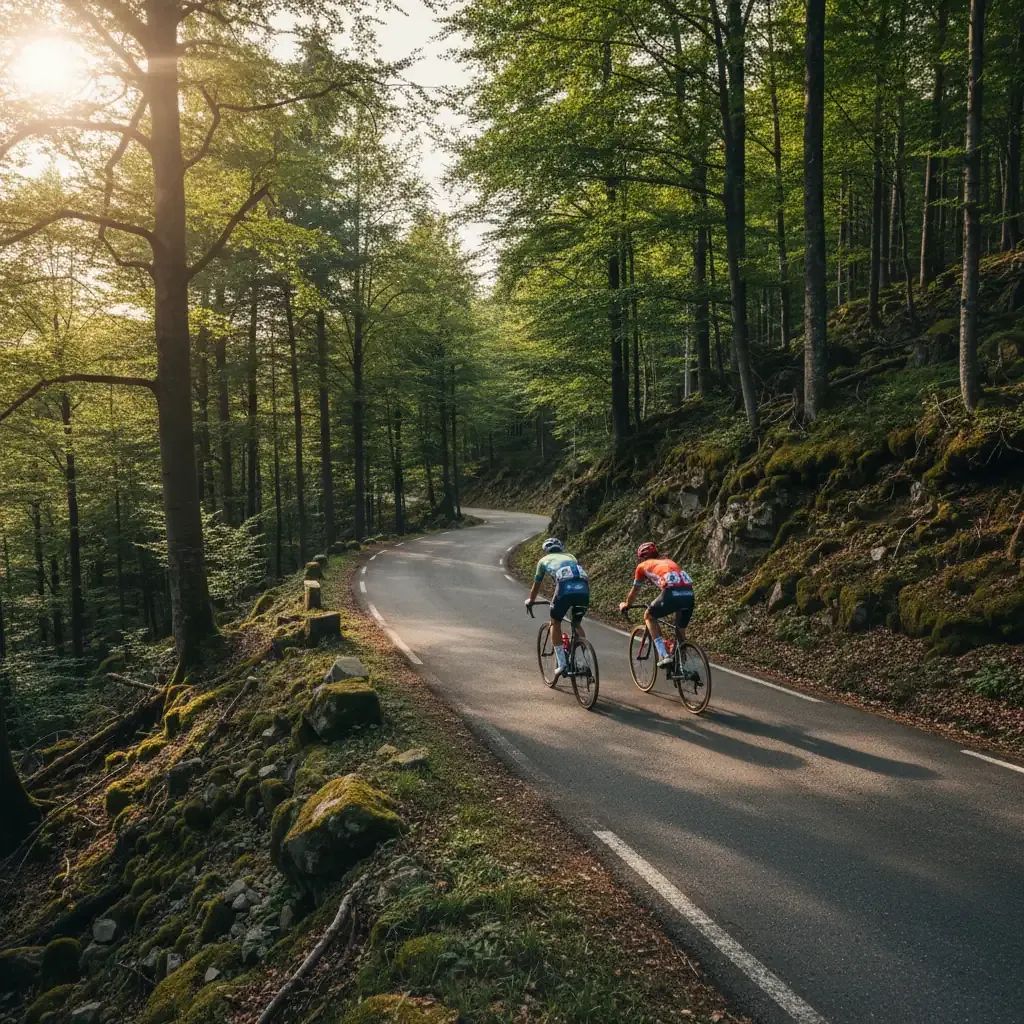
The UAE Team Emirates rider Tadej Pogačar secured his fourth Liège-Bastogne-Liège victory on Sunday, but it was a 19-year-old French prodigy who stole the post-race conversation. The Slovenian world champion openly acknowledged that Paul Seixas, who shadowed his decisive attack and finished second, represents a generational threat that could "destroy us all" within a few years.
Pogačar's comments underscore a seismic shift in professional cycling: the era of teenage phenoms who no longer need a decade of apprenticeship to challenge the sport's titans. Seixas is already proving that potential. The French rider placed second at Strade Bianche in March and won the Giro del Paese Basco in April. His consistency across diverse terrain suggests he could dominate Italy's spring and autumn classics for the next decade.
Why This Matters
• New benchmark for youth: Seixas is rewriting expectations for teenage riders, achieving results that took Pogačar and Remco Evenepoel until their early twenties.
• Economic impact: Major sponsors and teams, including Decathlon CMA CGM, are investing heavily in young talent, altering the financial landscape of cycling.
• Pressure on established stars: Riders in their late twenties, traditionally in their prime, now face career-threatening competition from athletes barely out of adolescence.
The Moment Pogačar Realized He Had Company
The decisive move came on the Côte de La Redoute, a brutal 2.1-kilometer climb with gradients exceeding 20%, situated approximately 40 kilometers from the finish. Pogačar launched his trademark acceleration, a tactic that has repeatedly shattered elite fields. Yet when he crested the summit, Seixas was still on his wheel.
"At the top he caught me and I thought: 'Ok, this is truly impressive,'" Pogačar recounted. The 27-year-old champion had to wait until the Roche-aux-Faucons, the final ascent 14 kilometers from the line, to finally drop the teenager. Seixas held on for second place, with Remco Evenepoel (Red Bull–Bora–Hansgrohe) taking third.
The fact that a 19-year-old could absorb Pogačar's hardest punch and recover to contest the finale is unprecedented in modern monument racing. For context, Pogačar himself was 21 when he won his first Tour de France in 2020—already considered remarkably young. Seixas is achieving comparable results two years earlier in his development curve.
What This Means for Italian Cycling
Seixas's second-place finish at Strade Bianche in March, where he tried to follow Pogačar's attack on the white gravel roads of Tuscany, demonstrated his adaptability to Italian racing conditions. The race, held over 184 kilometers from Siena to the Piazza del Campo, is notoriously unpredictable, favoring riders who can handle technical descents and explosive climbs on loose surfaces. His versatility as an all-rounder—capable of winning time trials, summit finishes, and one-day races—makes him a credible contender for Italy's major classics in the coming years.
How Training Science Accelerated His Development
The average age of WorldTour riders has shifted toward both ends of the spectrum: veteran domestiques are staying in the peloton longer, while elite talents are arriving younger. Power meters and biometric sensors now allow scouts to identify exceptional physiology before riders turn professional. This scientific approach accelerates development timelines considerably.
Seixas's Meteoric Rise
Born on September 24, 2006, in Lyon, France, Seixas began racing with VC Villefranche Beaujolais before joining professional cycling in 2025. His junior career included the 2024 world championship in the junior time trial and French national champion titles. He won the Tour de l'Avenir and finished seventh at Il Lombardia—the youngest rider to crack the top 10 of a monument in over a century.
The 2026 season marks his breakout. He won La Flèche Wallonne, the Faun-Ardèche Classic, and claimed stage victories at the Giro del Paese Basco. Through late April, he had accumulated significant Professional Cycling Statistics (PCS) points, reflecting an impressive points-per-day average compared to his 2025 performances.
Pogačar's Challenge: Stay Hungry or Get Devoured
The Slovenian's comments reveal a competitor's pragmatism. "Seeing Paul enter such a strong group at such a high level already at 19 motivates everyone else to keep improving," Pogačar said. "We'll keep working hard to try and beat him in the coming years and win as much as possible... until he destroys us all."
It's rare for a reigning champion to openly concede future dominance to a rival. Pogačar's willingness to acknowledge Seixas's potential reflects both the teenager's authentic performance at LBL and the competitive calculus now shaping professional cycling's elite tier.
The Road Ahead
For Italy's cycling community, Seixas represents both fresh competition and compelling narrative. Races held on Italian soil—Strade Bianche, Tirreno-Adriatico, Milano-Sanremo, Il Lombardia—will be battlegrounds for this generational duel. The 2026 Giro d'Italia, scheduled for May, could offer the next chapter in how Seixas develops as a stage-racing threat.
Tadej Pogačar's fourth Liège-Bastogne-Liège title is impressive, but Paul Seixas's performance may be the more consequential story. At 19, the French rider is forcing the sport's best to recalibrate their ambitions and timelines. For those invested in cycling—whether as fans, professionals, or business stakeholders in Italy—the implications are clear: the competitive landscape is shifting faster than anticipated.


