
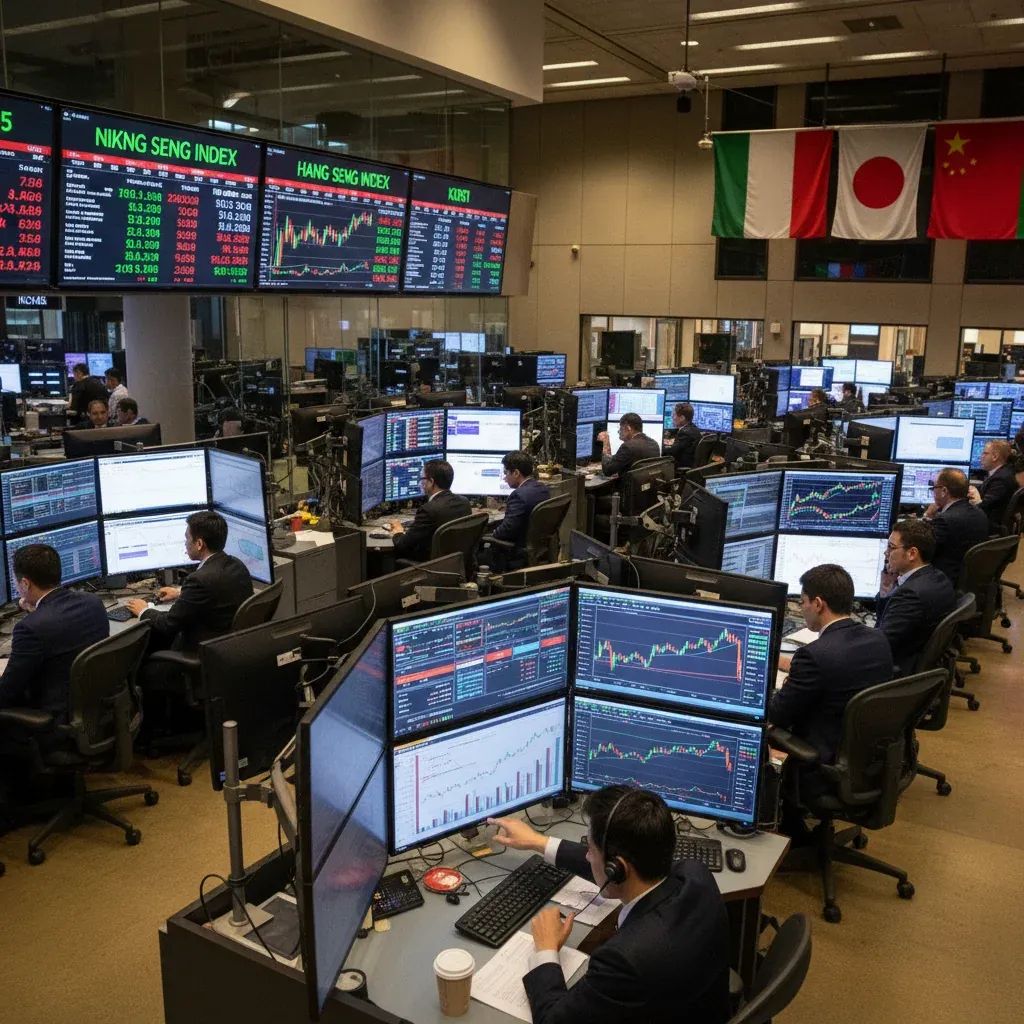
Italy investors are waking up to a fractured Asian trading session that combines a 10% surge in Tencent with cautious positioning ahead of critical U.S. employment data due Friday—a dynamic that could influence European bond spreads and the euro's purchasing power for Italian households and businesses.
Why This Matters:
• Italian government bonds (BTP) saw yields drop to 3.68%, narrowing the spread with German Bunds to just 72 basis points—directly affecting mortgage rates and corporate borrowing costs in Italy.
• Oil price decline (WTI down 1.05% to $91.19/barrel) and falling natural gas futures (down 1.71% to €48.25/MWh) could ease inflationary pressure on Italian energy bills.
• Technology stock rally in Asia—particularly semiconductors and AI—signals potential gains for Italy-listed multinationals with Asian exposure ahead of European market opening.
Semiconductor Rally Contrasts with Auto Sector Weakness
Asian equity markets delivered a split verdict as technology stocks surged while traditional manufacturing lagged. Tokyo's Nikkei 225 slipped 0.3%, dragged down by Nissan's 2.61% decline and Toyota's 2.12% drop—reflecting broader weakness in the automotive sector that affects Italian suppliers with Japanese ties.
In stark contrast, chip manufacturers rallied aggressively: Screen Holding jumped 4.05%, Lasertec gained 2.27%, and Advantest climbed 2.51% on the Tokyo exchange. The semiconductor enthusiasm spread to Seoul (up 0.15%) and Taiwan (up 0.48%), reflecting sustained global demand for AI infrastructure components.
Hong Kong's Hang Seng Index led regional gains with a 1.99% advance, propelled by Tencent Holdings' extraordinary 10% leap to 479.4 HKD. Reports indicate the Chinese tech giant is advancing AI capabilities within its WeChat ecosystem, signaling continued momentum in artificial intelligence deployment across major platforms. Shanghai's composite index gained a modest 0.44%, while Mumbai slipped 0.27% and Singapore rose 0.78%, reflecting broader uncertainty about regional growth trajectories.
What This Means for Italian Investors and Savers
The 72-basis-point spread between Italian BTPs and German Bunds represents a two-year low, signaling improved confidence in Italy's fiscal management among international bond buyers. For Italian households, this translates into potentially lower borrowing costs as yields compress across the eurozone periphery.
The euro's strength—trading at 1.16 against the dollar—makes dollar-denominated imports cheaper for Italian businesses but pressures exporters selling to U.S. markets.
Italy's energy-intensive industries stand to benefit if the current gas price decline (€48.25/MWh) persists. Natural gas represents a significant portion of Italy's electricity generation, and sustained price relief could support lower industrial electricity costs over the coming months.
Middle East Tensions Cloud Economic Outlook
Geopolitical uncertainty in the Persian Gulf region—where tensions involving Iran continue to escalate—injects volatility into commodity markets despite today's price dips. The Strait of Hormuz, through which 20% of global oil passes, remains a critical chokepoint. Any disruption could send crude prices sharply higher, according to energy analysts.
For Italy, which imports the vast majority of its petroleum needs, such disruptions would directly impact energy costs and transportation expenses. Gold's 0.65% climb to $4,532.55 per ounce reflects this anxiety among investors seeking safer assets amid geopolitical uncertainty.
U.S. Jobs Data to Set Market Tone
Friday's U.S. Non-Farm Payrolls report for May dominates investor attention. Consensus forecasts call for 95,000-102,000 new jobs, down from April's 115,000 figure. A weaker-than-expected print could trigger speculation about Federal Reserve rate cuts, potentially supporting risk assets, including European equities.
Conversely, a robust jobs number might reinforce the Fed's hawkish stance, keeping U.S. yields elevated and pressuring global stocks. Italian equity investors should watch the employment report closely: the FTSE MIB's banking sector—including Intesa Sanpaolo and UniCredit—tends to track U.S. rate expectations closely due to interconnected global credit markets.
Technology Stocks Signal Broader Shift
Beyond Tencent's headline-grabbing surge, the broader AI enthusiasm visible in Asian trading suggests a structural shift in global capital allocation. Semiconductor manufacturers, cloud infrastructure providers, and AI application developers are attracting investment flows that previously targeted traditional growth sectors.
The automotive sector's weakness—evidenced by Nissan and Toyota's declines—poses questions for companies with significant exposure to traditional manufacturing. For Italian investors, diversified international portfolios should account for these evolving sector trends.
Currency and Bond Market Implications
The dollar's slide to 1.16 per euro reflects both Fed policy uncertainty and relative European economic resilience. For Italian travelers planning summer holidays to the United States, the stronger euro provides better purchasing power compared to a year ago.
Italian exporters face the reality of currency headwinds, with compressed margins on goods sold to U.S. markets. The Bank of Italy has advised exporters to actively manage currency exposure.
French 10-year yields dropped 4.8 basis points to 3.58%, remaining 10 basis points below Italian equivalents—a reminder that market perceptions of fiscal discipline still differentiate eurozone members. Continued narrowing of this gap would further reduce Italy's debt servicing costs.
Market Positioning Ahead of Data Deluge
Beyond Friday's U.S. jobs report, investors face a week crowded with central bank speeches, corporate earnings releases, and geopolitical developments. The mixed signals from Asian markets—technology strength versus traditional sector weakness—mirror broader uncertainty about growth trajectories as central banks navigate inflation management.
Italian investors holding diversified portfolios that include international equities should expect continued volatility. Energy price movements warrant close monitoring. While today's declines in oil and gas futures provide short-term relief, the underlying geopolitical tensions suggest potential for market reversals.
The semiconductor sector's outperformance, Tencent's AI momentum, and persistent Middle East tensions create a complex investment landscape—one that demands attention from anyone in Italy with exposure to global markets and international trade.


