
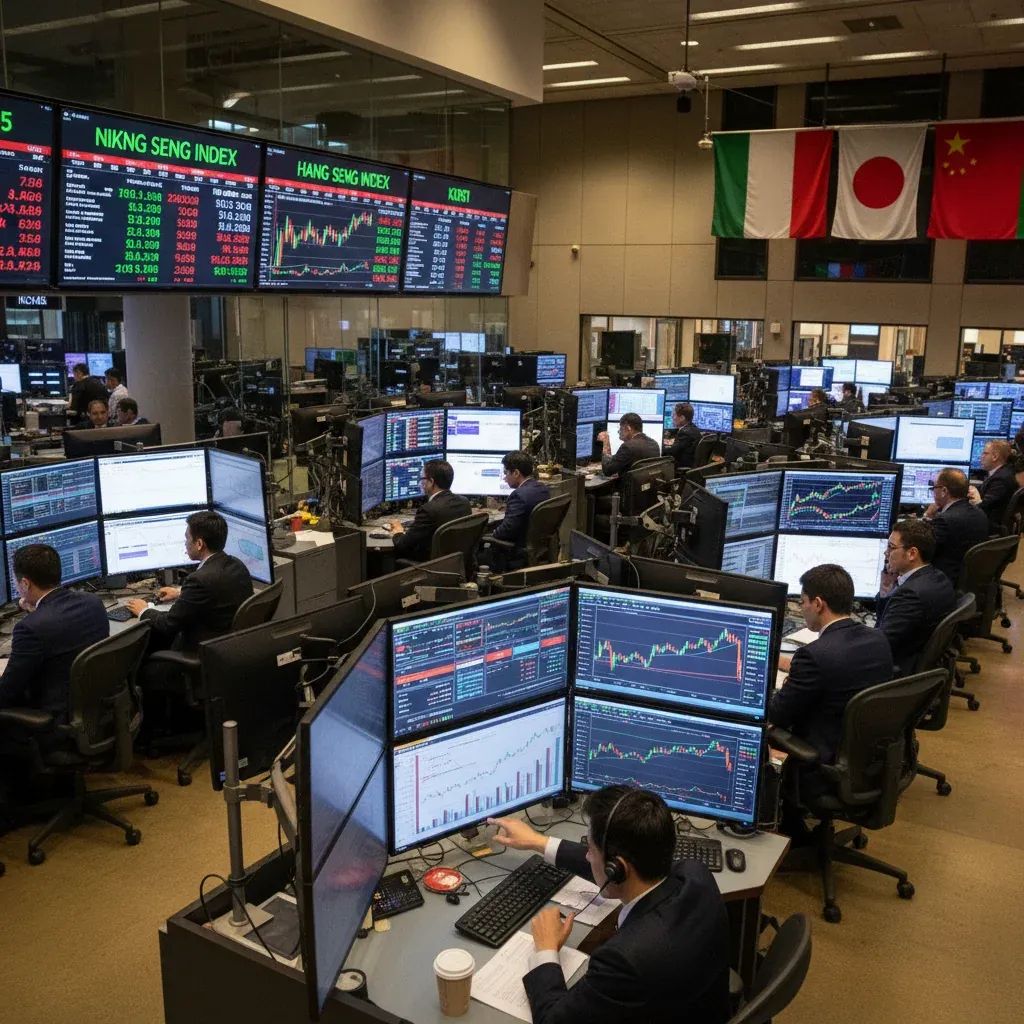
Italian investors face mixed signals from Asian markets on Wednesday, with geopolitical uncertainty over the Strait of Hormuz and currency volatility offsetting Wall Street's recent gains. As European trading desks prepare for the opening bell, futures point to a cautious start, with manufacturing data from Italy and inflation figures from the Eurozone due later in the session.
Why This Matters for Italian Investors
• BTP-Bund spread climbed to 78 basis points, pushing Italian 10-year yields to 3.66% — a signal of heightened sovereign risk perception that directly affects Italian borrowing costs and bond valuations.
• Gas prices edged up 0.22% to €43.54 per MWh, underscoring Europe's continued energy sensitivity and the importance of Hormuz negotiations.
• Dollar strength (€1.14 per USD) makes imports cheaper but pressures Italian exporters competing in global markets.
• Gold retreated 1.44% to $3,972 per ounce, suggesting reduced safe-haven demand.
Regional Performance: A Patchwork of Winners and Losers
Asian equity markets closed Wednesday's session without a clear trend, despite Wall Street's Dow Jones hitting a fresh record. Tokyo's Nikkei closed up 1.2%, buoyed by strong demand in the artificial intelligence sector. Electronics component manufacturers led gains: Taio Yuden surged 12.43% following an upgrade from Macquarie, while Kyocera climbed 7.3% and TDK added 3.64%. Automakers showed divergence, with Suzuki up 1.79% but Honda slipping 0.51%.
Taiwan's Taiex jumped 1.94%, reflecting continued investor enthusiasm for semiconductor and AI-related stocks. Shanghai edged higher by a modest 0.06% to 0.8%, supported by manufacturing data showing China's factory activity returned to expansion territory in June.
On the losing side, Seoul's Kospi dropped 2.04%, the sharpest decline among major Asian bourses. Analysts attributed the selloff to profit-taking after an exceptional second quarter. Sydney's S&P/ASX 200 fell 0.64%, while Hong Kong's Hang Seng slipped 0.63% in late trading. Mumbai gained 0.64%, and Singapore held flat at +0.06%.
Geopolitical Risk Premium: Hormuz Negotiations
Market participants remain focused on ongoing negotiations between the United States and Iran over the Strait of Hormuz, a critical chokepoint for global oil traffic. Recent developments have eased some immediate tensions: Brent crude now trades around $73-75 per barrel, while WTI sits at $69.50 — representing a significant decline from earlier peaks during heightened geopolitical tensions.
The situation remains fluid, with further rounds of diplomatic talks expected. Any escalation could trigger a rapid spike in energy prices and renewed volatility across global equity markets.
Currency Dynamics and Italy's Bond Market
The Japanese yen continues its historic slide, touching levels not seen in four decades at 162.60 per dollar and 185.60 per euro. Despite the Bank of Japan's recent rate increases and foreign exchange interventions, the underlying trend persists, driven by wide interest rate differentials with the Federal Reserve and other major central banks.
For Italy, the currency landscape presents mixed implications. A stronger dollar makes energy and commodity imports cheaper in nominal terms, but it erodes the competitiveness of Italian manufacturers exporting to dollar-denominated markets.
More critical for Italian investors is sovereign debt performance. The BTP-Bund spread widened to 78 basis points, with Italy's 10-year yield climbing 3.5 basis points to 3.66%, while German Bunds yielded 2.88% and French OATs 3.68%. This divergence reflects market concerns about fiscal discipline in Southern Europe, particularly ahead of today's Eurozone inflation release and the European Central Bank's July policy decisions.
What This Means for Italian Investors
For residents tracking their portfolios or pension funds with international exposure, Wednesday's session underscores the importance of geographic and sectoral diversification. Technology and electronics stocks in Japan and Taiwan continue to outperform, driven by global AI investment, while traditional industrial and automotive plays show mixed results.
The weakness in Seoul and Sydney suggests that markets which gained substantially in the first half of 2026 are vulnerable to profit-taking. On the fixed-income side, the uptick in Italian yields serves as a reminder that sovereign spreads remain sensitive to both domestic fiscal policy and external shocks. Anyone holding BTPs or considering an allocation should monitor both the PMI manufacturing indices due today and the parallel release of U.S. factory data.
Energy and Commodities: The Hormuz Effect
Natural gas prices in Europe ticked higher, gaining 0.22% to €43.54 per MWh, a modest move that nonetheless reflects the continent's energy vulnerability. Any escalation in Middle East negotiations or disruption to liquefied natural gas shipments could reverse recent stability.
Gold's 1.44% decline to $3,972 per ounce reflects reduced safe-haven demand. However, the metal's retreat may prove temporary if geopolitical talks stall or inflation data surprises to the upside.
European Futures Signal Cautious Open
Futures contracts on European indices point to a flat to slightly negative open, with London markets showing no movement in pre-market trading. The cautious tone reflects investor reluctance to commit capital ahead of key economic releases. Italy's manufacturing PMI, expected mid-morning, will offer the first hard data on the health of the country's industrial sector entering the third quarter. A reading below 50 would signal contraction and could weigh on Italian bank stocks and industrial names.
The broader Eurozone inflation figure carries significant weight, as it will shape expectations for the ECB's July policy meeting. Any upside surprise could prompt traders to reprice the probability of additional rate hikes, putting pressure on borrowing costs across the currency bloc and potentially widening sovereign spreads further.
Sector Spotlight: Tech Momentum Versus Auto Uncertainty
The divergence between technology and automotive stocks in Asian trading offers insight for European investors. AI-related stocks and semiconductor manufacturers continue to attract capital, while traditional auto manufacturers face headwinds from slowing consumer demand and rising production costs.
Italian investors with exposure to European tech or semiconductor equipment makers may benefit from continued momentum, while those holding positions in legacy automotive or consumer discretionary sectors should monitor for volatility.
The Road Ahead
As trading begins in Milan, investors will be parsing a complex set of inputs: AI-driven gains in Asia, ongoing geopolitical uncertainties in the Middle East, currency movements, and a packed calendar of economic data releases. For Italian households and institutional investors alike, the message is clear: diversification across asset classes and regions remains essential, and close monitoring of fiscal and geopolitical developments will be necessary for navigating market conditions ahead.


