
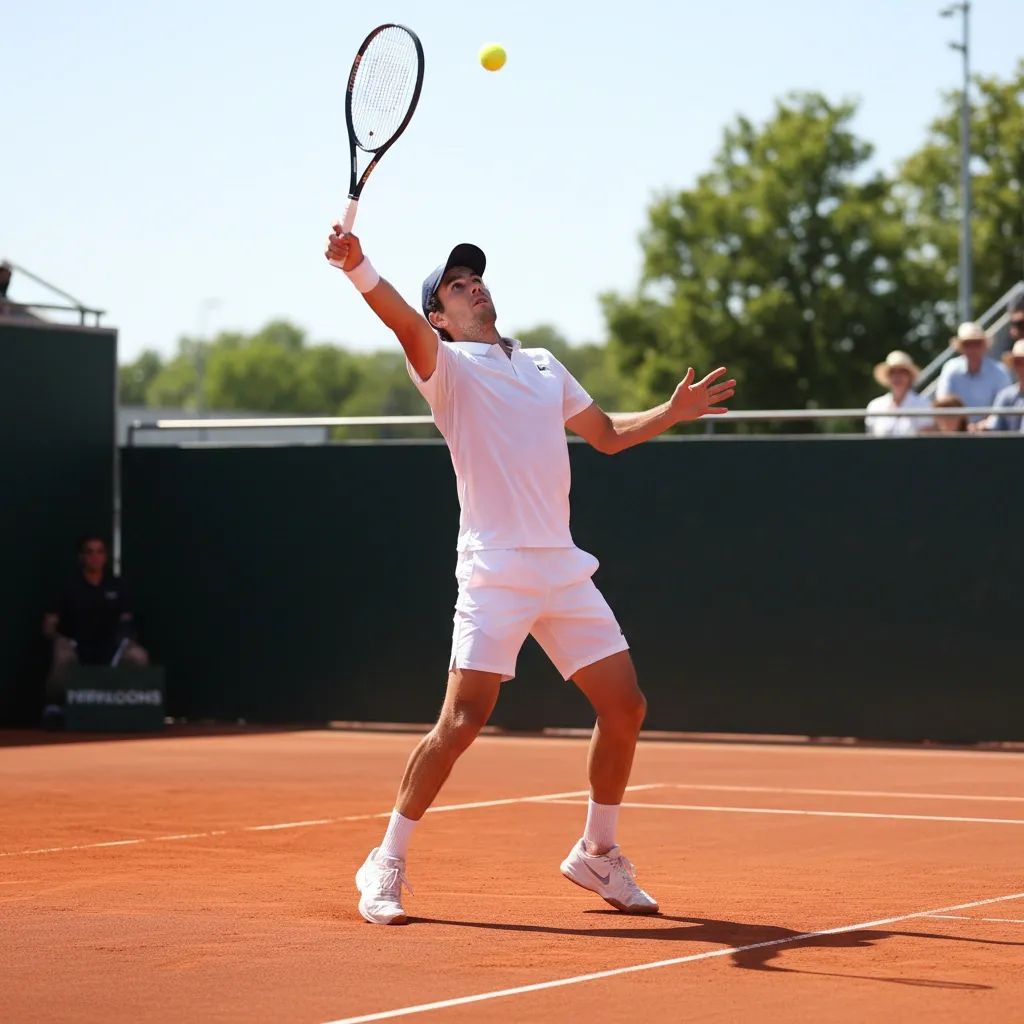
Spain's Carlos Alcaraz, the world number 2, has taken his most concrete step yet toward rejoining the ATP Tour after a two-month absence triggered by a wrist injury, according to training footage released by his team. The 23-year-old ran without any protective brace for the first time since April, signaling potential availability for the upcoming North American hard court swing culminating in the US Open.
Why This Matters:
• Alcaraz has missed Madrid, Rome, Roland Garros, and Wimbledon (starting June 29) due to right wrist damage sustained in April.
• He retains the number 2 ATP ranking behind Italy's Jannik Sinner, despite the prolonged layoff.
• Target return: Masters 1000 events in Canada (August 2) and Cincinnati (August 13), with full fitness expected for the US Open in late August.
• No racquet work yet, but removal of wrist protection marks a critical recovery milestone.
The Comeback Timeline Takes Shape
Video posted to social media by Alberto Lledó, Alcaraz's physical trainer, shows the Spaniard jogging shirtless across an outdoor track with no visible brace or tape on his injured wrist—a stark contrast to previous public appearances in which he wore either a rigid splint or elastic compression sleeve. Lledó's caption—"The weeks are flying by! I can't keep up with you anymore"—offers the first tangible hint that the athlete is regaining top-end conditioning.
The injury forced Alcaraz to abandon plans for clay court play in May and subsequently pull out of grass season altogether, including the Queen's Club warm-up and Wimbledon itself. His coaching staff has adopted a deliberately cautious approach given the delicate anatomy of the wrist, a joint critical to racquet control and spin generation. Medical advisers reportedly warned against rushing back before bone and ligament structures fully stabilize.
Though no official return date has been announced, the player's camp is eyeing the Canadian Open in Montreal (starting August 2) and the Cincinnati Masters (opening August 13) as realistic benchmarks. Both events serve as traditional lead-ins to the US Open, scheduled to begin in late August at Flushing Meadows—the final Grand Slam of the 2026 season and a tournament Alcaraz won in 2024.
What This Means for the Alcaraz-Sinner Rivalry
Italian tennis followers accustomed to watching Alcaraz clash with compatriot Jannik Sinner at major events will have to wait a few more weeks for that rivalry to resume. The current world number 1, Sinner now enjoys an undisputed run through Wimbledon and the summer hard court circuit without his closest competitor.
The Alcaraz-Sinner rivalry has become one of the sport's defining narratives over the past two years, with both players splitting recent Grand Slam titles and trading the top ranking multiple times. Italy's tennis media has closely tracked Alcaraz's rehabilitation process, particularly given the implications for Sinner's path to year-end number 1—a position heavily influenced by summer results in North America. The potential August rematch offers fresh commercial appeal for pay-per-view packages and broadcast partners heading into the US Open.
Prize Money Dispute Impacts Sinner and Top Players Ahead of US Open
While Alcaraz works toward match fitness, a separate controversy is taking root among ATP professionals over Grand Slam prize distribution. According to reporting by The Times, Sinner is among a group of top players considering forms of protest at the US Open, including a potential boycott of the mixed doubles exhibition event.
The grievance centers on the revenue share allocated to competitors. Current figures show Grand Slam tournaments distribute between 13% and 17% of total revenue to prize pools, with Wimbledon 2026 earmarking approximately 14.4% and Roland Garros just under 15%. Players, led by union representatives and high-profile voices like Sinner, are demanding that figure rise to 22% by 2030—a jump that would lift total prize money from roughly $300 million to $400 million annually across the four majors.
Wimbledon announced a 20% increase in its 2026 prize fund, reaching a record €75.1 million, but athletes argue the gesture remains insufficient given soaring broadcast rights and sponsorship revenue. By comparison, professional leagues in basketball (NBA) and American football (NFL) allocate close to 50% of revenue to player compensation.
The US Open mixed doubles event, redesigned this year to feature top singles players such as Alcaraz, Novak Djokovic, and Emma Raducanu, carries a $1 million winner's purse and represents a high-profile commercial experiment. Organizers hoped the format would draw casual viewers and boost ticket sales, but the very prominence of the event now makes it a natural target for collective action. A coordinated withdrawal by stars would undermine the event's marketing appeal and send a public signal to tournament directors.
Sinner's potential involvement is significant: as the reigning world number 1 and a former union council member, his participation in any boycott would lend institutional weight and media amplification. Italian federation officials have not commented publicly, but sources close to the player suggest he views the dispute as both a labor rights issue and a matter of professional respect.
Italian Contingent Heads to Halle Grass Courts
While the top of the draw awaits Alcaraz's return and navigates labor tensions, Italy's Flavio Cobolli is preparing for his first ATP 500 tournament as a top-10 player. Seeded sixth at the ATP 500 Halle event in Germany, Cobolli draws a challenging opener against American Frances Tiafoe, ranked 28th.
Tiafoe holds a 3-1 career edge over the Italian, including a win earlier this year at Indian Wells. Grass remains Cobolli's least experienced surface, making the Halle draw a key proving ground ahead of Wimbledon. His coaching team has prioritized serve placement and net approach—skills essential on fast turf—during training camps in the lead-up.
Also competing in Halle qualifying is Lorenzo Sonego, who faces Georgia's Nikoloz Basilashvili (world number 118) for a main draw berth. Sonego won three of their four prior meetings, including a grass court encounter at Wimbledon in 2025. Fellow Italian Mattia Bellucci advanced past Kazakhstan's Mikhail Kukushkin 6-4, 6-3 and will play Australia's Alex Bolt in the final qualifying round.
The Halle tournament serves as a traditional Wimbledon warm-up, offering Italian players rare opportunities to bank ranking points and test conditioning on grass before the sport's most prestigious major begins June 29. Italian tennis officials view Cobolli's seeding—his highest yet at an ATP 500 event—as validation of the federation's long-term investment in junior development and coaching infrastructure.
Alcaraz's Ranking Resilience and the Road Ahead
Despite missing four consecutive months of elite competition, Alcaraz has maintained his number 2 ranking, a testament both to his dominant 2025 season and the ATP's rolling 52-week points system. However, that cushion will erode if he cannot defend points earned last summer in Canada, Cincinnati, and New York.
Medical staff have emphasized that wrist injuries in tennis carry high recurrence risk if athletes return prematurely. The joint absorbs extreme rotational forces during serve and groundstrokes, particularly on hard courts where ball impact generates greater shock transmission. Alcaraz's team is reportedly using biomechanical analysis and load management protocols to minimize that danger once he resumes hitting.
If the Spaniard does make the Canadian Open, he will face a compressed schedule with little room for match-play rust. The gap between Montreal and the US Open spans just three weeks—a narrow window to regain timing, confidence, and competitive sharpness against opponents who have been active throughout the summer.
For now, the sight of Alcaraz running freely offers the clearest sign yet that one of tennis's most dynamic talents is inching closer to a full comeback—and that the Alcaraz-Sinner rivalry, watched so closely across Italy and beyond, may soon resume in earnest.


