
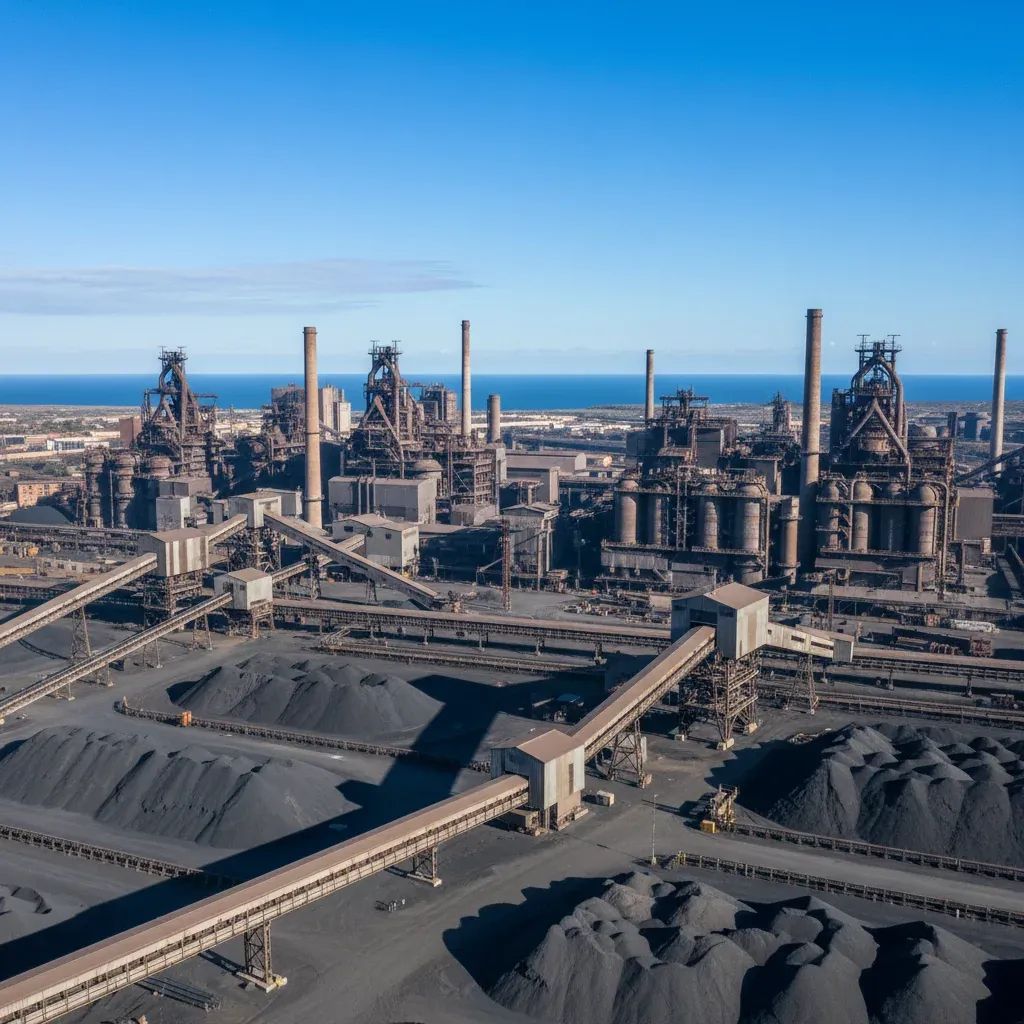
U.S. investment firm Flacks Group is racing to lock in control of Europe's largest steel complex by month's end, with a binding agreement potentially signed before April. The proposal to rescue the ex-Ilva steelworks—now operating as Acciaierie d'Italia in Amministrazione Straordinaria (a form of court-supervised insolvency protection under Italian law) under court-appointed commissioners—carries an industrial overhaul price tag of up to €5 billion and promises to retain 8,500 jobs across Italy's southern industrial heartland.
Why This Matters
• Timeline: Flacks must submit complete documentation by March 12, with a binding deal expected by March 31 if approved.
• Government stake: The Italy Cabinet will retain a 40% ownership interest, keeping public leverage over strategic assets.
• Court deadline: A Milan Tribunal ruling mandates cessation of hot production at the Taranto facility by August 24 unless environmental permits are updated—adding urgency to any ownership transition.
• Union resistance: Labor groups are pushing for full nationalization instead, calling the private bid inadequate.
The Dossier Flacks Must Deliver
According to statements released to ANSA, the Flacks Group family office is finalizing a documentation package to be delivered to commissioners no later than March 12. The submission will include a revised industrial plan, proof of the acquiring entity's financial standing, a capital commitment letter, and evidence of substantial asset availability. Flacks representatives confirmed to Italian media that the group is simultaneously negotiating with "leading industrial partners" to bolster the bid's credibility.
If commissioners deem the package acceptable, Flacks Group anticipates executing a binding acquisition agreement before the end of March. The timeline is aggressive: Italy's Minister of Enterprise and Made in Italy, Adolfo Urso, has publicly directed commissioners to finalize negotiations within three weeks, underscoring Rome's impatience with the protracted insolvency of the Taranto steelworks.
What the Deal Entails for Italy
The proposed structure would see Flacks acquire a controlling stake while the Italian government holds 40% of equity, preserving public influence over employment and environmental compliance. Flacks has signaled willingness to grant the state an option to purchase an additional 40% stake in the future, potentially allowing Rome to reclaim majority control if the turnaround succeeds.
The €5 billion capital commitment would fund electrification of production lines, installation of two electric arc furnaces (EAF) with combined capacity of 4 million tonnes per year, and retention of one blast furnace producing roughly 2 million tonnes annually. The hybrid configuration is designed to meet demand for high-grade steel used in automotive, energy pipeline, and shipbuilding sectors—products that pure EAF technology struggles to replicate.
Raw material strategy centers on direct reduced iron (DRI) and hot briquetted iron (HBI), supplemented by scrap. Flacks is evaluating MIDREX and ENERGIRON HYL technologies, both hydrogen-ready, though the firm acknowledges that immediate full-scale green hydrogen use remains economically unviable. Initial operations would rely on natural gas as a transition fuel.
Industrial Partners Not Yet Confirmed
Flacks Group has disclosed ongoing talks with major industrial players but has not finalized partnerships. Reports suggest potential involvement from Ukraine's Metinvest Group, Italy-based equipment manufacturer Danieli, and possibly India's Jindal Steel. Marcegaglia Group, a leading Italian steel trader, is rumored to be eyeing a commercial partner role rather than equity participation.
Commissioners have previously expressed reservations about the limited scope of proposed partner stakes, pressing for more substantial commitments from co-investors with proven steelmaking expertise. Flacks Group, founded in 1983 as the private family office of Michael Flacks, specializes in distressed asset turnarounds across real estate, mining, oil and gas, and chemicals—but lacks a track record in integrated steel production prior to late 2025. The firm's portfolio includes the July 2024 acquisition of Artemyn (the mining division of Imerys SA) and the disposal of packaging and accessory businesses in 2018.
In December 2025, Flacks struck an initial framework agreement with the Italy government to take over Acciaierie d'Italia, marking the group's entry into European heavy industry. The firm has since expressed interest in Thyssenkrupp's steel division and British Steel, aiming to assemble a pan-European steel platform capable of competing with Asian and North American producers.
The Union Counterpunch
Labor organizations have mounted vocal opposition to the Flacks proposal, arguing that private equity solutions prioritize short-term cost-cutting over long-term industrial stability. Italian metalworkers' unions are lobbying for a full nationalization plan that would place the ex-Ilva complex under direct state management, citing the strategic importance of domestic steel capacity to European automotive and construction supply chains.
A tripartite meeting among government officials, commissioners, and union representatives is scheduled for March 31, though sources indicate it may be moved forward to accelerate decision-making. Union officials have criticized Flacks for what they characterize as vague commitments on workforce protections and environmental upgrades, pointing to the August 24 court-imposed production halt as evidence that legal and regulatory risks remain unresolved.
Environmental Compliance Clock Ticking
The Milan Tribunal has ordered cessation of hot production at Taranto by August 24, 2026, unless the facility secures an updated Integrated Environmental Authorization (AIA), Italy's environmental permit system equivalent to EU environmental clearances. The ruling places acute pressure on any prospective owner to demonstrate rapid progress on emission controls, dust suppression, and wastewater treatment—investments that form part of the Flacks modernization blueprint but require regulatory approval and construction timelines that may extend beyond the court's deadline.
Flacks Group has publicly committed to operating the site in full compliance with Italian environmental statutes, emphasizing that worker health and ecological responsibility are "non-negotiable principles." However, critics note that previous owners failed to meet similar pledges, and the €5 billion capital plan does not specify how much will be earmarked for environmental retrofits versus production capacity expansion.
What This Means for Residents and Workers
For the 8,500 employees currently on payroll at Taranto (in Puglia, on Italy's southern Adriatic coast, approximately 500km southeast of Rome) and ancillary sites, the Flacks bid represents both promise and uncertainty. The investment commitment, if executed, would secure jobs for at least two years under Italian insolvency law and potentially far longer if the modernization plan succeeds. Workers in the Puglia region, where Taranto is located, have few alternative employers of comparable scale, making the steelworks' survival a matter of regional economic stability.
For residents living near Taranto, this deal carries immediate practical implications. The facility's industrial operations directly impact local air quality and environmental health—decades of pollution have made the city a symbol of Italy's struggle to balance heavy industry with public health. A successful modernization could improve conditions through emission controls and cleaner production technologies, while a failure could trigger further economic decline and environmental deterioration in the region. Housing values, local services, and job opportunities for the broader Puglia community depend significantly on the steelworks' viability.
For Italy's automotive and construction sectors, continuity of domestic steel supply is critical. Disruption at Taranto would force manufacturers to import from Germany, France, or Turkey, increasing costs and lead times. Higher steel prices ripple through the economy, raising construction costs for homes and infrastructure projects, and increasing production costs for vehicles—ultimately affecting housing affordability and transportation expenses for Italian residents nationwide. The Italy government's 40% stake is designed to ensure that production priorities align with national industrial policy rather than purely financial returns, protecting domestic industries and keeping costs competitive.
The Road Ahead
March 12 marks the first critical gate: submission of the full documentation package. Commissioners will evaluate the industrial plan, financial guarantees, and partner commitments against criteria including production sustainability, environmental compliance, and workforce protection. If the package clears review, a binding agreement could be signed before March 31, though union resistance and potential legal challenges from rival bidders or environmental groups could delay closure.
Should Flacks prevail, the firm will inherit one of Europe's most complex industrial turnarounds—a facility burdened by legacy pollution liabilities, aging infrastructure, and a politically charged labor environment. Success would position Flacks as a major player in European steel; failure would likely force full nationalization or piecemeal liquidation of assets, with significant job losses and strategic consequences for Italy's manufacturing base.


