
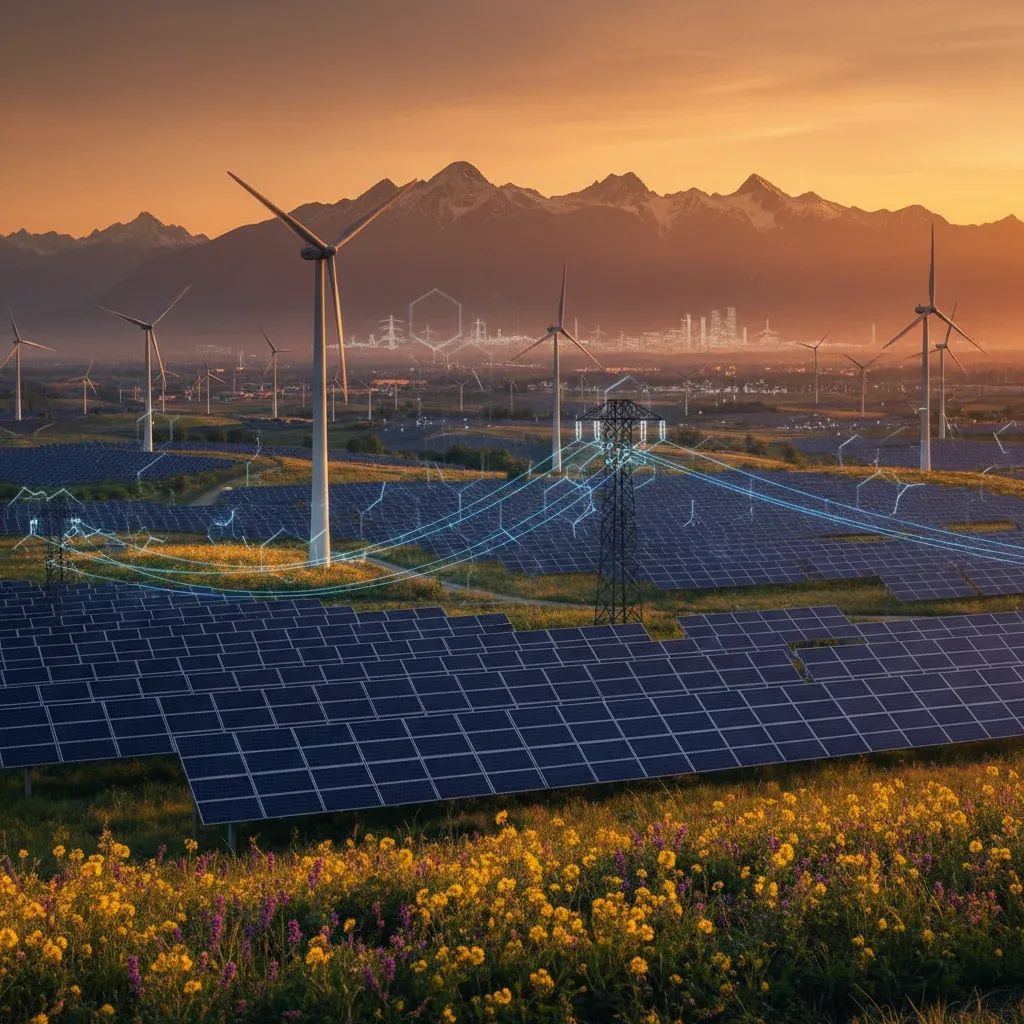
Italy-based energy and utilities operator A2a has delivered a mixed first-half performance that underscores the broader tensions rippling through the country's energy transition: soaring revenues masking margin compression, and ambitious green investment targets running headlong into rising regulatory costs and infrastructure bottlenecks.
Why This Matters
• Revenue surge: A2a posted €8.42 billion in revenue for the first half, up 22% year-over-year, driven by wholesale electricity trading and retail volume growth.
• Profitability squeeze: Despite the revenue jump, adjusted net profit fell 11% to €374 million, weighed down by higher hydroelectric concession fees and increased depreciation from capital spending.
• Renewables push: The group now operates 2.7 GW of installed renewable capacity, up 5% from the previous year, with €718 million invested in the first half—mostly in grid expansion, solar farms, and circular economy projects.
• Data center heat recovery: A2a and Equinix have operationalized a landmark district heating partnership in Milan, expected to supply thermal energy equivalent to the needs of over 21,000 homes annually starting this year.
Revenue Growth Masks Margin Pressure
A2a's topline expansion reflects the group's deeper penetration of Italy's B2B electricity market, where volumes intermediated on wholesale platforms and retail sales both accelerated. Electricity sold climbed 24% to 15.9 TWh, with the business-to-business segment driving the bulk of that growth. Green electricity sales rose 11% to 5.4 TWh, a sign that corporate clients are increasingly locking in renewable power purchase agreements (PPAs) to meet decarbonization targets.
But the revenue tailwind did not translate into proportional profitability gains. Adjusted EBITDA came in at €1.18 billion, down 3% from the same period in the previous year. The culprit: a sharp increase in concession fees for hydroelectric installations, a recurring friction point for Italian utilities as the state seeks to extract more rent from legacy infrastructure. Several waste treatment plants also underperformed, temporarily dragging on margins.
Management partly offset these headwinds through stronger output from wind and solar assets and improved results in energy trading and regulated distribution businesses—electricity grids and the water cycle, both of which enjoy stable, inflation-indexed returns. Yet the net effect was a profit squeeze: adjusted net income dropped to €374 million, down 11%, with higher depreciation charges linked to accelerated capex also weighing on the bottom line.
Investment Momentum in Renewables and Infrastructure
A2a deployed €718 million in capital expenditure during the first six months, a 5% increase year-over-year. Roughly 70% of that outlay went toward development projects: upgrading and expanding electric distribution grids, constructing new photovoltaic installations, and scaling up circular economy operations such as waste-to-energy facilities.
The group's installed renewable capacity now stands at 2.7 GW, spanning hydro, wind, solar, and business-to-business retail solar installations. That represents a 5% uptick from the previous year. The company is targeting 5.6 GW of renewable capacity by 2035, implying an additional 3 GW of wind and solar over the next nine years—a trajectory that places A2a squarely in the middle tier of Italy's utility landscape, behind Enel but ahead of many regional players.
The challenge is that Italy's renewables permitting regime remains one of the slowest in Europe. Roughly 70% of utility-scale projects are stalled in bureaucratic limbo, as regional implementation of the government's "suitable areas" decree has fragmented and tightened the approval process. Grid congestion between the electricity-rich South and demand-heavy North also threatens to limit output, with curtailment—forced reductions in renewable generation—expected to rise without significant grid investment or energy storage capacity.
A2a's strategy hinges on regulated assets and PPAs to de-risk this uncertainty. The group's sustainable debt ratio has climbed to 82%, reflecting investor appetite for green-labelled bonds tied to tangible decarbonization metrics.
Milan Data Center Heat Recovery: A Flagship Circular Economy Project
One of the more tangible wins for A2a in the first half is the Equinix partnership, which brings the group's data center strategy into operational reality. The project, centered in Settimo Milanese, captures waste heat from Equinix's server campus and routes it through a new 72 MW heat pump facility and 6,000 cubic meter thermal storage system into A2a's district heating network—the same infrastructure that already warms landmarks like the Duomo and Palazzo Reale.
At full capacity, the system will recover 225 GWh of thermal energy annually, enough to heat more than 21,000 homes and prevent 345,000 tonnes of CO₂ emissions per year—roughly equivalent to the carbon absorption of 220,000 trees. The project represents a 20% increase in the heat supplied through A2a's Milan network and is positioned as one of the largest data center heat export initiatives in Europe outside Scandinavia.
This is not A2a's only play in the sector. The company has earmarked €1.6 billion for data center infrastructure within its long-term investment plan, anticipating a tenfold increase in Milan's data center capacity over the coming years. A separate heat recovery project linked to Retelit's Avalon 3 Data Center is also set to come online imminently, supplying energy for an additional 1,250 households.
The partnership dovetails with A2a CEO Renato Mazzoncini's framing of the company's strategic vision: an ecosystem where digital and energy transitions reinforce each other. In a context of regulatory friction and commodity price volatility, these circular economy projects offer both fixed revenues and brand differentiation in a crowded market.
How A2a Stacks Up Against Enel and Terna
A2a's mixed performance contrasts sharply with the results posted by two of its larger peers. Terna, Italy's electricity grid operator, reported revenue growth and improved profitability metrics in its most recent reporting period, with EBITDA rising and net profit gains supported by strong investment in grid upgrades essential to absorbing more intermittent renewable generation.
Enel, meanwhile, saw retail market pressures in Italy offset by strong international performance. Enel's installed renewables capacity reached 92.1 GW, with 73% from green sources, and the group has maintained elevated investment levels. Note: Results from competitors may reflect different reporting periods.
The divergence highlights a structural reality: A2a operates in a competitive, liberalized retail market with fewer regulatory cushions than Terna and less geographic diversification than Enel. That leaves it more exposed to domestic policy risk—particularly around hydroelectric fees—and to commodity price swings in wholesale markets.
What This Means for Residents and Investors
For households and businesses in Milan and northern Italy, A2a's infrastructure investments translate into more reliable electricity and water services, expanded district heating coverage, and—eventually—lower-carbon energy supply. The Equinix heat recovery project alone could reduce heating costs for thousands of homes while cutting emissions, though the tariff impact will depend on how A2a prices the recovered energy relative to natural gas alternatives.
For investors and market watchers, A2a has provided guidance for full-year results and adjusted net profit targets, contingent on stable commodity prices, operational improvements at underperforming plants, and no further regulatory surprises.
Yet the company's trajectory reflects the broader friction facing Italy's utilities: ambitious decarbonization goals colliding with permitting gridlock, infrastructure constraints, and escalating state extraction from legacy assets. A2a has the balance sheet and project pipeline to navigate these tensions, but the margin squeeze and profit decline are reminders that the energy transition in Italy remains as much a regulatory and political story as a technological one.


