
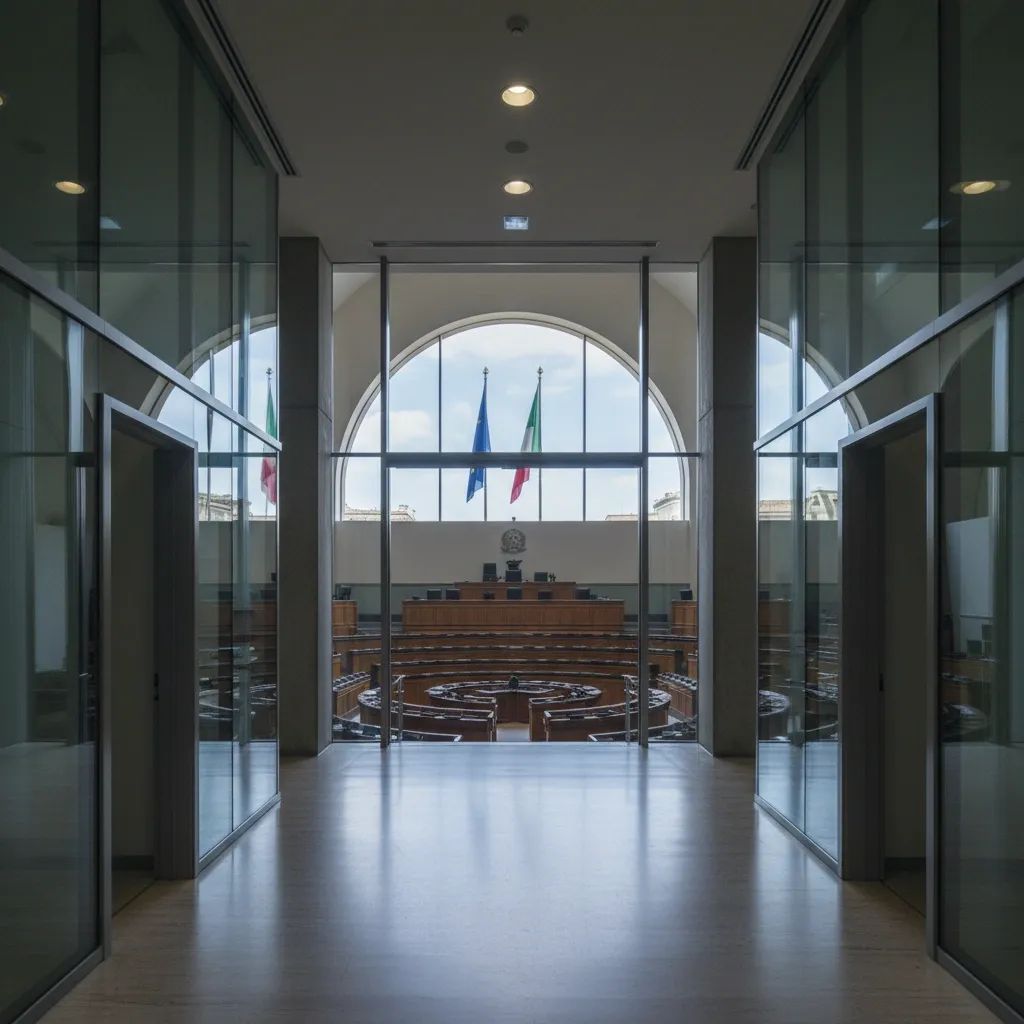
Italy's Futuro Nazionale movement, led by former general Roberto Vannacci, is weighing whether to enter its first major parliamentary contest—a high-stakes gamble that could test whether its 140,000 registered members and 7% polling numbers translate into real votes.
The by-election for Italy's Chamber of Deputies in the Reggio Calabria district (Calabria-05) is scheduled for September 27-28, 2026, filling the seat vacated by Forza Italia's Francesco Cannizzaro after he became mayor in June. With the candidate registration deadline set for August 24, 2026, Vannacci's party faces a strategic fork: capitalize on momentum or wait for a safer proving ground.
Why This Matters
• First electoral test: Futuro Nazionale has never fielded its own parliamentary candidate before, relying entirely on poll performance and membership drives.
• Direct challenge to Forza Italia: The seat belongs to the center-right party, making this a potential flashpoint within the governing coalition.
• Voter sentiment barometer: Results could signal whether Vannacci's nationalist platform has staying power beyond social media buzz.
• Deadline pressure: All parties have until August 24, 2026 to finalize candidates, forcing rapid decisions post-Ferragosto.
The Vannacci Calculation
Futuro Nazionale is internally divided. Optimists within the party argue that current polling at 7% provides sufficient tailwind to justify the risk. Collecting the required 300 to 600 signatures for ballot access is achievable, and even a modest result would generate four weeks of national media coverage leading up to the vote.
Paolo Ferrara, president of UniReggio (a local education and university institution), has emerged as the leading potential candidate. Ferrara has openly endorsed the "Vannacci phenomenon" on social media and frequently posts content alongside Domenico Furgiuele, the Italy Deputy and Futuro Nazionale's regional commissioner for Calabria. His local profile and institutional connections make him an attractive standard-bearer.
Yet the cautious faction within the party warns that premature exposure risks humiliation. These advisors advocate sticking to membership growth and polling momentum, deferring the "real test" until the next Italy national elections. An internal assembly is scheduled for August 15 in Santa Trada, a coastal hamlet in Villa San Giovanni, where Furgiuele and Edoardo Ziello (Futuro Nazionale's national organizational director) will debate the options. Vannacci himself will not attend but confirmed he is evaluating the decision and will announce his choice "at the appropriate moment"—echoing his recent playbook when he launched fellow paratrooper Carmelo Burgio as a mayoral candidate in Milan.
What This Means for the Center-Right Coalition
Should Futuro Nazionale enter the race, it would directly complicate Forza Italia's path to retaining the seat. The party enjoys deep roots in Calabria, the political homeland of the late Jole Santelli and current regional president Roberto Occhiuto, who serves as deputy to party leader Antonio Tajani (though some describe Occhiuto as a quiet rival).
Forza Italia has not yet formalized its candidate, but Fabio Roscioli is widely expected to run. Roscioli, the party's national treasurer and a Fininvest corporate attorney, holds the trust of the Berlusconi family, giving him establishment credibility. His candidacy aims to preserve the seat in center-right hands, but a Vannacci-backed challenger could siphon off protest votes and nationalist sentiment, narrowing the margin or even threatening an upset.
The constituency—comprising Reggio Calabria and 71 surrounding municipalities extending to Villa San Giovanni—traditionally leans center-right, but fragmentation among coalition partners could open a pathway for opposition forces or insurgent movements.
The Opposition Scramble
The "campo largo" (broad field) coalition, uniting the Democratic Party (PD) and Five Star Movement (M5S), is attempting to settle on a unified candidate. A coordinating table involving national leaders and local representatives is expected to convene shortly after Ferragosto to finalize the choice.
Carmine Fotia, a Reggio Calabria-born journalist, announced his availability in late July, claiming backing from segments of the left. However, sources indicate that unanimous support across the entire coalition is far from guaranteed, and Fotia's candidacy may not survive internal negotiations. The opposition's ability to coalesce around a single figure will determine whether they can mount a credible challenge or fracture into competing factions.
The Vigevano Precedent
Futuro Nazionale's only prior electoral involvement came in Vigevano, where the movement backed a civic list led by Furio Suvilla. That list captured 14% of the vote, enough to block the Lega from reaching the runoff—a symbolic victory that demonstrated Vannacci's capacity to disrupt traditional alliances. Yet supporting a local civic list differs significantly from fielding a parliamentary candidate under the party's own banner, with national scrutiny and organizational demands.
Strategic Risks and Rewards
For Vannacci, the Calabria by-election offers a dual-edged opportunity. A strong showing—say, 5% to 8%—would validate the party's viability and potentially attract defections from other right-wing factions. It would also establish organizational infrastructure in the South, a region where Futuro Nazionale's presence remains underdeveloped compared to the North.
Conversely, a dismal result could puncture the aura of inevitability cultivated by membership figures and polling. It would expose the gap between online enthusiasm and ballot-box discipline, emboldening critics who dismiss Futuro Nazionale as a social media mirage. The party's detractors within Forza Italia—whom Vannacci has repeatedly targeted in public statements—would seize on any weakness as proof that his movement poses no real threat.
What This Means for Residents in Italy
For residents tracking Italy's evolving political landscape—whether Italian citizens or foreign residents concerned with policy stability—the Calabria by-election serves as an early indicator of coalition stability heading into the next general election cycle. Futuro Nazionale's entry would inject volatility into what was expected to be a straightforward center-right hold, potentially previewing broader fragmentation.
Residents concerned with Italy's policy continuity should monitor whether Vannacci's nationalist platform gains traction in a traditional constituency, as this could influence coalition dynamics in Rome. A successful Futuro Nazionale showing might embolden the party to demand policy concessions or ministerial positions, complicating governance.
The outcome will also test whether Italy's electorate is gravitating toward new political formations or remains anchored to established parties like Forza Italia, the Democratic Party, and the Lega. For anyone analyzing Italy's political trajectory, September 27-28, 2026 offers a microcosm of larger tensions—nationalism versus establishment conservatism, coalition unity versus factional ambition, and the durability of newcomer movements in a system historically resistant to insurgents.


