
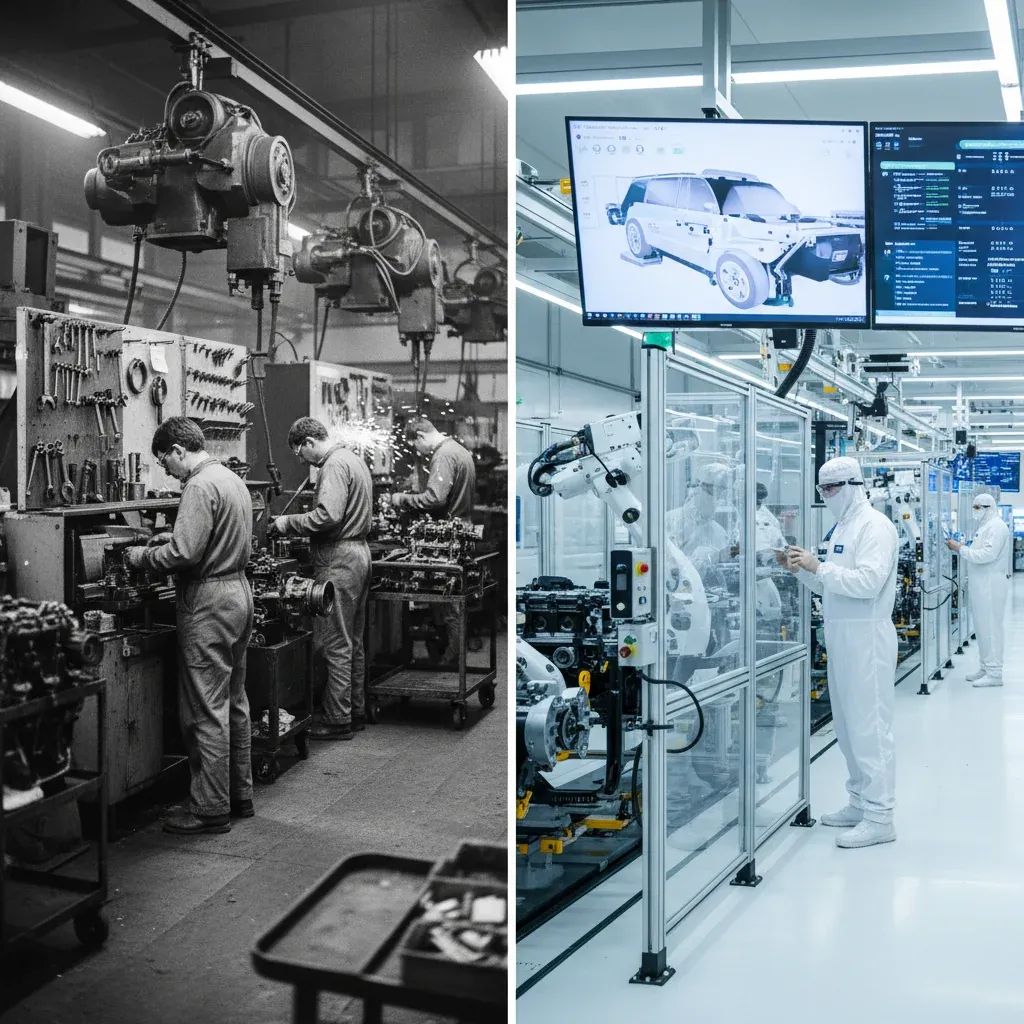
The Museo Nazionale dell'Automobile in Turin is presenting a unique retrospective that traces not just automotive production but the enduring relationship between workers and machines—a final photographic testimony from one of Italy's most influential industrial documentarians. Mimmo Frassineti's work, spanning six decades, captured a disappearing world of human precision within factory walls, and his last commission, completed just weeks before his death in February 2026, stands as a powerful reflection on how manufacturing has and hasn't changed over 45 years.
Why This Matters
• Final exhibition opens May 3, 2026: Over 40 photographs compare Frassineti's 1980 and 2024 Ferrari Maranello shoots, offering a rare institutional comparison of Italian manufacturing across nearly half a century.
• **Preserved through CDP's digitization project: More than 20,000 historical images from Cassa depositi e prestiti now document Italy's post-war industrial growth, accessible through ongoing cultural initiatives.
• Turin as the final venue: The exhibition completes a geographic circuit through Modena (Ferrari's birthplace), Rome (CDP's institutional home), before settling at the automotive capital's premier museum.
How Italian Industrial Photography Became Serious Art
Frassineti's journey parallels a broader shift in how Italy regarded its own manufacturing. After training in art history at Rome's Università La Sapienza and working as a cinema and television set designer, he moved into photojournalism with a freelancer's hunger for documentation. In 1976, he co-founded AGF (Agenzia Giornalistica Fotografica), which quickly became essential to Italian visual journalism, while simultaneously beginning a long collaboration with La Repubblica.
His international assignments—covering conflicts and daily life across the Middle East, Africa, Asia, and the Americas for National Geographic, Time, and Stern—made him a recognized name. Yet it was the factory floor, not the war zone, that became his consuming interest. The assembly line's rhythm, the precision in workers' hands, the moment when a part fits perfectly—these were the subjects that kept him returning to Italian manufacturing sites for 45 years.
This focus reflected a cultural moment. Starting in the late 1970s, Italian scholars and photographers began treating the factory as a legitimate site of historical and aesthetic meaning. Pioneering books like La fatica dell'uomo (1979) and Storia fotografica del lavoro in Italia 1900–1980 positioned workers and machines as subjects worthy of serious documentation. Companies like Ansaldo began preserving their own visual archives as memoria visiva—visual memory—recognizing that photographs could preserve institutional identity in ways that balance sheets never could.
What Changed at Ferrari Between 1980 and 2024
The exhibition structures its 45-year comparison around seven conceptual pillars: Connessioni (connections between workers), Sintonia (harmony in production), Manifattura (handcrafted quality), Precisione (technical accuracy), Orgoglio (worker pride), Passione (emotional investment), and Pazienza (sustained patience). When viewed side by side, the 1980 and 2024 images tell a story not of wholesale rupture but of selective evolution.
The transformation is evident in the material conditions: robotics now handle repetitive tasks that humans performed in 1980. Climate-controlled clean rooms have replaced oil-stained concrete. Workers interact with touchscreen interfaces instead of hand-drawn assembly diagrams. Yet Frassineti's compositional eye remained unchanged—he still hunted for the concentrated face, the moment of individual judgment, the pride when precision meets outcome. The machines became more sophisticated, but the demand for human judgment didn't disappear; it transformed into different kinds of expertise.
This visual comparison matters because it complicates a common narrative about manufacturing. The photographs suggest that automation didn't eliminate the human element—it repositioned it. Where 1980 showed workers grinding, welding, and hand-assembling parts, 2024 shows technicians programming systems, inspecting quality through magnification, problem-solving in real time. Less physical strain; more cognitive responsibility. The work changed form rather than vanishing.
Italian automotive photography has a genealogy. Luigi Ghirri, another master of industrial documentation, photographed the same Maranello facilities in the 1980s, and those images were exhibited at the Mauto under the title Rosso Ferrari. Where Ghirri's work emphasized spatial relationships and used color to explore chromatic tensions, Frassineti's black-and-white aesthetic focused relentlessly on texture, gesture, and human endurance. The two photographers approached the same subject with different philosophical temperaments—Ghirri's compositions were almost dreamlike; Frassineti's were unflinchingly realist.
The Broader Role of CDP as Industrial Memory Keeper
The exhibition exists within Cassa depositi e prestiti's larger mission to digitize, preserve, and publicly share its institutional archives. Since 2019, CDP has undertaken the systematic recovery and digitalization of its holdings—a collection spanning the 1930s through the 1990s that documents how public financing supported Italy's post-war industrial transformation. The archive contains more than 20,000 photographs showing the textile networks of northern Italy, the steel mills of Liguria, the automotive clusters of Piedmont and Emilia-Romagna, and shipbuilding operations along the coasts.
Giovanni Gorno Tempini, CDP's president, framed the Frassineti exhibition as evidence of the institution's commitment to "valorizing artistic patrimony" and stewarding "a highly significant photographic archive." CDP operates a corporate museum in Rome, established in 2019, which houses 17th- to 19th-century artworks alongside mid-century commissions created for the avant-garde periodical Civiltà delle Macchine—publications that attempted to reconcile modernism with industrial culture.
Since its establishment in 2020, Fondazione CDP—the philanthropic arm of the larger institution—has directed funding toward cultural preservation and grassroots initiatives, particularly in southern Italy. In 2025, the foundation launched a €1 million competition for "Ecosistemi Culturali al Sud Italia" (Southern Italian Cultural Ecosystems), targeting municipalities across Campania, Puglia, Basilicata, Calabria, Sicily, Sardinia, Abruzzo, and Molise. Projects run between 24 and 36 months, with selections expected by June 2026.
A separate initiative, "Per l'Italia del futuro," allocated approximately €5 million to support heritage valorization projects connected to the centenary of Postal Savings Bonds. Third-sector organizations applied by April 30, 2025, with funded projects scheduled to begin by September 2025 and run for 12 to 24 months. These programs suggest that CDP is institutionalizing the preservation and public presentation of Italy's cultural and industrial heritage as a long-term mission rather than a one-off exhibition strategy.
What This Means for Residents
For those living in or visiting Turin, this exhibition offers access to a rare institutional dialogue: not just between two moments in manufacturing history, but between a master photographer's early and late vision. The Mauto, located at Corso Unità d'Italia 40, is already one of Europe's most comprehensive automotive museums; this exhibition extends its scope into visual anthropology and industrial memory.
The inclusion of Arnaldo Pomodoro's sculpture La Colonna del viaggiatore (The Traveler's Column)—normally held in CDP's Rome museum—adds a contemporary art dimension. Pomodoro, now 99 years old, remains among Italy's most recognized living sculptors internationally, and his presence underscores the curatorial ambition to treat industrial photography as fine art rather than mere documentation.
Benedetto Camerana, the Mauto's president, described the exhibition as "another chapter" in the museum's longtime Ferrari partnership and "the beginning" of institutional collaboration with CDP—characterizing the latter as "a primary national institution that, like us but on a much broader scale, looks to history and the preservation of this country's industrial cultural heritage."
The choice of Turin as the final venue is significant. The city's identity as Italy's automotive capital—home to Fiat's historic factories and design studios—makes it the logical endpoint for an exhibition that began in Modena (Ferrari's manufacturing epicenter) and passed through Rome (CDP's institutional base). The geographic triangle mirrors the distribution of Italian automotive and financial power.
For cultural visitors and residents interested in industrial heritage, the exhibition runs through May 3, 2026, with standard museum admission and accessibility via Tram 9 and Bus 35 from central Turin. Given CDP's ongoing digitization initiatives, portions of the archive may eventually become publicly accessible online, though no digital portal has been formally announced. Future exhibitions and resources will likely emerge from the foundation's 2025–2026 cultural funding calls, results due by mid-2026.
Why This Photography Still Resonates
In an era when Italian manufacturing faces pressure from automation, offshoring, and fragmented global supply chains, Frassineti's final work presents both a nostalgia and a quiet argument about irreplaceable value. The photographs suggest that while machinery transforms—becomes cleaner, faster, more precise—the irreplaceable human element—judgment, patience, the embodied knowledge that comes from repeating a task 10,000 times—persists in different forms.
The photographer died at 83, having worked for 60 years. His last commission proved his final statement: that even as factories modernize beyond recognition, the relationship between a worker and their work remains the essential constant. The machines change; the need for human precision and care does not.


