
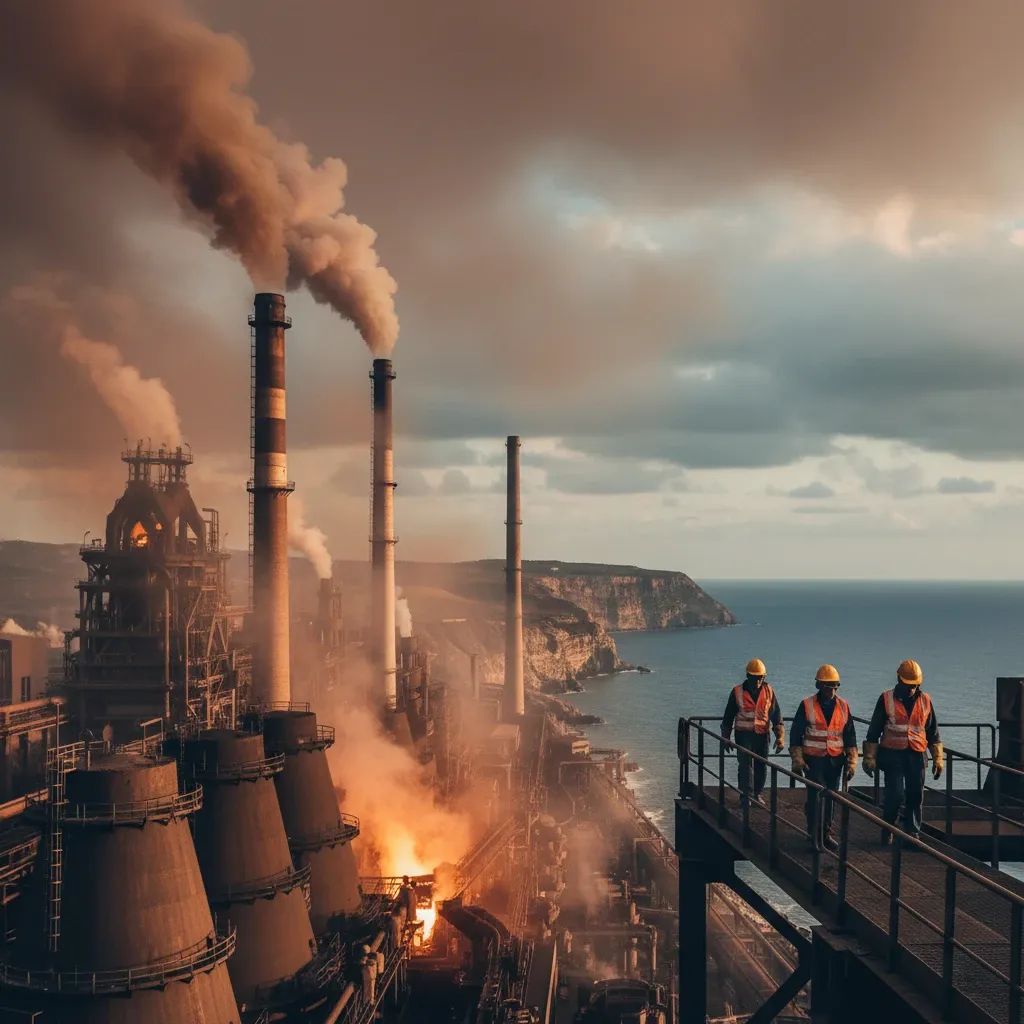
The Italian government has scheduled two high-stakes meetings in early September to address the fate of the former Ilva steel plant in Taranto and the wider economic future of the southern port city, a move that could determine whether thousands of jobs are saved or lost in one of Italy's most environmentally devastated industrial zones.
Why This Matters
• Jobs on the line: Up to 8,000 direct employees and an additional 3,000 workers in the supply chain face unemployment if the steel plant's closure proceeds as ordered by a Milan court.
• National steel production: Prime Minister Giorgia Meloni has declared maintaining steel production capacity a national priority, signaling the government views the crisis as more than a local issue.
• September deadline: Two separate roundtables will convene at Palazzo Chigi in the first week of September — one to review bids for the plant, another to explore alternative economic development for Taranto.
• 90-day clock ticking: A court ruling from late July ordered the shutdown of the plant's "hot area" within 90 days due to environmental violations, with the deadline arriving in late October.
Government Elevates Taranto Crisis to National Priority
In a letter to Prefect Ernesto Liguori responding to a request from local business associations, Prime Minister Meloni outlined a dual-track approach to the Taranto crisis. The first roundtable, coordinated by Undersecretary Alfredo Mantovano and involving multiple cabinet ministers, will examine the various expressions of interest submitted in recent weeks for the plant's future ownership and operational structure. The second, running in parallel, will focus exclusively on diversifying Taranto's economy through new entrepreneurial investments that can function independently of the steelworks.
Meloni emphasized that the meetings would include national union leadership, regional representatives from Puglia, and local authorities, giving the discussions the weight and visibility of a national-level crisis response. "This constitutes both a problem and a national commitment," she wrote, guaranteeing that preserving a significant steelmaking capacity remains a government objective of national importance.
Her intervention came as President Sergio Mattarella issued a message to the Quotidiano di Puglia newspaper ahead of the 20th Mediterranean Games, which Taranto is hosting. Mattarella described the city as "custodian of historical, cultural, and artistic heritage of inestimable value" but acknowledged residents have faced "dramatic aspects of employment and health, economic development and quality of life" in recent times. The choice of Taranto to host an international sporting event, he noted, reflects the city's role within the Republic and offers hope that the games will help Taranto "embrace the future."
Court Order Forces Reckoning on Pollution Legacy
The urgency driving these September meetings stems from a Court of Appeal in Milan ruling issued in late July that ordered the closure of the plant's critical "hot area" — encompassing blast furnaces, coking facilities, and sintering plants — within 90 days. The court cited ongoing environmental and health hazards, particularly related to asbestos and fine particulate emissions, that continue to plague the facility despite decades of promised remediation.
This section of the plant is essential for primary steel production. Without it, the Taranto site cannot function as an integrated steelworks, effectively rendering it incapable of producing raw steel from iron ore. The decision has placed the government in a bind: how to maintain Italy's strategic steelmaking capacity while addressing court-mandated environmental compliance that appears technologically and financially out of reach in the short term.
The plant has been under judicial seizure with permission to operate since 2012 due to severe pollution. Studies have linked emissions to an estimated 90 excess deaths per year in Taranto's population between 2004 and 2010, with elevated rates of lung cancer, respiratory disease, and cardiovascular illness documented in surrounding neighborhoods. Among workers, over 2,000 occupational illnesses have been recognized by INAIL and local health authorities between 2005 and 2024, including 934 tumor cases.
Italian Steel Consortium Offers Partial Solution
In response to the court ruling, a consortium of 14 Italian steel companies, organized under the industry association Federacciai, submitted an expression of interest to acquire the former Ilva facilities — but explicitly excluding the hot area in Taranto. Their proposal envisions a new company (newco) that would focus on the "cold area" of production, processing steel slabs into finished products.
The consortium has requested that all legal, environmental, and social liabilities tied to the hot area remain the responsibility of the Italian state. The proposal has been welcomed by the government as at least a partial path forward, though it leaves unresolved the question of primary steelmaking capacity and the fate of workers tied to blast furnace operations.
It remains unclear whether other bidders have emerged. Speculation earlier in 2026 mentioned interest from an American fund, Flacks Group LLC, and the Indian steelmaking giant Jindal Steel International, though no confirmed offers from these parties have been publicly disclosed as of late August.
What This Means for Residents and Workers
For Taranto's residents, the September roundtables represent a make-or-break moment in a decades-long saga. The city has lived under the shadow of the Ilva plant for generations, benefiting from employment but suffering disproportionate rates of illness and environmental degradation. Infant mortality in Taranto stands at 3.7 per 1,000, significantly above the national average of 2.5, and cancer incidence in the Tamburi and Paolo VI neighborhoods is 70% higher than the city average.
The unions — including Fim-Cisl, Fiom-Cgil, Uilm, and USB — have described the situation as a "social bomb without precedent" and appealed directly to President Mattarella for intervention. They are demanding immediate measures including a moratorium on layoffs, income protection for workers, a clear industrial plan, and guarantees for environmental remediation. The unions also stress the urgent need to diversify Taranto's economy so it no longer depends solely on steelmaking.
Business associations estimate that 3,000 jobs in the supply chain are at immediate risk, with several supplier companies preparing for collective dismissal procedures. Combined with the roughly 8,000 employees of Acciaierie d'Italia (the plant's current name under extraordinary administration) and an additional 1,500 workers tied to the legacy Ilva entity, the total workforce potentially affected exceeds 12,000.
Mediterranean Games Offer Symbolic Renewal
The timing of the crisis coincides with Taranto's hosting of the 20th Mediterranean Games, an international multi-sport event that has brought significant infrastructure investment and global attention to the city. Both Mattarella and Meloni have highlighted the games as a symbol of Taranto's potential beyond heavy industry. Meloni noted in her letter that the sporting event is "the result of a financial and organizational commitment that involved the government first and foremost."
There is cautious optimism that the investments made for the games — in sports facilities, transportation, and urban renewal — could serve as a foundation for long-term economic diversification. However, activists and residents worry that the celebratory atmosphere surrounding the games may distract from the immediate employment and health crises facing the city.
Decades of Failed Promises and Broken Deals
The former Ilva's tortured history has been marked by repeated efforts to balance industrial production with environmental compliance, nearly all of which have fallen short. In December 2020, the Italian state entered a public-private partnership with steelmaking giant ArcelorMittal, with the state-owned investment vehicle Invitalia acquiring a 60% stake in the plant. The deal envisioned €1.08 billion in investments and a production target of 8M tonnes of steel by 2025, incorporating low-carbon technologies.
By January 2024, however, the relationship had collapsed. The government proposed a capital increase to raise Invitalia's stake to 66%, but ArcelorMittal refused further financial commitments. The company exited management the following month, and the facility was placed under extraordinary administration — a form of state-supervised bankruptcy protection.
By March 2025, the plant was described as in "complete stall," with furnaces often shut down or operating at minimum capacity. The European Commission had approved a €390M bridge loan in February 2026 to keep operations afloat, recognizing the strategic importance of the facility and its workforce, but those funds have done little to resolve the underlying legal and environmental impasse.
What Comes Next
The September roundtables will determine whether the Italian government can broker a deal that preserves some steelmaking capacity while addressing judicial mandates and public health concerns. The October deadline for shutting down the hot area looms large, and failure to act could trigger mass layoffs and the effective end of primary steel production in Taranto.
For residents, the choice is stark: accept the continued health risks of an operating plant or face the economic devastation of its closure. The government's promise of a dedicated roundtable for economic diversification offers a glimmer of hope, but decades of failed remediation efforts and broken industrial promises have left many skeptical that this time will be different.


