
The Italy national delegation will field 498 athletes when the Mediterranean Games open in Taranto in 11 days, making it the largest contingent among the 26 participating nations—and positioning the country as a frontrunner in a competition that promises to reshape southern Italy's sporting infrastructure and economic trajectory for decades to come.
Why This Matters:
• €350M in public investment has transformed nearly 30 sporting venues across Puglia, creating facilities that rival Serie A standards
• Opening ceremony tickets sold out in 4 days, signaling unprecedented public interest in the region
• 200,000 visitors expected between August 21 and September 3, providing a major boost to local tourism and business
• President Sergio Mattarella will preside over the inaugural ceremony at Stadio Erasmo Iacovone on August 21
A 30-Year Wait Ends for Puglia
Carlo Molfetta, the Games' director general and a 2012 Olympic gold medalist in taekwondo, describes the regional capital as a city "in ferment"—a place that "doesn't yet know exactly what to expect" but is experiencing a mix of "frenzy, restlessness, and happiness" as the countdown accelerates. The last time Puglia hosted this scale of international competition was 1997, when Bari welcomed the Mediterranean Games. But the sporting landscape has transformed beyond recognition since then.
"Today an event like this has an organization and an impact that aren't even remotely comparable to what we saw three decades ago," Molfetta explains from his office in Taranto. "This is an enormous opportunity not just for Taranto specifically, but for all of Puglia."
The numbers support his optimism. Nearly 4,000 athletes from 26 National Olympic Committees, plus four representatives from Athletica Vaticana, will descend on the region for two weeks of competition. Prime Minister Giorgia Meloni is expected to attend alongside President Mattarella, cementing the political significance of an event that many view as a test case for post-industrial regeneration in Italy's deep south.
Infrastructure Legacy: Beyond the Headlines
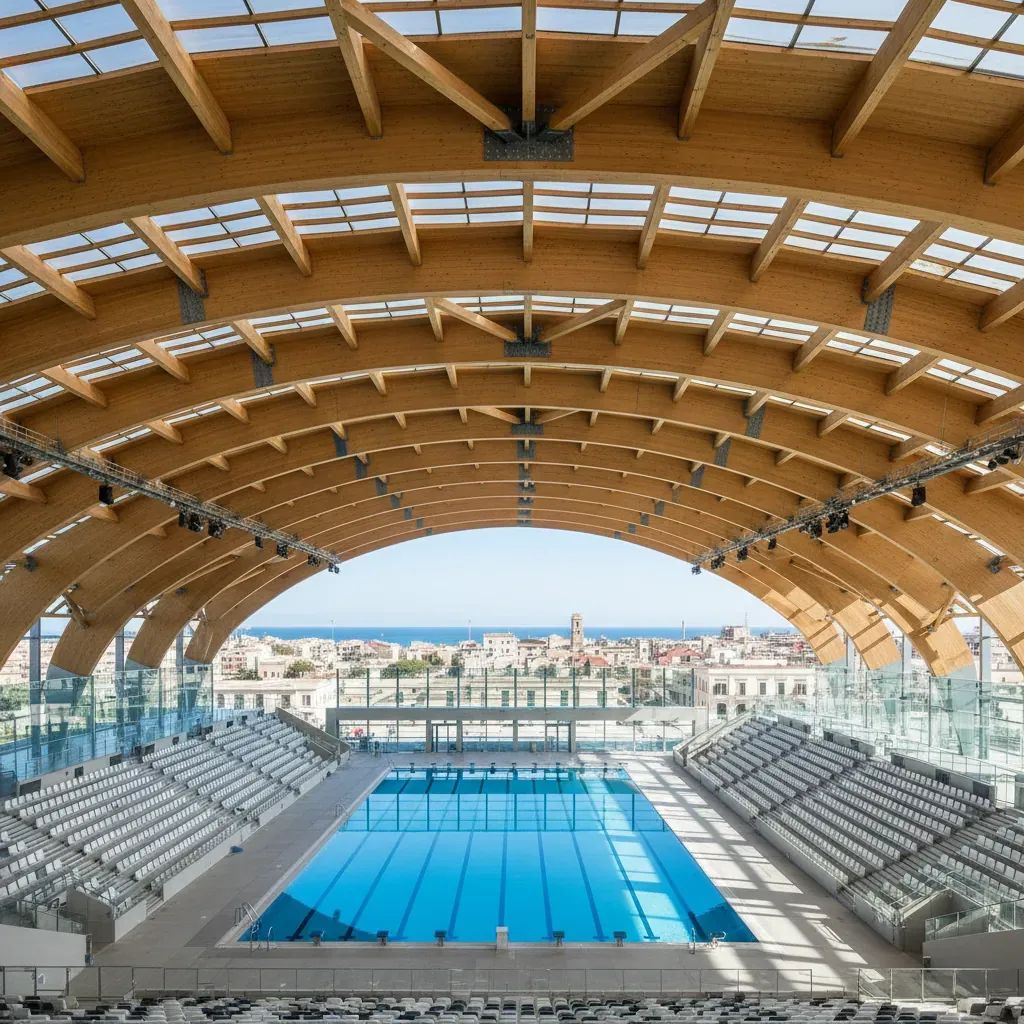
The physical transformation of Taranto and surrounding municipalities represents the most tangible legacy of the Games. The Stadio del Nuoto Torre d'Ayala, positioned dramatically along the Mar Grande waterfront, now boasts two Olympic-standard 50-meter pools—one covered, one open-air—with seating for 2,000 spectators and a timber roof fitted with photovoltaic panels. Swimming events will run from August 22 to 25, with 35 titles at stake.
"In the Puglia territory, you cannot find two Olympic pools anywhere else," Molfetta notes. "The stadium is a jewel of cutting-edge design that many Serie A teams would envy. The tennis complex has 7 courts and a center court with 1,500 seats. These are structures that will leave the territory something important for organizing international events of any kind in the future."
The PalaRicciardi, a nearly-zero-energy building covering 22,170 square meters, will serve as a multipurpose venue for athletics, basketball, and cultural events long after the closing ceremony. The refurbished Erasmo Iacovone stadium has become a symbol of the city's infrastructural rebirth. In addition, over 40,000 square meters of athletic surfaces—including running tracks, synthetic turf, and specialized flooring for basketball and padel—have been installed across venues in Fasano, San Giorgio Jonico, Avetrana, Lecce, Martina Franca, and beyond.
Extraordinary Commissioner Massimo Ferrarese has publicly acknowledged the tight deadlines. Some projects, including the roller-skating track in Parco Urbano della Salinella, required deadline extensions to August 27. Yet the overall pace of completion has surprised even skeptics.
What This Means for Residents
For people living in Puglia, the Games represent more than two weeks of elite sport. The new and renovated facilities are designed for year-round public use, providing training grounds for local clubs, educational programs for schools, and recreational spaces for families. Medical-sports clinics, gyms, and open-access areas will remain available to the community indefinitely.
The €5.5M earmarked for urban improvements—including a new park with spray fountains, streetscape upgrades, and port-area beautification—aims to improve daily life in neighborhoods that have long struggled with post-industrial decline. Accessibility upgrades, including barrier-free design at venues like the Renzino Paradiso stadium in Talsano, ensure broader public participation.
Economically, the influx of 200,000 visitors is expected to provide a significant short-term boost to hotels, restaurants, and service providers. But the longer-term play involves positioning Taranto as a destination for sports tourism and international competitions, leveraging the new infrastructure to attract events that bring sustained revenue and global visibility.
The Italy government has committed specific funding to compensate police forces deployed for security operations across Taranto and neighboring provinces in Bari, Brindisi, and Lecce from August 17 through September 4, underscoring the scale of the logistical challenge.
Italy's Medal Hunt and the Competition Ahead
Molfetta is cautiously optimistic about Italy's medal prospects. The home delegation includes Olympic champions and world titlists across multiple disciplines, and the country has historically dominated the Mediterranean Games, finishing first in the overall medal count 14 times out of 19 editions. At the most recent Games in Oran, Algeria, in 2022, Italy claimed 159 medals—48 gold, 50 silver, and 61 bronze—comfortably ahead of Turkey's 108.
But the competition will be fierce. Turkey is sending 332 athletes, France 330, and Spain 249. Turkey finished second in Oran and has shown consistent growth, while France and Spain have strong historical records in Mediterranean competition. "I hope the result is no different from the last Mediterranean Games when we won the medal table," Molfetta says, "but it's not easy with Spain, France, and Turkey. I hope that home support gives all our athletes an extra gear."
The View from the Other Side
Now 42, Molfetta won his Olympic gold in London on August 11, 2012, overcoming a 6-0 deficit against Gabon in the taekwondo final to stage a dramatic comeback. He admits to feeling "a bit of envy" watching the athletes prepare, but his focus is firmly on the organizational challenge.
"When you cross to the other side, it's easy to forget what you did as an athlete or who you were, with a vision 'only' as an executive," he reflects. "But if you don't forget, you can add value to the organization by putting yourself in support of the athletes."
That philosophy has shaped his leadership style. The memories of his own final remain vivid: the stress, the nervousness, the moment he faced defeat and refused to accept it. "What I remember is what I am: never give up, because before the end you can always do anything," he says. "And that's what I carry with me in my present role as director general: moving forward toward the goals even in difficulties, without looking anyone in the face."
As the August 21 opening ceremony approaches, that resilience will be tested. But for Taranto, for Puglia, and for the 498 athletes preparing to represent Italy on home soil, the stakes have never been clearer. This is not just a sporting event—it is a blueprint for regional transformation, a €350M bet that infrastructure and ambition can rewrite the future of Italy's industrial south.


