
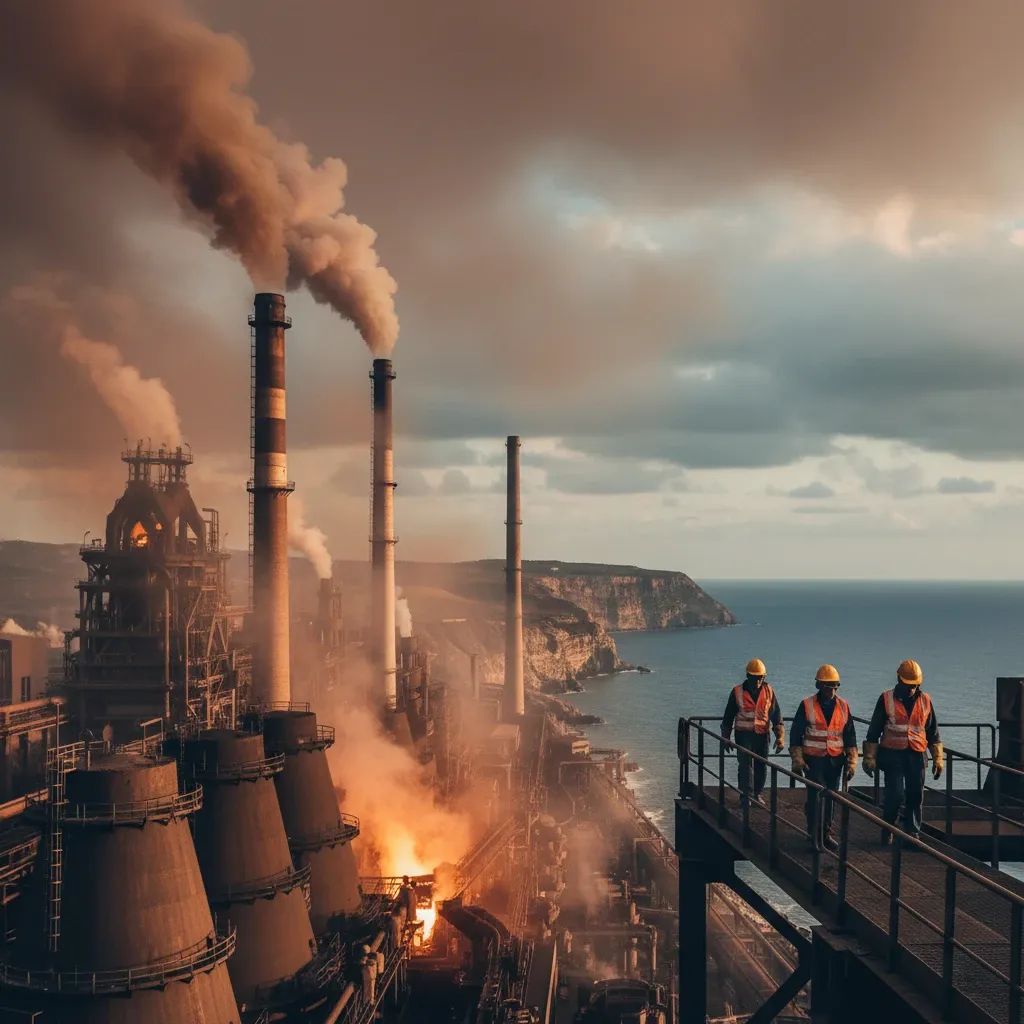
The Italy Ministry of Enterprises and Made in Italy has instructed legal counsel to explore grounds for appealing a Milan court order that threatens to shut down the former Ilva steelworks in Taranto within 90 days unless environmental hazards are eliminated. The directive, delivered by Minister Adolfo Urso, marks a turning point for one of Europe's most contentious industrial disputes—a battle between jobs and public health that has paralyzed southern Italy's largest employer for over a decade.
Why This Matters
• 90-day deadline: The Milan Court of Appeal ruled July 27 that the hot area must close unless asbestos is removed and airborne particulate emissions drop below safety thresholds.
• Thousands at risk: The indotto—supplier firms servicing the steel plant—warned of mass layoffs and production halts if the ruling stands.
• Government pushback: Italy is considering a Cassation appeal and emergency decree to manage the transition, though legal experts say blocking a court order outright would be unconstitutional.
The Ruling That Changes Everything
On July 27, 2026, the Milan Court of Appeal issued a peremptory and immediately enforceable decision ordering the suspension of operations at the hot rolling area of the former Ilva complex in Taranto. The judges demanded full asbestos removal and verified compliance with PM10 and PM2.5 limits—benchmarks the plant has repeatedly failed to meet despite possessing an updated Integrated Environmental Authorization (AIA) issued in 2025.
Unlike prior rulings, which could be sidestepped with administrative reviews or ministerial extensions, this judgment is final at the appellate level and executable. The court explicitly stated that health rights supersede production rights, even when companies hold valid operating permits. The decision aligns with a June 2024 ruling by the European Court of Justice, which bars member states from indefinitely postponing environmental safeguards when grave dangers to human health are documented.
The Milan judges cited ongoing failures: inadequate monitoring of fine particulate matter, insufficient protections during high-wind episodes, and lackluster management of refining gases and coke emissions. They noted that residents in neighborhoods adjacent to the steelworks continue to face elevated risks of respiratory illness and cancer, a reality confirmed by ASL Taranto epidemiological data showing statistically significant excesses in lung cancer mortality, respiratory hospitalizations, and oncological incidence.
What This Means for Workers and the Regional Economy
Taranto's steel industry directly and indirectly sustains tens of thousands of jobs across the Puglia region. The former Ilva remains the largest private employer in Italy's Mezzogiorno, and its supplier network—spanning logistics, maintenance, engineering, and raw materials—depends almost entirely on the plant's hot area remaining operational.
Confindustria Taranto, the regional employers' federation, convened an emergency meeting at the Ministry in Rome. President Salvatore Toma relayed that Minister Urso has authorized lawyers representing the commissari straordinari (special administrators overseeing the bankrupt Acciaierie d'Italia entity), the Ministry itself, and regional and municipal governments to assess whether appellate remedies exist.
Business associations including Confapi, AIGI, Confartigianato, and Federmanager have described the scenario as "unprecedented" and warned that some suppliers have already announced suspensions. They reject any "mini Ilva" strategy involving mass redundancies, instead advocating for a national industrial transition plan anchored by public ownership, gradual decarbonization through electric arc furnaces, and a Direct Reduced Iron (DRI) facility.
The Ministry has disclosed that 17 investment proposals worth over €2 billion have been submitted to diversify Taranto's economy across eight sectors, potentially creating more than 1,000 new positions. Yet these initiatives cannot offset an abrupt steelworks closure, which would trigger what local officials call "social catastrophe."
Legal Pathways and Constitutional Limits
Italy's judicial system permits multiple levels of review. The Corte di Cassazione (Supreme Court) hears appeals on questions of law, not fact, and could theoretically suspend enforcement pending its decision. However, government sources have cautioned that issuing a decree to nullify the Court of Appeal's order would violate constitutional principles of judicial independence.
Legal advisers to the supplier associations have floated the argument of extra petizione—a procedural defect whereby a court grants relief beyond what plaintiffs requested. The Milan ruling stemmed from a citizens' lawsuit demanding environmental protections, not plant closure per se; the judges imposed the 90-day deadline as a coercive measure to force compliance.
Precedent exists for Cassation appeals in the Ilva saga. In earlier phases, the special administrators contested enforcement orders by arguing that administrative procedures were still pending. The Supreme Court has yet to rule definitively on whether a court can order production halts when an AIA—even an outdated or contested one—is formally in place.
A separate avenue involves the Constitutional Court, should parties argue that emergency legislation conflicts with fundamental rights. Italy's European Court of Human Rights has already ruled against the state once in the Ilva matter, finding in a landmark decision that prolonged pollution constituted a violation of Article 8 (right to private and family life).
Political and Economic Calculus
Minister Urso has publicly stated that steel output at Taranto rose significantly in 2025 and continued to climb in the first quarter of 2026, signaling improved operational stability under state administration. He has promoted the possibility of an Italian consortium taking over the plant, backed by a €2 billion capital injection.
Indian conglomerate Jindal, once considered a frontrunner, suspended acquisition talks following the July ruling, insisting it would only proceed under a fundamentally revised legal and industrial framework. Meanwhile, the government approved a €100 million bridge loan to keep the facility solvent through the summer.
Don Antonio Panico, vicar of the Diocese of Taranto, has called for a "decree salva Taranto" (save-Taranto decree), arguing that for 14 years the state has rescued the company but abandoned the city. He pointed to health studies linking decades of unchecked emissions to elevated mortality, even during periods when the plant nominally respected statutory limits.
Environmental advocates counter that chronic exposure to benzopyrene, dioxins, and heavy metals has contaminated agricultural land, poisoned livestock milk, and forced fishing bans in the Mar Piccolo inlet. Taranto's population has declined steadily, a demographic signal of entrenched distress.
Next Steps and Unanswered Questions
The Ministry has proposed establishing a working group to identify the most exposed firms and laborers, preparing targeted relief measures if the shutdown proceeds. Whether such support would include wage guarantees, relocation assistance, or retraining programs remains unclear.
Industry groups insist that a managed transition is the only sustainable path—one that couples environmental remediation with continued production under strict monitoring, phased asbestos removal, and investment in cleaner steelmaking technologies. They argue that shuttering the hot area without a fallback plan would not remedy pollution; it would simply relocate jobs and economic activity abroad, leaving Taranto with neither industry nor health improvements.
Legal experts expect a Cassation filing within weeks, potentially triggering a stay of execution. If the Supreme Court declines to intervene, or if it upholds the Milan ruling, the Italian government faces a stark choice: defy a judicial order and risk constitutional crisis, or accept the closure and manage the resulting economic fallout.
For residents of Taranto, the debate has long ceased to be abstract. The question is no longer whether the plant can be saved, but whether a city can.


