
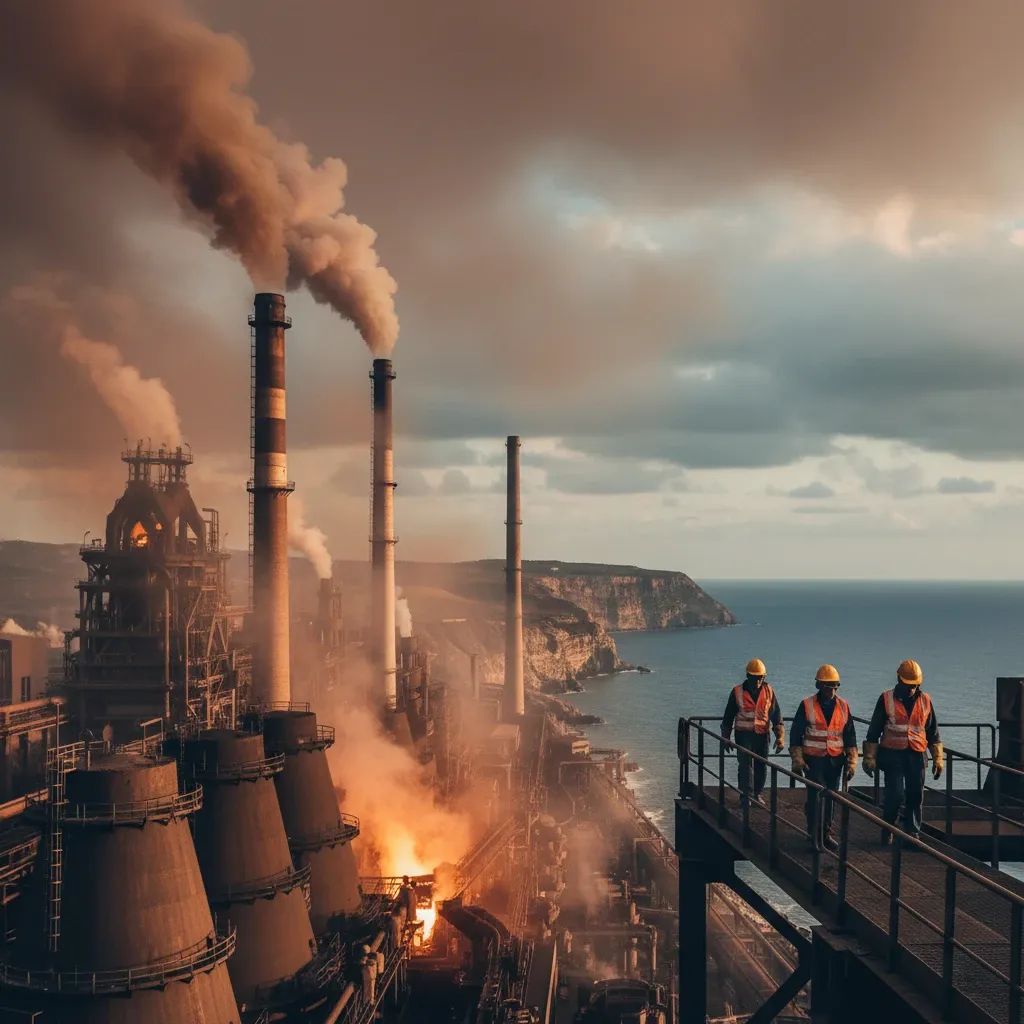
The Italy Cabinet has launched an emergency intervention to prevent the collapse of the country's largest steel producer, approving a 100.5 M€ lifeline for Acciaierie d'Italia—the rebranded former Ilva—and ordering a fast-track industrial rescue plan following a court ruling that threatens to shut down the Taranto plant within three months.
Why This Matters:
• Job security at risk: Over 10,000 direct jobs and thousands of contractor positions hang in the balance across Taranto, Genova, and Novi Ligure as the Milan Court of Appeals ordered the closure of the hot production area within 90 days unless asbestos removal and emissions cuts are completed.
• Industrial continuity challenged: The ruling effectively forces the government to redesign the ongoing sale process, originally targeting the entire complex. The new tender will likely focus only on cold-rolled operations.
• Nationwide ripple effect: Genova and Novi Ligure sites depend on hot-rolled coils from Taranto. A shutdown in the south means cascading production halts across northern plants serving automotive and appliance manufacturers.
• Strike action begins July 29: All unions called eight hours of work stoppages at every Acciaierie d'Italia facility to demand concrete protections and a special law for Taranto.
Government Scrambles to Rewrite Sale Strategy
The July 27 ruling by the Italy Court of Appeals in Milan fundamentally upended the sale timeline for Acciaierie d'Italia. The court identified over 2,000 kg of residual asbestos in the Taranto hot area and ordered immediate emissions reductions—a task company officials say is technically impossible to complete in 90 days.
In response, Italy Prime Minister Giorgia Meloni convened an urgent Cabinet session on July 27, unlocking emergency funding and setting in motion a technical working group under the Ministry of Enterprises and Made in Italy (Mimit), scheduled to begin meetings on July 29. The working group will include representatives from Puglia Region, the Taranto municipality, labor unions, and multiple ministries—Economy, Labor, and Enterprise.
Undersecretary to the Prime Minister Alfredo Mantovano led an eight-hour marathon negotiation at Palazzo Chigi on July 28 with union leaders from Fiom-Cgil, Fim-Cisl, Uilm-Uil, Ugl Metalmeccanici, Usb, and Federmanager. He emphasized that the government is not treating the situation as adversarial but acknowledged the tight timeline: "We are not throwing in the towel, but we must not see ourselves as opposing sides."
The Cabinet's emergency decree provides the 100.5 M€ bridge loan to ensure business continuity while the new plan is drafted. Officials described it as a financial buffer for the cold-rolled division, which remains operational and generates revenue, particularly from galvanized steel for automotive clients.
What the "Extraordinary Plan" Means for Workers
The term "piano straordinario"—extraordinary plan—was repeated throughout the Palazzo Chigi talks, but its contents remain largely undefined. The government committed to presenting concrete proposals within a month, with technical sessions running through August.
Union leaders laid out explicit demands:
• A central and direct role for the Italian State in managing the industrial future of the complex, with some factions—especially Usb—pushing for full nationalization.
• Extraordinary wage protections and compensation measures for workers facing layoffs or reduced hours.
• A special legislative framework for Taranto to address the unique environmental, economic, and social challenges of the city, which has been heavily dependent on steel production for decades.
Ferdinando Uliano, secretary general of Fim-Cisl, warned that shutting down the hot area would automatically trigger the closure of cold-rolled operations. "Closing the blast furnaces means closing Genova and Novi Ligure as well. Those sites are conditioned by what happens in Taranto, so preventing the closure becomes an absolute necessity," he explained.
Michele De Palma of Fiom-Cgil underscored the existential stakes: "This isn't a normal negotiating table. We have a court sentence that says everything shuts down in 90 days. Closing the hot area means closing the entire ex-Ilva. This time must be used to guarantee solutions for workers and industrial continuity."
Davide Sperti, general secretary of Uilm-Uil, called for unity beyond factional disputes. "Ninety is a number that can frighten," he said, adding that the government must take full responsibility for guiding the process with transparency, resources, and a strong public presence. "There is no more room for delays or partial solutions."
The unions announced a coordinated strike for July 29, spanning all Acciaierie d'Italia sites, with assemblies and information sessions planned to mobilize rank-and-file support.
Impact on Northern Steel Plants
The interdependency between Taranto's hot production and the finishing plants in Genova-Cornigliano and Novi Ligure has become the focal point of regional concern. Both sites process hot-rolled coils shipped from the south into value-added products for demanding industries—automotive, appliances, and construction.
Novi Ligure employs roughly 545 workers, a third of whom are already rotating through layoff schemes. Local union representatives say the court ruling will bring "additional redundancies" and extended use of wage-guarantee programs (cassa integrazione) if Taranto's furnaces go cold.
Genova faces a similar reality. The Liguria Region government issued statements reaffirming that Cornigliano remains a strategic asset and that it is coordinating with the national government to safeguard jobs. The ruling has revived discussions of a "split scenario"—separating Taranto from the northern plants in future sale negotiations.
Officials in both regions worry that a prolonged shutdown or partial sale could leave cold-rolled sites without raw material supply, forcing buyers to source coils from foreign producers—a move that would undermine Italy's domestic steel value chain and erode competitive positioning in European markets.
Jindal Reaffirms Acquisition Interest with Conditions
Late on July 28, the India-based Jindal Group released a statement confirming its continued interest in acquiring the entire Acciaierie d'Italia perimeter—hot and cold operations—despite the turbulence caused by the Milan court ruling.
Jindal's commitment, however, is explicitly conditional on reaching agreements with the government and the extraordinary administration. The company's strategic vision centers on building a new carbon-free blast furnace in Taranto, which would address emissions concerns and align with European decarbonization mandates.
Press reports indicate that Jindal has raised its bid to approximately 4 B€, broken down as 1 B€ for the assets themselves and 3 B€ in reconstruction and modernization investments. The timeline for signing a framework agreement has been pushed back from late July to an estimated September or October window, reflecting the complexity added by the court's intervention.
The government had originally expected to present a preliminary deal outline to unions by July 28, but the judicial shock forced a pause and a broader reconsideration of sale parameters. The new tender—focused on cold operations—will require a fundamental rethinking of how the hot area is handled, possibly through state management or a parallel process.
No Extraordinary Appeal Against Milan Ruling
Mantovano clarified during the Palazzo Chigi summit that the government did not discuss filing an extraordinary appeal against the Milan court's decision, though the option remains theoretically on the table. "No one in the government will argue with the judiciary," he said, adding that he found it discordant when some plaintiffs described the ruling as "checkmate," saying "this is not a chess game."
The government's posture reflects a pragmatic acceptance that legal challenges could consume precious time and political capital without guaranteeing reversal. Instead, the focus has shifted to operational and financial measures that can be enacted quickly under existing authority.
Legal experts note that even if the government pursued an extraordinary appeal—a rare mechanism reserved for cases of exceptional public interest—the process would not automatically suspend the 90-day clock. That reality has concentrated minds on the industrial and labor response.
Usb Criticizes Government as "Political Surrender"
Not all unions are satisfied with the government's approach. The Unione Sindacale di Base (Usb) issued a statement labeling the Cabinet's response a "political and industrial surrender" and demanding full nationalization of Acciaierie d'Italia. Usb argued that the court ruling is the consequence of "fourteen years of errors and missed political choices" by successive administrations.
Usb representatives called for extraordinary protections for all workers—not just those in Taranto—and accused the government of treating the crisis as a negotiation rather than an emergency requiring decisive state intervention. The union's more radical stance reflects broader frustration in Taranto, where residents have endured decades of environmental degradation, health crises, and economic uncertainty tied to the steel plant.
What Happens Next
The technical working group begins formal sessions on July 29 at the Mimit headquarters in Rome, with a mandate to draft the extraordinary plan within one month. That plan will need to reconcile competing imperatives: environmental compliance, job preservation, investor confidence, and fiscal prudence.
The 90-day countdown is now the dominant constraint. If no viable solution emerges, the commissioner for Acciaierie d'Italia, Giancarlo Quaranta, will be forced to begin a phased shutdown of the hot area, a move that would cascade through the entire group and trigger mass layoffs.
For residents and workers across Taranto, Genova, and Novi Ligure, the next month will determine whether Italy's largest steel complex survives as an integrated operation or fractures into separate pieces—and whether the state steps in to reclaim control of an industry it privatized decades ago.


