
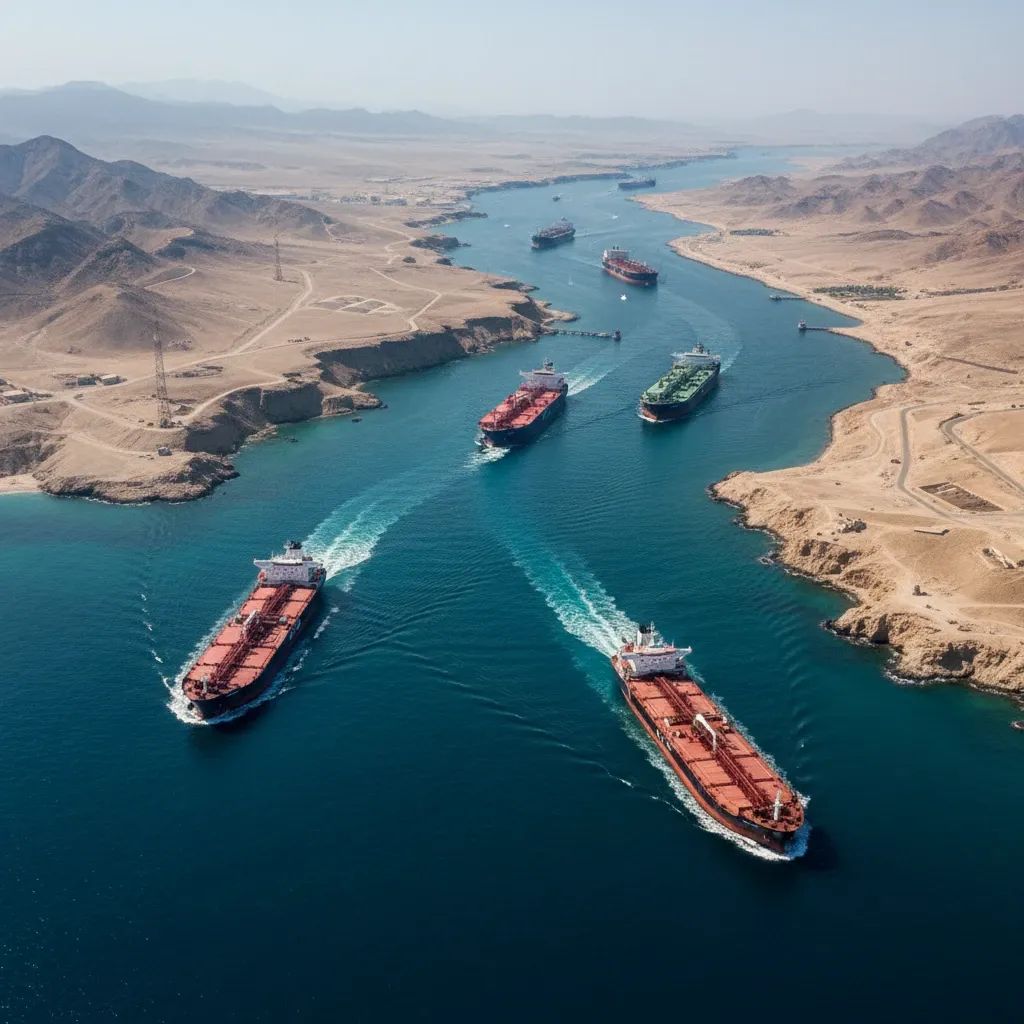
Iran's Revolutionary Guards have effectively choked off tanker traffic through the Strait of Hormuz, triggering a direct military confrontation with the United States that threatens to push global oil prices past $130 per barrel and disrupt supply chains across Europe and Asia. One tanker reportedly caught fire after an explosion while attempting passage through what Tehran now calls a "mined route," forcing two others to reverse course. The closure marks a dramatic escalation in a standoff that has already sent Brent crude above $92 and paralyzed one of the world's most critical energy arteries.
Why This Matters
• Energy security at risk: Roughly 20% of global oil consumption and one-fifth of liquefied natural gas pass through this 33-kilometer strait—the only maritime access for Gulf producers.
• Price shock incoming: Analysts warn Brent could hit $100–$150 per barrel if the blockade holds, driving up fuel costs, electricity bills, and inflation across Italy and the EU.
• Supply chain disruption: Ships rerouted around Africa face 10 extra days at sea and transport cost increases up to 15%, affecting everything from plastics to fertilizers.
• Military escalation: U.S. President Donald Trump has threatened to strike Iranian infrastructure—bridges or power plants—for every attack on shipping, while Iran vows to block "not a single drop" of oil if Washington follows through.
Iran Declares Full Control Over Strategic Waterway
In a statement carried by Iranian state media, Iran's Islamic Revolutionary Guard Corps (IRGC) announced it has established complete dominance over the Strait of Hormuz and will keep it "totally closed" as long as Washington continues what Tehran calls "aggressive actions" in the region. The Guards warned that any vessel attempting passage without coordination with the Islamic Republic would meet the same fate as the tanker that burst into flames.
"Three U.S.-backed tankers attempted to cross the mined route south of the Strait of Hormuz," the IRGC communiqué read. "After one tanker exploded and caught fire, the other two quickly turned around and withdrew." The statement underscores Iran's strategic calculus: leverage control over a chokepoint handling roughly 21M barrels of oil daily to counter American military pressure.
Iran's top military command, Khatam al-Anbiya, has escalated the rhetoric further. Brigadier General Seyyed Majid Mousavi issued a public warning that any U.S. strike on Iranian infrastructure—particularly bridges or power stations—would trigger immediate retaliation targeting regional oil, gas, and electricity facilities. "Should the United States proceed with their threats, the Armed Forces of the Islamic Republic will not permit the export of even a single drop of oil," the command declared.
U.S. Strikes Hit Multiple Iranian Provinces
Overnight, U.S. military forces launched raids across three Iranian provinces—Khuzestan, Hormozgan, and Bushehr—targeting operational centers, maritime infrastructure, drone hangars, and logistical hubs, according to reports from Al Jazeera and Iran's Mehr News Agency. The strikes represent Washington's most aggressive military response yet, aimed at degrading Tehran's ability to threaten civilian and commercial shipping.
In Khuzestan province in southwestern Iran, missiles struck at least three cities, including Ramshir, where an asphalt plant was reportedly hit, and areas adjacent to Ahvaz and Mahshahr, a major port city. In Hormozgan, explosions were heard in Sirik, a town with strategic overlook of the Strait itself. Perhaps most significantly, the governor of Bushehr confirmed an attack on an electrical substation near the Bushehr Nuclear Power Plant, causing several hours of blackout in the city. A U.S. missile strike also targeted a passenger terminal area in Shalamcheh, near the Iraqi border, though local officials told Mehr no casualties resulted and travelers continued to move through the crossing.
According to Iran's Ministry of Foreign Affairs, the Islamic Republic has already launched retaliatory drone and missile attacks against U.S. military bases in Jordan, Bahrain, and Kuwait, claiming significant damage and possible casualties. Unconfirmed reports also suggest Iranian forces attacked two vessels in the Gulf, resulting in one death and eight injuries.
Trump Threatens Infrastructure Strikes, Proposes 20% Transit Fee
President Trump has dramatically raised the stakes, threatening to hit an Iranian bridge or power plant—including facilities in or near Tehran—for every attack on shipping in the Strait. "Iran will pay a steep price and will be decimated," Trump declared, announcing the restoration of a naval blockade in the area. In a move that drew mockery from Tehran, the U.S. president also floated imposing a 20% toll on goods transiting the Strait, ostensibly to pay for American surveillance and escort services.
Iran's Foreign Minister dismissed the toll proposal with irony but took the infrastructure threats seriously. The IRGC has publicly vowed an "eye-for-eye" doctrine, promising that any strike on Iranian civilian infrastructure will be met with attacks on regional energy facilities belonging to U.S. allies.
What This Means for Italy and European Energy Markets
Italy, which imports a significant share of its refined petroleum products and relies on stable global oil prices to manage inflation, faces immediate economic fallout from the Hormuz crisis. Although Italy sources much of its natural gas from North Africa and Russia via pipeline, the country remains exposed to global oil price shocks that ripple through transportation, manufacturing, and electricity generation costs.
European natural gas prices could surge toward €90 per megawatt-hour if the conflict persists, putting fresh pressure on household energy bills and industrial competitiveness. Italy's inflation rate, which had been moderating, risks re-accelerating toward 4–5% if Brent crude sustains levels above $100. The Banco d'Italia has warned that prolonged energy volatility could shave as much as 0.5 percentage points off GDP growth in the second half of 2026.
Supply chain managers across Italy are already bracing for longer lead times and higher freight costs. Goods that normally transit the Strait—including 30% of global nitrogenous fertilizers, industrial chemicals, and electronics components—will have to be rerouted around the Cape of Good Hope, adding roughly 10 days to shipping schedules and pushing up logistics expenses by 10–15%. This will hit Italian importers and exporters alike, particularly in sectors like automotive, agriculture, and fashion that depend on just-in-time delivery.
Global Oil Markets on Edge, Strategic Reserves Deployed
Brent crude has already climbed past $92 per barrel, with traders pricing in the risk of sustained disruption to the roughly 17–18M barrels per day of crude and refined products that typically flow through Hormuz. The International Energy Agency (IEA) reports that advanced economies released 400M barrels from strategic reserves in March 2026 during the first Hormuz closure, but those stocks—equivalent to roughly 20 days of Strait throughput—are being drawn down at record pace and cannot substitute for structural trade over prolonged periods.
Asian markets face the most severe exposure. China, India, Japan, and South Korea collectively receive more than 80% of the oil transiting Hormuz, and alternative routes via pipeline can handle less than one-eighth of required volumes. Any sustained closure threatens to push Asian benchmark prices even higher, creating a cascading effect on global commodity markets.
Meanwhile, alternative infrastructure offers limited relief. The UAE and Saudi Arabia have built pipelines that bypass the Strait, but combined capacity remains well short of the 17–18M barrels per day needed to replace seaborne flows. Qatar, the world's largest LNG exporter, has no alternative export route, meaning any prolonged blockade could trigger shortages in European and Asian gas markets.
Historical Echoes: The Tanker War and Operation Praying Mantis
This is not the first time Iran has weaponized the Strait of Hormuz. During the Iran-Iraq War (1981–1988), both sides targeted merchant shipping in what became known as the "Tanker War." Iraq launched 283 attacks and Iran 168, aiming to cripple each other's oil revenues. Despite repeated threats, Iran never fully closed the Strait, recognizing its own dependence on those export routes.
Tensions peaked in April 1988 when a mine damaged the USS Samuel B. Roberts, prompting the U.S. to launch Operation Praying Mantis, the Navy's largest surface engagement since World War II. American forces destroyed two Iranian surveillance platforms, sank two Iranian vessels, and damaged another. The operation successfully deterred further Iranian mine-laying, though it did not end the broader conflict.
The current standoff carries echoes of that period but with higher stakes. Global energy demand is significantly larger, alternative suppliers more constrained, and geopolitical fault lines deeper. Unlike 1988, when a ceasefire eventually ended hostilities, no clear diplomatic path has emerged in 2026. The UN Security Council condemned Iran's March 2026 blockade but failed to pass a resolution demanding reopening of the Strait after Russia and China used their vetoes in April.
Diplomatic Efforts and International Coordination
Behind the military posturing, diplomatic channels remain active, though progress appears limited. The new Mossad chief, Roman Gofman, recently met with CIA Director John Ratcliffe in Washington to coordinate intelligence on Iran's nuclear program and regional activities. Italy and other European capitals have reportedly relaunched negotiations on broader Middle East stability, including efforts to de-escalate tensions in Palestine and Lebanon, in hopes of creating diplomatic space for a Hormuz resolution.
However, Iran's Foreign Ministry has called on the international community to hold Washington accountable for the crisis, arguing that U.S. military strikes and blockade threats violate international law. The U.S. Central Command (CENTCOM) maintains that the Strait remains open and claims to have facilitated passage of roughly 900 merchant vessels and 450M barrels of crude since early May—a figure that contradicts on-the-ground reports of near-total closure and ships shutting down engines and transponders to avoid detection.
Near-Term Outlook: Volatility and Uncertainty
For residents and businesses in Italy, the immediate priority is managing the economic fallout. Fuel prices at the pump are likely to rise in the coming weeks, and industries dependent on petrochemical feedstocks or global supply chains should prepare contingency plans for higher input costs and longer delivery windows. The Italian government has yet to announce specific relief measures, but pressure is building for targeted support to trucking, agriculture, and energy-intensive manufacturing sectors.
The Hormuz crisis underscores Italy's vulnerability to distant geopolitical shocks and the fragility of global energy infrastructure. While Europe has diversified its energy sources since the 2022 gas crisis, oil markets remain globally integrated, and disruptions in the Gulf reverberate quickly across the continent. Whether diplomacy can defuse the current standoff—or whether the cycle of strikes and counter-strikes escalates into a broader regional war—remains the defining uncertainty of the summer of 2026.


