
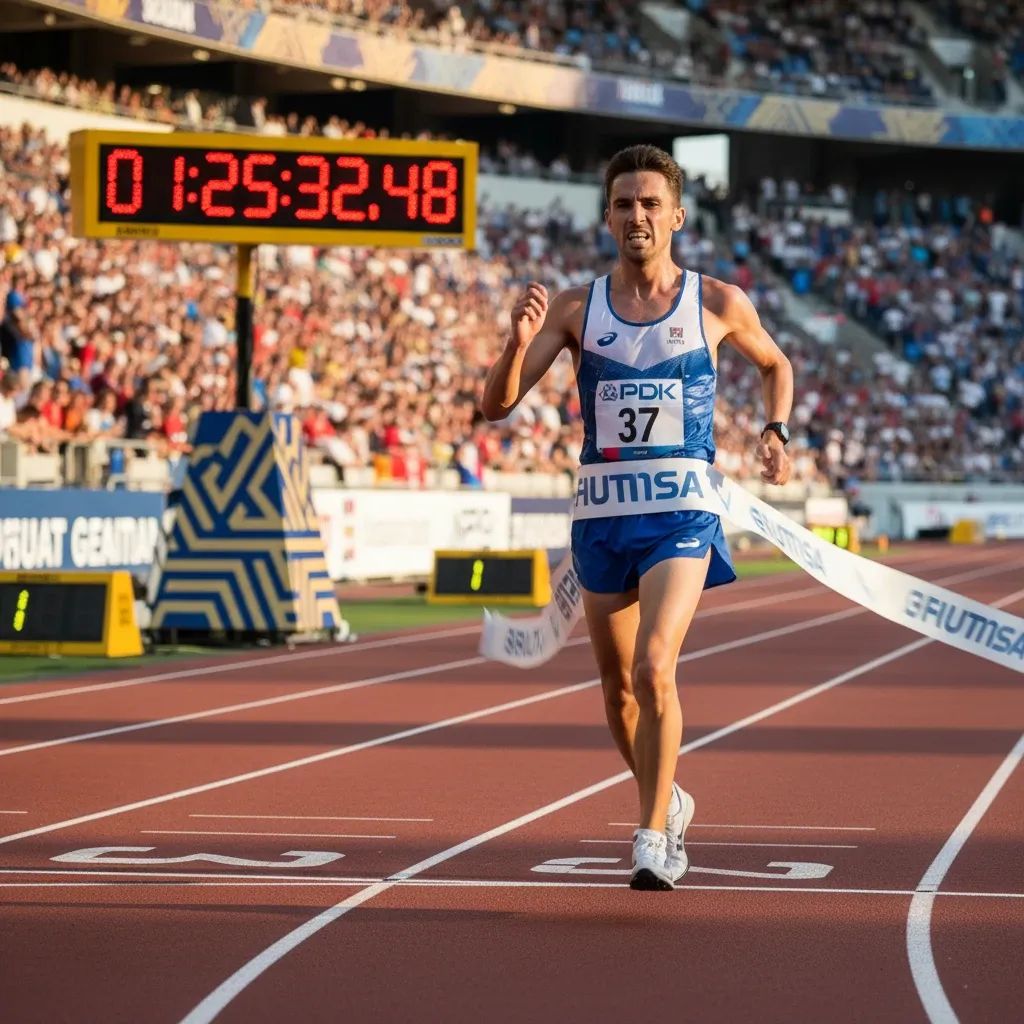
The Italy national athletics team has a new champion. Sofia Fiorini, a 22-year-old from Bibbiena in Arezzo, claimed gold in the marathon race walk at the European Athletics Championships in Birmingham on August 15, completing the 42.195 km distance in 3:15:11—a time that established her as one of the inaugural world record holders in this newly ratified discipline. Her victory caps a remarkable season and underscores Italy's growing dominance in competitive race walking.
A World Record on European Soil
Fiorini's performance at Birmingham's Alexander Stadium didn't just secure a continental title; it broke the 3:17:00 target time that World Athletics had set as the benchmark for the marathon race walk world record. The discipline, only recently added to the official international calendar in 2026, places extraordinary demands on athletes: maintaining continuous contact with the ground while covering marathon distance at race pace. Fiorini's execution was clinical, pulling away from Poland's Katarzyna Zdzieblo (silver) and Spain's Raquel Gonzalez (bronze) in the closing kilometers.
Speaking at the finish line, Fiorini described the experience in terms that belied the physical ordeal. "Gold gives me a sensation of lightness, after this period of long training blocks," she said. "It was a very fun race, especially the finish. At the beginning I was suffering because I wanted to go harder, but the marathon demands patience. When I got the signal, I attacked. I enjoyed myself."
Why This Matters
• Italy now holds 5 medals from the Birmingham race walk events, including golds from Fiorini and Massimo Stano, cementing the nation's reputation as a powerhouse in the discipline.
• Fiorini is balancing elite sport with academics, currently studying Economics and Management at Milan's prestigious Bocconi University—a model that may resonate with young Italian athletes weighing professional sport against educational security. She enrolled at Bocconi in 2023 while intensifying her training commitments, managing her dual pathway through careful scheduling and institutional support for athlete-students.
• The marathon race walk is new to the official athletics program, meaning Fiorini's record will stand as the inaugural benchmark for the event.
From Provincial Beginnings to Continental Glory
Fiorini's path to the top started in 2018 with Atletica Casentino Poppi, a small club in Tuscany's Casentino Valley. Though she began track and field at age 4, she did not specialize in race walking until her teenage years. In 2020, she switched to Libertas Unicusano Livorno, and in May 2025, she began working with coach Alessandro Gandellini—a partnership that has coincided with a breakthrough in performance.
Before Birmingham, Fiorini had already posted a string of impressive results in 2025 and 2026. In 2025, she won national titles in both the half-marathon and marathon race walk. In 2026, she swept the indoor 3,000 m race walk national record with a time of 12:12.41 (breaking a mark that had stood since 1991), earned silver at the World Race Walk Team Championships in Brasília in April, and set a half-marathon best of 1:32:36 in La Coruña—also a European U23 record.
The Italian Race Walk Factory
Fiorini's success is not an isolated phenomenon. Italy's race walk program is experiencing a generational surge, producing medal contenders across age groups. At Birmingham, the senior team collected five medals in total: golds from Fiorini and Stano, silvers from Francesco Fortunato and Alexandrina Mihai, and bronze from Andrea Cosi.
The youth pipeline is equally robust. At the 2026 World U20 Championships, Serena Di Fabio won gold in the 5,000 m race walk and set an Italian junior record. At the European U18 Championships in Rieti in July, Rebecca D'Alessandro took gold and Caterina Carissimi claimed bronze, both in the 5,000 m. Davide Sorressa added a silver in the men's event. Nineteen-year-old Giuseppe Disabato made his senior debut at the World Team Championships after four consecutive international youth podiums.
Fiorini herself credits this collective environment. "The senior athletes have been a huge stimulus," she said. "I watched their races on TV. We give each other strength, all the way down to the youth categories where they've had great results. We're a united group. That's the strength of the Italian race walk movement."
What This Means for Residents and Fans
For Italian sports fans, Fiorini's gold is more than a feel-good story—it's a signal that the country's investment in athletics, particularly in technical endurance disciplines, is paying off. Race walking, often overlooked in favor of sprints or middle-distance running, requires a unique combination of aerobic capacity, biomechanical precision, and mental discipline. Athletes must maintain a rigid gait—always keeping one foot in contact with the ground and the advancing leg fully extended—while covering distances up to and beyond marathon length. Judges monitor every stride, and three red cards result in disqualification.
The discipline's technical demands mean that success is rarely accidental. It requires years of coaching, biomechanical refinement, and a robust support network—resources that Italian athletics federations and clubs have clearly been able to provide. Fiorini's ability to balance this with a degree program at Bocconi, one of Europe's top business schools, also offers a template for young athletes navigating the pressures of dual-track careers.
A Shift in Mentality
Fiorini's post-race comments hint at a psychological evolution that may be as important as her physical development. "I've been doing race walking since I was young," she said. "But recently I've changed my mindset—I'm having fun. I want to keep going like this."
That shift—from grinding obligation to competitive joy—is a recurring theme among elite athletes who break through to the next level. Fiorini attributes her success to a realization that the real race happens in training. "The true competition begins in the training sessions," she explained. "The race itself is just the culmination."
Looking Ahead
Fiorini's world record, set at age 22, places her among the early standard-bearers of a discipline still finding its footing on the global stage. The marathon race walk will feature at the 2028 Los Angeles Olympics, replacing the 50 km event, and Fiorini is now a favorite for a podium finish. Her ability to peak at major championships, combined with the depth of Italy's race walk program, suggests that the Italian national team will remain a formidable presence in the years ahead.
For now, Fiorini is savoring the moment. "Gold gives me that feeling of lightness," she repeated. In a sport defined by relentless forward motion and unyielding rules, that sense of effortlessness may be the rarest achievement of all.


