
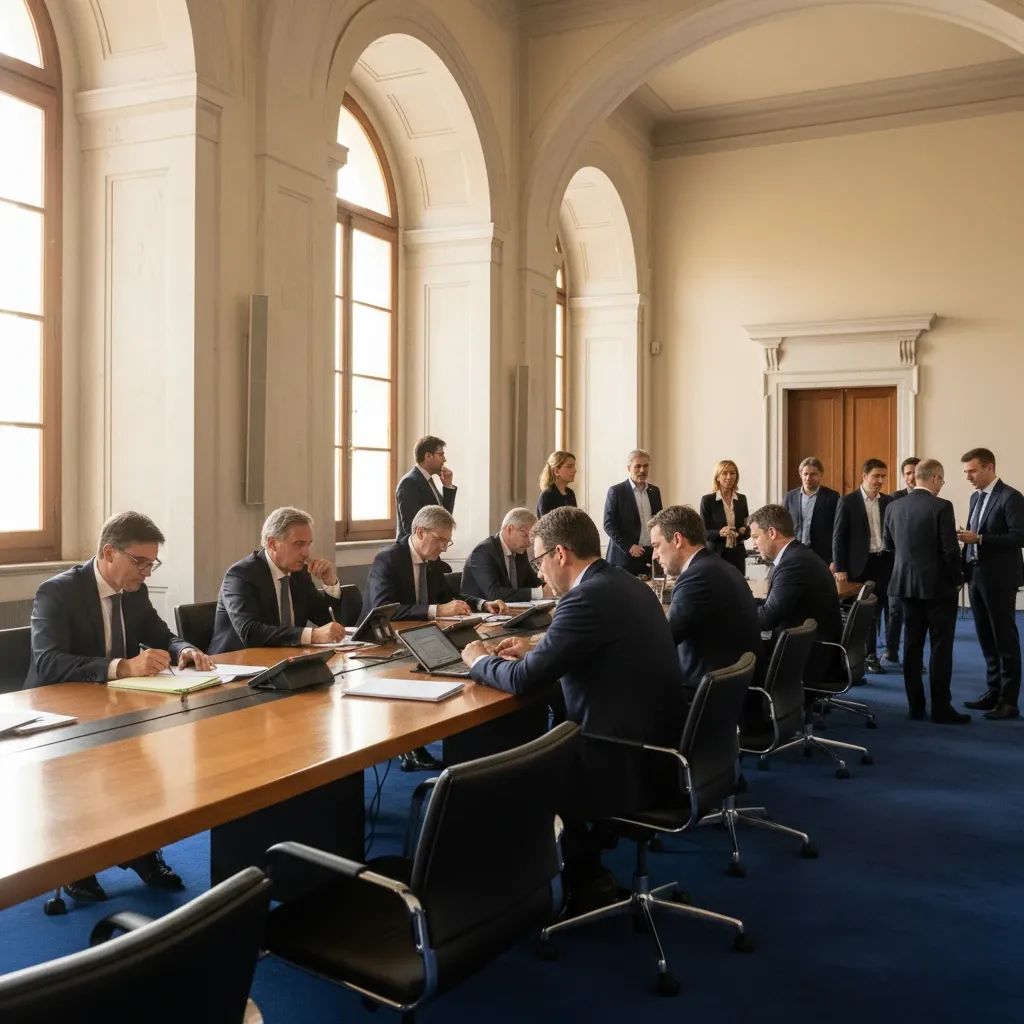
The Italian Senate President Ignazio La Russa has ignited a fresh debate over sexism in Italian politics after telling a female journalist "You're pretty, but above all good" on March 5, 2026, during a public event at Palazzo Madama. The remark, made to Roberta Benvenuto, a reporter for La7's investigative program Piazzapulita, has drawn condemnation from journalism unions and reignited scrutiny of how women in the profession are treated by the country's political establishment.
Why This Matters
• Pattern of Conduct: La Russa's comment is the latest in a series of similar incidents involving Benvenuto and other female journalists, raising questions about institutional respect for women in the media.
• Timing: The remark occurred at the inauguration of an exhibition titled "The Face of Women", dedicated to the mothers of Italy's Constitution—an irony not lost on critics.
• Union Response: The National Federation of the Italian Press (FNSI) expressed solidarity with Benvenuto, calling out what it described as "creeping patriarchy" still affecting women journalists.
What Happened at Palazzo Madama
La Russa was attending the opening of a women's history exhibit when Benvenuto approached him to ask a question about Defense Minister Guido Crosetto. Before refusing to answer—citing the event's focus—the Senate President made his controversial greeting. According to multiple accounts, La Russa initially said, "Who are you? Ah… you're pretty," before adding, "but above all good. Above all good, because today women are valued above all when they're good."
The qualification didn't soften the blow. Speaking on Rai Radio1's program Un Giorno da Pecora the following day, Benvenuto described the comment as textbook sexism. "The sexism is self-evident," she said. "If I had been a man, I would never have received that response." She added, generously, that she was willing to believe "the second-highest office of the State slipped the clutch," using an Italian idiom for an unforced error.
A Troubling Track Record
For Benvenuto, this was hardly an isolated experience. She recounted a string of episodes that, taken together, paint a picture of casual disrespect from senior government figures. In one incident, Justice Minister Carlo Nordio reportedly asked her to prepare him a spritz during an official event—a request that would be unusual to direct at any journalist, let alone one covering him professionally.
In 2023, when she pressed Agriculture Minister Francesco Lollobrigida on the Cutro migrant shipwreck—a tragedy that killed dozens—he dismissed her with the line, "The absence of answers creates frustration for you." And Andrea Delmastro Delle Vedove, a lawmaker from the ruling Fratelli d'Italia party, once told her she was "anaffettiva"—emotionally detached—during another contentious exchange.
"My trophy case from this point of view is pretty full," Benvenuto said wryly on air. "I just hope this government doesn't have any more gems in store."
What This Means for Women in Italian Journalism
The incident has reopened a broader conversation about the obstacles women still face in Italy's newsrooms and press galleries. The FNSI's statement highlighted that female journalists remain "penalized" in their work, not just by lower pay or fewer promotions, but by the everyday indignities that male colleagues rarely encounter. Being judged on appearance before competence, being dismissed as emotional or frustrated, or being asked to perform menial tasks—these microaggressions accumulate and signal that women are not seen as equals.
For expats and international observers, this episode offers a window into the culture of Italian political institutions. While similar problems exist in many democracies, Italy's case is compounded by a traditional public sphere where gender roles and hierarchies are often less questioned. The timing of La Russa's remark—at an event celebrating women's constitutional contributions—underscores the gap between symbolic gestures and daily realities.
Government Silence and Growing Pressure
As of this writing, La Russa has not issued a formal apology or clarification. His office has remained silent on the matter, and no statement has been released by the Senate press team. This silence is itself significant. In an era when even minor slips can escalate into political crises, the lack of response suggests either indifference or a calculation that the controversy will fade.
Other recent cases have ended differently. In a separate incident, Maurizio Falco, a government commissioner overseeing the demolition of informal settlements, resigned after audio emerged of him directing vulgar, sexist insults at journalist Costanza Tosi of the program Fuori dal Coro. That episode, which involved explicit language, prompted immediate calls for his removal from lawmakers across the spectrum, including Senator Barbara Floridia of the Five Star Movement, who chairs the Rai Oversight Committee.
The contrast raises questions about where the line is drawn. Is a comment on appearance a lesser offense than an outright insult? Critics argue that both reflect the same underlying dismissiveness, and that tolerance for the former enables the latter.
A Broader Pattern in Italian Politics
La Russa's remark fits within a wider landscape of gender issues in Italian political discourse. Prime Minister Giorgia Meloni has herself spoken about experiencing sexism, though often in the context of criticizing what she views as double standards applied to her by opponents. Meanwhile, several figures in her party have faced criticism for insensitive or offensive remarks toward women.
The debate over accountability for sexist language in politics remains contested and often intensely partisan, making it harder to build consensus on what concrete institutional steps should be taken.
International Context and Comparisons
Italy is not alone in grappling with these issues, but it lags behind many of its European peers in terms of gender parity in media leadership and political representation. In broadcast journalism, women are more visible but often face expectations that appearance matters significantly in their work.
Other European countries have introduced codes of conduct, mandatory training, and transparent complaint mechanisms to address workplace sexism. In Italy, such measures exist on paper but enforcement is patchy, and high-profile incidents like the La Russa case often generate outrage but little systemic change.
What Comes Next
For now, Benvenuto has returned to her reporting duties, and the story has begun to fade from the front pages. But the episode has left a mark. Journalism unions are calling for clearer protocols to address sexist behavior by public officials, and some lawmakers have floated the idea of a parliamentary inquiry into gender dynamics in political communication.
Whether any of this will translate into action remains to be seen. Italy's political class has proven adept at weathering scandals, and without sustained pressure from civil society, media organizations, and voters, the status quo is likely to persist. What is clear is that women in Italian journalism are no longer willing to accept these slights in silence. The question now is whether the institutions they cover will finally start listening.


