
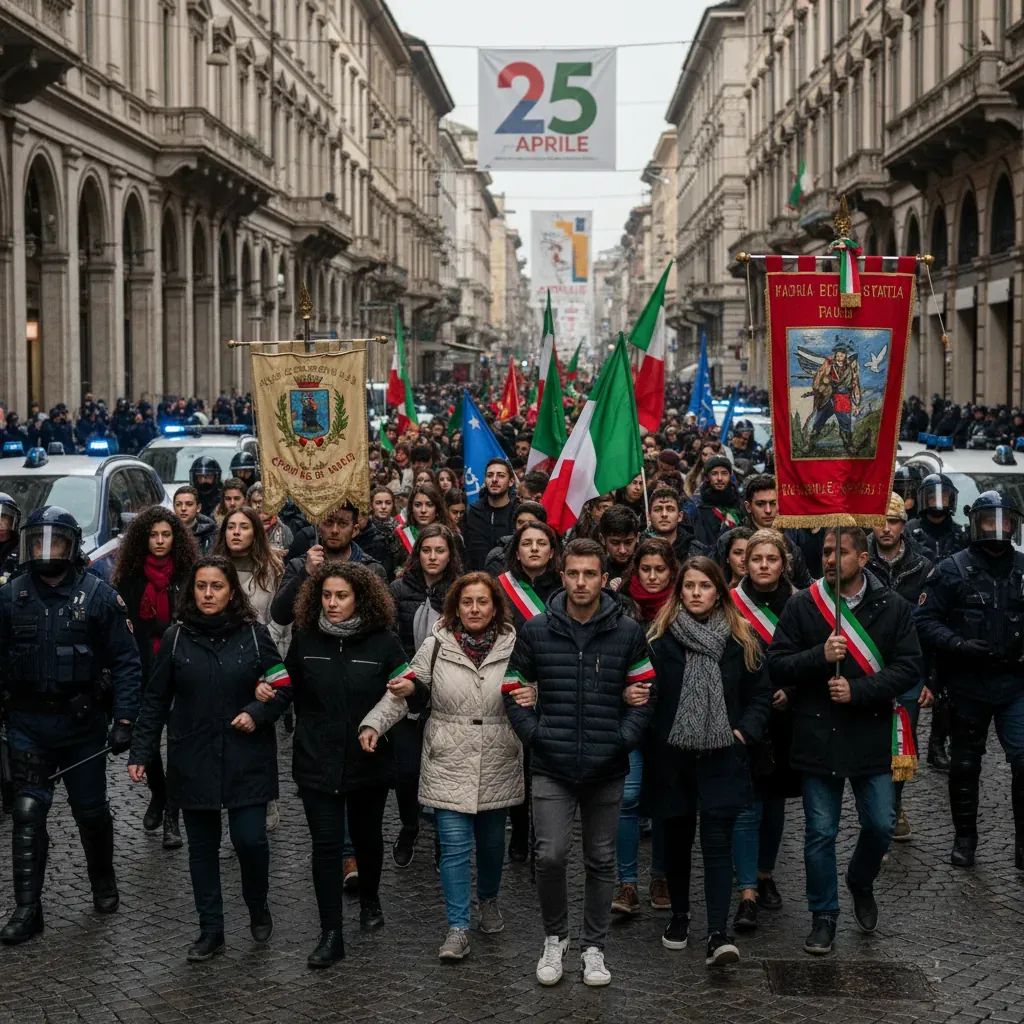
A fracture within Italy's most prominent antifascist organization has spilled into public view, following violent clashes and controversial leadership statements during Liberation Day commemorations on April 25, 2026. The National Association of Italian Partisans (ANPI) now faces an internal crisis that threatens to reshape its relationship with the Jewish community and test the limits of political tolerance on Italy's streets.
Luciano Belli Paci, the son of Holocaust survivor and life senator Liliana Segre, announced he is reconsidering his membership in the ANPI after being physically expelled from the April 25, 2026 parade in Milan. "I don't know if the conditions exist to keep my ANPI card," he told Italian news agency ANSA. Belli Paci, who holds a leadership position within the organization, described the statements by ANPI national president Gianfranco Pagliarulo as "unacceptable" for appearing to blame victims rather than aggressors.
What Happened in Milan
The confrontation erupted when Belli Paci marched with the Jewish Brigade and the "Left for Israel" group through Milan's Liberation Day procession. Pro-Palestinian demonstrators surrounded the contingent, shouting epithets including "You are just missed bars of soap"—a reference to Nazi extermination practices—and physically blocking their path. After a prolonged standoff, riot police escorted the Jewish delegation out of the parade for their safety.
Walker Meghnagi, president of the Milan Jewish Community, accused ANPI leadership of orchestrating the exclusion, alleging the organization had effectively declared "no Jews in the parade." He labeled the incident a "coup" and called Pagliarulo and local ANPI officials "antisemites without knowing it." The accusation sparked a fierce rebuttal from ANPI, which announced plans for legal action against Meghnagi, dismissing his claims as "farneticating, provocative, false, and deliberately instrumental."
Pagliarulo defended the organization's position by asserting the Jewish Brigade had "violated agreements" by bringing Israeli and American flags to the event. He argued these symbols represented warfare rather than liberation, a stance that has divided Italy's traditional antifascist coalition along geopolitical fault lines.
Violence in Rome Compounds the Crisis
In the capital, the same day brought a different kind of attack. Two ANPI members wearing partisan scarves were shot with an air-compression pistol near Parco Schuster on Via delle Sette Chiese. One victim sustained wounds to his neck and hand, while the other was struck in the shoulder. Though the injuries were classified as minor, both victims reported severe psychological shock.
Rome's Digos investigative unit and the San Paolo police station are reviewing public and private surveillance footage to identify the assailant, described as riding a light-colored scooter while wearing a black helmet and military-style jacket. Prosecutors are expected to pursue charges of aggravated assault with a likely political motive, though no arrests have been made.
The Rome branch of ANPI condemned the shooting as a "terrorist act" and vowed not to be intimidated. "Like the partisans who did not let themselves be deterred by attacks, raids, and reprisals, we will continue our fight for their memory and to preserve their legacy: the democratic Republic founded on labor and its Constitution, against all forms of nazifascism, authoritarianism, and supremacism," the provincial committee declared.
Broader Tensions at Liberation Day Events
The clashes were not isolated. In Rome's Piazzale Ostiense, demonstrators carrying Ukrainian flags were shoved, sprayed with pepper irritant, and had their banners ripped away by far-left and anarchist groups. Matteo Hallissey, president of +Europa and the Italian Radicals, was among those hit with the spray. In both Milan and Rome, the Jewish Brigade faced insults, projectiles including cans and firecrackers, and organized attempts to physically remove them from the processions.
Milan Mayor Giuseppe Sala publicly condemned the language used against the Jewish marchers, stating it represented "a 25 April that cannot please us." The CISL labor union and the Union of Italian Jewish Communities (UCEI) issued statements expressing solidarity with the Brigade and denouncing antisemitic rhetoric.
The Political Fault Lines
The controversy exposes deeper rifts within Italy's left over the Ukraine conflict, NATO expansion, and the Israel-Palestine crisis. Pagliarulo has repeatedly criticized NATO's presence at Liberation Day events, describing the alliance as "not an organization of peace" and insisting such symbols contradict the day's message. He has also sparred with Senate President Ignazio La Russa, accusing him of "offending the memory of those who fell for Italy's Liberation" by continuing to speak of reconciliation with fascists.
With more than 170,000 members, ANPI remains a significant force in Italian civil society, with Pagliarulo citing the organization's scale as evidence that antifascism remains a "vital necessity" for younger generations. Yet the organization's stances on NATO, Ukraine, and now the Jewish Brigade have alienated traditional allies, including portions of the Jewish community that have historically marched alongside ANPI.
Emanuele Fiano, a prominent figure in "Left for Israel," expressed profound disappointment, noting that in 50 years of participation, he had never witnessed such hostility at a Liberation Day march. His sentiment reflects a broader unease among Italian Jews, many of whom view ANPI's evolving positions as abandoning the coalition that once united Holocaust survivors, partisans, and their descendants.
What This Means for Residents
For Italians, the schism within ANPI raises uncomfortable questions about the compatibility of antifascism with pluralistic expression in public commemorations. The incidents demonstrate that historical memory has become a battleground for contemporary geopolitics, with organizers and participants increasingly unable to separate World War II narratives from today's conflicts.
The legal proceedings initiated by ANPI against Meghnagi, combined with potential criminal charges in Rome, will likely produce judicial interpretations of hate speech, assembly rights, and political violence in the coming months. Residents should anticipate heightened police presence at future political commemorations, particularly those involving Israeli, Palestinian, or NATO symbolism.
For the Jewish community in Italy, the events mark a potential turning point in relations with mainstream antifascist organizations. If Belli Paci and others follow through on their membership withdrawals, ANPI risks losing its moral authority as the inheritor of Italy's partisan legacy, particularly among those whose families directly suffered under fascism and Nazism.
The air-gun shooting in Rome, though resulting in minor physical injuries, sends a chilling signal that political violence is creeping back into Italian civic life. The fact that the victims were identifiable by their partisan scarves suggests targeted intimidation, a tactic that evokes the darkest periods of Italy's 20th century. Whether authorities can identify and prosecute the perpetrator will test the state's commitment to protecting political expression, even expression that some find controversial.
As Italy approaches the 80th anniversary of the Republic's founding, the discord at Liberation Day events underscores how fragile consensus remains around the meaning of resistance, antifascism, and national identity. The coming weeks will reveal whether ANPI can repair the breach with its Jewish members or whether the April 25, 2026 commemorations mark the beginning of a lasting split in the coalition that once claimed to speak for all victims of fascism.


