
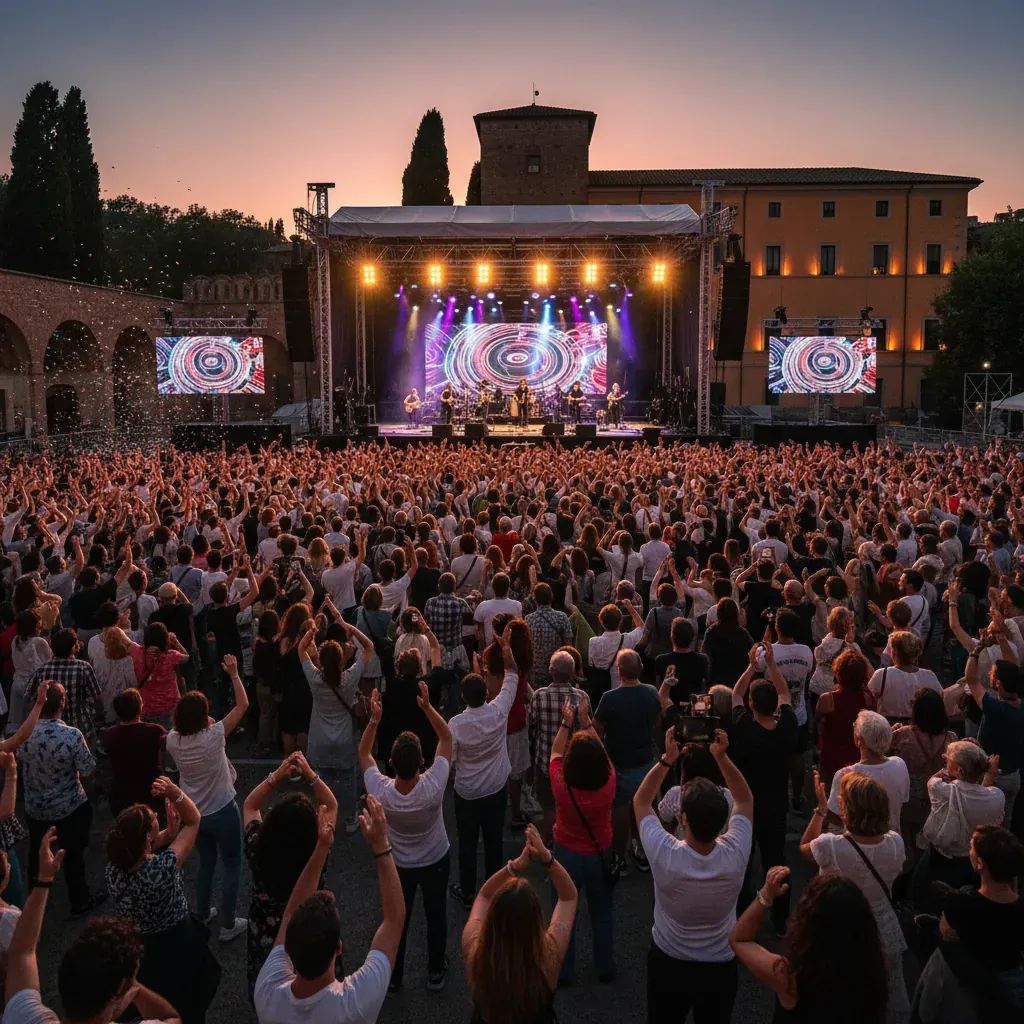
The Sanremo Song Festival attracted 9.053 million viewers on Wednesday evening—down from 11.8 million on the equivalent night in 2025—as Italy's traditional television viewing habits continue their rapid fragmentation. While Wednesday's 59.5% national share technically edged ahead of Tuesday's 58%, the underlying trend reflects a structural challenge: fewer Italians are watching live television events, regardless of share percentages.
For residents and professionals across Italy, this matters directly. If viewership continues declining, the €90 annual household television license fee becomes a flashpoint in Italy's coalition government—some politicians already question whether RAI justifies its funding when streaming platforms offer alternatives. Additionally, Liguria's hospitality sector—hotels, restaurants, and tourism services—depends on Festival visibility to justify occupancy rates during peak week; declining viewers threatens jobs and revenue in regions where the industry operates.
What the Numbers Reveal
Monday's opening night attracted 9.6 million households, down approximately 3 million from 2025's premiere (12.6 million). The highest concentration occurred around 21:59 on opening evening, when concurrent viewership peaked at 15.38 million—indicating that initial promotion and curiosity drive tuning, but retention degrades sharply after 23:00.
Industry observers attribute this compression to several overlapping forces. Demographic fragmentation has accelerated dramatically: viewers aged 55 and above maintain traditional appointment-television habits, while audiences under 45 increasingly access Festival content through TikTok clips, YouTube short-form compilations, or delayed playback via RaiPlay streaming. This fundamentally alters advertising value—premium primetime slots nominally cost €400,000 to €500,000 per 30-second advertisement, yet agencies have begun challenging rate cards, citing the millions-viewer deficit as leverage for price reductions.
The proliferation of streaming platforms and on-demand consumption has created what researchers term "appointment television fatigue"—the declining appetite among urban professionals for four-hour live broadcasts when mobile-optimized, curated alternatives offer selective access to desired segments. RAI's internal monitoring confirms that while overall viewership appears stable week-to-week, the composition has shifted profoundly toward older demographics, leaving younger-skewing consumer brands uncertain about their Festival advertising return-on-investment.
Olympic Momentum and Festival Timing
Francesca Lollobrigida and Lisa Vittozzi, both medalists from Milan-Cortina 2026, appeared on the Ariston stage Wednesday alongside Paralympic Alpine skier Giacomo Bertagnolli and his sighted guide Andrea Ravelli, plus wheelchair curling competitor Giuliana Turra. The timing was deliberately strategic: with the Olympic Games concluding only 48 hours prior, RAI's scheduling intended to create narrative continuity between national athletic triumph and cultural spectacle.
Industry observers questioned whether Sanremo could fully capitalize on Olympic momentum. The athlete presence did expand traditional Sanremo demographics—sports enthusiasts who typically skip multi-hour music marathons tuned in specifically for the Olympic segment, according to internal RAI demographic breakdowns. Yet the viewership lift proved minimal, suggesting that either three weeks of uninterrupted Olympic coverage had exhausted audience capacity, or that the sequential calendar positioning reduced the emotional resonance that simultaneous events might have generated.
By positioning a national cultural event immediately after Olympic success, RAI reinforced its institutional role as custodian of Italian national identity—directly countering political opposition arguments that the public broadcaster has become redundant in an on-demand era.
Tragedy as Cultural Anchor
Achille Lauro's rendition of "Perdutamente" transcended entertainment and became an act of nationwide collective mourning. The ballad functioned as tribute to the 41 victims of the Crans-Montana nightclub fire in Switzerland on New Year's Eve 2025, which claimed six Italian teenagers. What distinguished this moment: the mother of 16-year-old Achille Barosi, one of the Italian casualties, had sung the identical song beside her son's coffin during January funeral services.
Stripped of theatrical production and performed in near-silence, the performance triggered over 2 million social media interactions within one hour, according to RAI measurement data. The segment illuminated Sanremo's irreplaceable cultural function in the Italian national consciousness—the Festival operates simultaneously as entertainment spectacle, commercial engine, and nationwide grief repository. Few comparable television events in Europe occupy this unique role, combining profit motive with emotional catharsis and cultural ritual.
The Commercial Reality: Charts and Booking Revenue
By Thursday morning, eleven of the top twelve positions on Italy's official singles chart were occupied by Festival entries, illustrating the event's dominant effect on the commercial music infrastructure. Fedez and Masini's "Male Necessario" claimed the number-one position, followed by Ditonellapiaga with "Che Fastidio!" and Sayf's "Tu mi piaci tanto." Even mid-tier placements translate into tangible professional outcomes: the winning song guarantees three to six months of radio rotation, booking fee increases (typically 200-300%), and international licensing inquiries from European broadcasters.
This commercial phenomenon operates independently of viewership trends. A performer can chart at festival-high positions even as overall television audience shrinks—because the remaining viewers are concentrated, committed, and immediately mobilize purchases and playlist additions. For the music industry, Sanremo placement functions as mandatory career infrastructure for breakthrough artists and career-revitalization for established ones.
Achille Lauro's album "Comuni Mortali" surged to sixth position on the album chart following his Wednesday appearance, offering real-time evidence of how a single emotional television moment translates into streaming and purchase behavior. The effect operates across genre boundaries: established acts like Kid Yugi (retaining number-one with "Anche gli eroi muoiono") and Geolier (second with "Tutto è possibile") experience momentum extensions rather than disruption from Festival entries.
Laura Pausini's Calculated Return
Grammy-winning Laura Pausini joined Carlo Conti as co-host across all five Festival evenings—her first major television hosting role since her legendary 1993 Sanremo victory as a performer launched her trajectory to international stardom. Her subsequent career included seven Grammy nominations, sold-out stadium tours across four continents, and a Golden Globe for film performance—positioning her as one of Italy's most globally recognized cultural exports.
Pre-event analysis predicted that Pausini's presence would offset domestic viewership decline through international brand prestige and emotional resonance tied to her career-defining Festival moment three decades ago. She maintained audience share levels relative to Tuesday's performance, though she could not reverse the absolute viewer contraction. Her participation generated substantial pre-Festival media buzz, particularly among older demographics and international Italian diaspora communities monitoring via streaming services abroad.
By positioning a globally successful female artist in the co-hosting role, RAI signaled both continuity with Sanremo tradition and openness to contemporary sensibilities. Pausini's international prominence also subtly countered the narrative that Sanremo represents an outdated Italian cultural artifact.
Liguria's Blue Economy and Tourism Impact
Aboard the Costa Toscana cruise ship docked in Sanremo harbor, regional and national officials convened during Festival week to advance economic narratives directly tied to viewership and tourism visibility. Simona Ferro, Vice President of Liguria Region, Edoardo Rixi, Infrastructure Deputy Minister (participating via videolink from Singapore), and Mario Zanetti, Confindustria maritime delegate and Costa Cruises CEO, outlined the strategic importance of Italy's maritime and logistics sector.
Zanetti articulated a compelling industrial argument: the blue economy constitutes an estimated €216.7 billion in annual value, representing approximately 11.3% of national GDP and employing over one million workers across transportation, tourism, port operations, and subsidiary services. Italy dominates Mediterranean short-sea shipping and possesses natural geographic advantages as Europe's primary logistics platform.
For Liguria specifically, the region manages nearly 1,300 coastal tourism concessions, generating approximately 20,000 jobs during peak summer months, supplemented by roughly 20,000 boat moorings along the region's shoreline. Festival week traditionally drives significant occupancy rates for regional hotels and hospitality businesses—meaning declining television visibility directly threatens revenue and employment in these sectors. If viewership continues declining, regional tourism authorities may need to develop alternative promotional strategies or consider restructuring the Festival duration to maintain profitability.
Cover Night and Format Questions
Thursday evening's Cover performance round delivered one of the Festival's strongest ratings moments. The Serata Cover attracted approximately 13.575 million viewers in total audience measurement, achieving a remarkable 70.8% average share—among the highest ever recorded for this specific competition round. Ditonellapiaga and TonyPitony triumphed with an interpretation of "The Lady Is a Tramp."
The cover-song round's outsized performance relative to competitive rounds suggests that audience preferences tilt toward nostalgic, familiar material rather than new composition—a data point with implications for festival format evolution. Industry analysts note that cover songs require less intellectual investment for viewers; audiences recognize the melodies and can focus on interpretive variations and performance quality.
What Happens Next
The final evening on February 28 will reveal whether Wednesday's hold-steady performance signals a stabilization or merely temporary leveling within a broader decline. The evening's winner will be designated as Italy's representative to the 2026 Eurovision Song Contest in Vienna.
If ratings decline continues, RAI may restructure from five nights to three-four, redesign competition mechanics to attract younger audiences, or expand interactive digital components and social-media integration. Each format modification carries downstream implications for Liguria's tourism model, advertising rate cards, and the artistic supply chain that depends on Sanremo visibility for career advancement.
What remains constant despite rating fluctuations: the Festival's commercial and cultural infrastructure operates semi-independently of viewership trends. The winning song will dominate Italian summer playlists; top finishers will secure booking revenue across club circuits; streaming platforms will feature artist interview content for weeks following conclusion.
The substantive questions now concern format and sustainability. The metrics suggest the traditional appointment-television model that sustained Sanremo for seven decades faces its most significant long-term challenge since streaming platforms fragmented national audiences—and no institutional actor has yet demonstrated capacity to reverse this trend. For residents across Italy, watching how RAI, regional government, and industry players respond will determine whether the Festival evolves or gradually contracts.


