
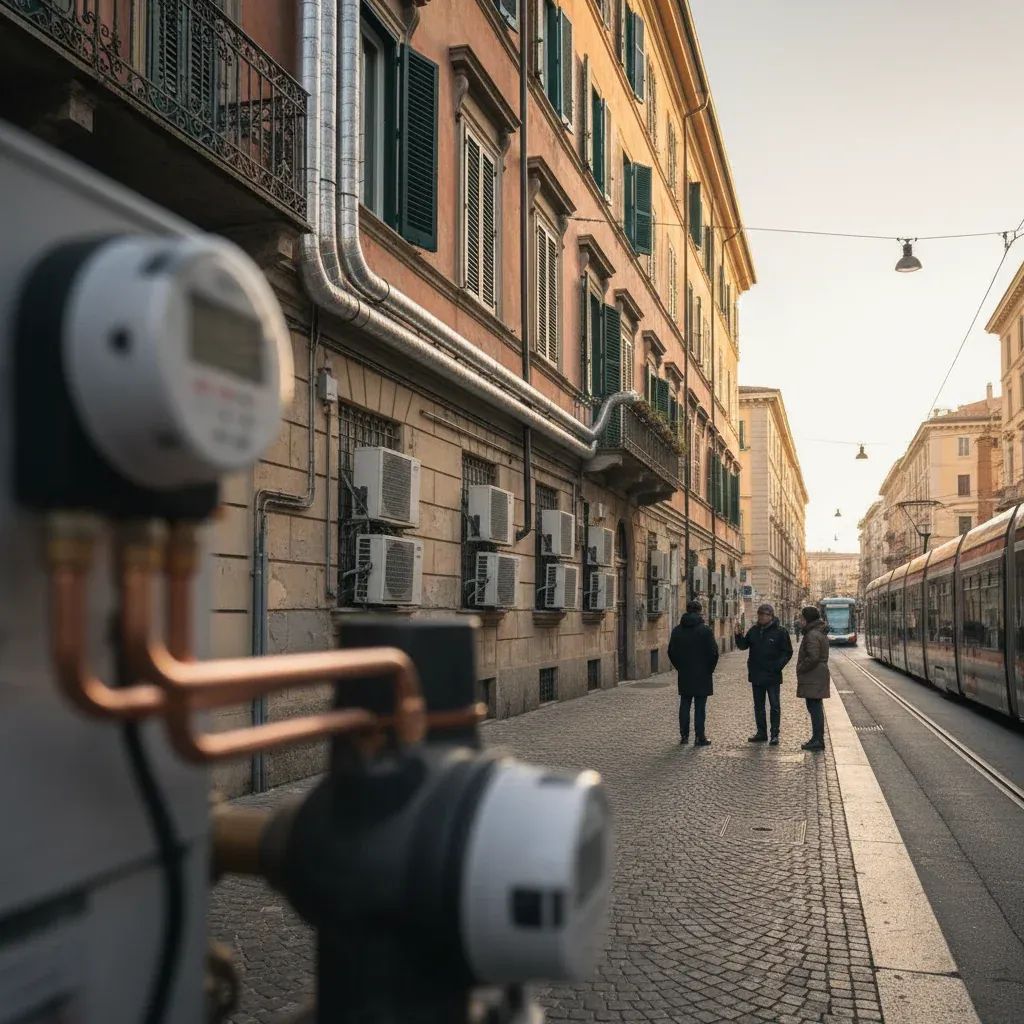
Italy's Economy Braces for Stagflation Threat as Oil Surges Past $120 on Hormuz Blockade
The Italy Ministry of Economy and Finance is scrambling to assess the damage from a historic oil shock, as Brent crude threatened to pierce the $120-per-barrel ceiling this week amid mounting fears that the Strait of Hormuz could remain shut for an extended period. The crisis, triggered by U.S. President Donald Trump's refusal to negotiate a reopening deal with Iran, now presents Italy—one of Europe's most energy-vulnerable economies—with a dual threat: soaring inflation and near-zero growth.
Why This Matters
• Fuel prices are spiking: Diesel and gasoline have already climbed 32% and 22% respectively across Europe in two weeks, hitting Italian businesses and households hardest.
• Inflation will overshoot targets: Forecasters now peg Eurozone inflation at 2.6% for the full year, with Italy likely exceeding 3% by Q4—well above the ECB's 2% target.
• Growth is stalling: Italian GDP projections have been slashed to between 0.4% and 0.7% for 2026, with some analysts warning of outright recession if the blockade persists.
• Central bank dilemma: The European Central Bank may be forced to raise rates as soon as June, even as the economy weakens—a classic stagflation trap.
The Blockade: Trump's Gamble, Teheran's Countermove
On April 29, Brent crude surged 7.15%, trading at $119.36 per barrel, while WTI jumped 7.26% to $107.18. The spike came hours after media reports—first carried by Axios—revealed that Trump had rejected Iran's latest offer to partially reopen the Strait of Hormuz, the narrow waterway through which roughly 20% of the world's oil flows.
According to sources close to the White House, Trump views the U.S. naval blockade of Iranian ports as his primary bargaining chip and has instructed Pentagon planners to prepare contingency operations for a prolonged standoff. The president has reportedly authorized the U.S. Navy to destroy any vessels attempting to lay mines in the strait and has threatened further military action if Tehran continues to refuse concessions on its nuclear program.
Iran, for its part, reimposed transit restrictions in late April after Revolutionary Guard naval units fired warning shots at tankers attempting passage and intercepted an Indian-flagged vessel. Iranian officials insist they cannot guarantee freedom of navigation while facing what they describe as an illegal blockade of their own export terminals. The result: a mutual chokehold that has effectively halted tanker traffic through one of the planet's most strategic waterways since late February, when the crisis erupted following coordinated U.S.-Israeli strikes.
Energy Markets in Panic Mode
Natural gas prices mirrored the oil rally. On April 29, the Dutch TTF benchmark jumped 7.5% to approach €47 per megawatt-hour—double the levels seen at the start of the year. The escalation follows a force majeure declaration by Qatari state energy giant QatarEnergy, which suspended roughly 17% of its liquefied natural gas (LNG) export capacity after infrastructure attacks linked to the wider regional conflict.
For Italy, the implications are severe. The country imports virtually all of its oil and the bulk of its gas, making it roughly twice as sensitive to energy shocks as the United States, according to sensitivity models from the International Energy Agency. The IEA has labeled the Hormuz blockade "the largest supply disruption in the history of the global oil market."
U.S. government data released last week showed a surprise draw of 6.2 million barrels from American crude inventories for the week ending April 24, compounding supply anxieties. Distillate and gasoline stocks also fell sharply, signaling tightening fundamentals even in North America, which is less exposed to Middle Eastern crude flows.
What This Means for Italian Households and Businesses
Energy-intensive sectors—chemicals, steel, ceramics, and heavy manufacturing—face an immediate competitiveness crisis. The Confederation of Italian Industry (Confindustria) has warned that prolonged triple-digit oil prices could shutter plants and accelerate the offshoring of production to regions with cheaper energy access.
Retail fuel costs are already climbing. Pump prices for diesel, the lifeblood of Italy's logistics and agriculture sectors, have risen more than 30% since early April. That translates directly into higher costs for food, construction materials, and virtually every good that requires transportation.
For households, the pain is twofold: higher bills and eroded purchasing power. The Bank of Italy estimates that a sustained $100-per-barrel oil environment would subtract roughly one percentage point from real disposable income over the course of a year, suppressing consumption and dragging down overall economic activity.
Small and medium enterprises in the tertiary sector—restaurants, hotels, retail—are already reporting sharp increases in utility bills, with some operators facing energy costs 40% to 50% above 2025 levels. Unlike during the 2022 energy crisis, the Italian government has far less fiscal room to deploy subsidies or price caps, constrained by stricter EU budget rules and elevated public debt.
The Stagflation Specter
Economists use the term stagflation to describe the nightmare scenario of high inflation combined with stagnant or negative growth. Italy now faces precisely that risk.
Goldman Sachs revised its Brent forecast for Q4 2026 to $90 per barrel—up from an earlier $80 estimate—citing slower-than-expected recovery of Gulf production and delays in normalizing export flows. More pessimistic scenarios envision Brent holding above $115 or even $140 if the Hormuz impasse drags into the summer months.
In such an environment, the European Central Bank confronts an agonizing choice: tolerate inflation above target to protect fragile growth, or raise interest rates and risk tipping the Eurozone into recession. Financial markets are now pricing in at least one 25-basis-point rate hike by June, with a second move possible by year-end.
S&P Global and Morningstar have both flagged the likelihood of monetary tightening if oil shocks persist, warning that higher borrowing costs would further depress business investment and residential construction—two sectors that had been expected to support Italian GDP in 2026.
The Italian Treasury (MEF) has modeled a downside scenario in which GDP growth slows to just 0.4% if Middle Eastern tensions remain unresolved. That compares with a baseline forecast of 0.7%, itself a modest figure that relies heavily on continued disbursements from the National Recovery and Resilience Plan (PNRR). Strip out PNRR-funded infrastructure spending, and Italy's underlying growth rate would be close to zero—or negative.
Broader Geopolitical Fallout
The Hormuz standoff has ripple effects far beyond energy markets. Fertilizer prices have spiked more than 5% as natural gas—a key feedstock for ammonia production—becomes scarcer and costlier. That threatens to prolong food inflation, particularly in import-dependent Southern European markets like Italy, where bread, pasta, and produce prices had only recently begun to stabilize.
There are also concerns about China's response. Beijing is Iran's largest oil customer, and Chinese tankers have continued attempting transits despite the U.S. blockade. Any escalation involving Chinese-flagged vessels could draw the world's second-largest economy into direct confrontation with Washington, amplifying market volatility and complicating supply chains that Italian manufacturers depend on for components and raw materials.
Financial analysts note that the crisis has revived the debate over energy security and the green transition. Some policymakers in Brussels and Rome are calling for accelerated investment in solar, wind, and nuclear capacity to reduce dependence on volatile fossil fuel imports. However, such infrastructure takes years to build, offering little relief in the near term.
What Comes Next
For now, all eyes are on Washington and Tehran. Diplomatic efforts led by Pakistan and other intermediaries have so far failed to break the deadlock. Trump has publicly stated that Iran's economy is "near collapse" due to sanctions and the blockade, and that he will not ease pressure until Tehran agrees to dismantle key elements of its nuclear program.
Iran, meanwhile, has attempted to circumvent the blockade by demanding transit fees in cryptocurrency from ships seeking passage—a move analysts describe as turning the strait into a "digital tollbooth." That gambit has done little to restore normal traffic volumes.
Market participants expect continued extreme volatility in oil and gas prices until a credible path to reopening the strait emerges. Some traders are positioning for Brent to test $130 if hostilities intensify or if Saudi Arabia and the UAE prove unable to offset lost Iranian and Qatari barrels.
For Italian policymakers, the message is stark: prepare for a summer of high energy costs, stubborn inflation, and weak growth. The window for fiscal or monetary maneuver is narrow, and the risk of a full-blown stagflation episode—something Europe has not experienced since the 1970s—is no longer a remote possibility. It is a live threat demanding urgent contingency planning.


