
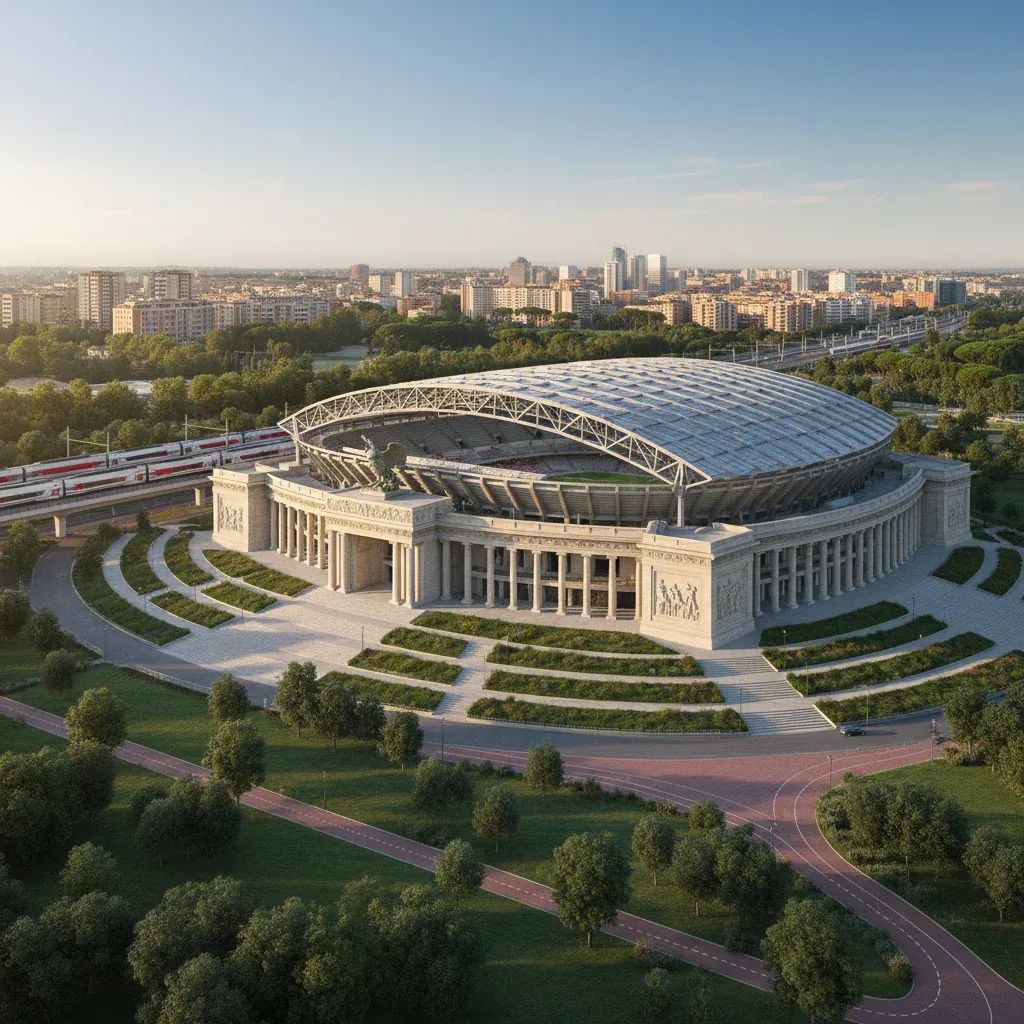
The Comune di Napoli has cleared a critical administrative hurdle in its campaign to secure a hosting slot for Euro 2032, as the city's service conference formally approved the feasibility study for a sweeping renovation of the Diego Armando Maradona Stadium. The approval, which came in late July, allows Naples to meet UEFA's July 31 deadline for submitting its technical dossier—a step that keeps the southern Italian city in the running alongside Rome, Milan, Turin, and others vying for one of five Italian host slots in the joint Italy-Turkey tournament.
Why This Matters:
• Project cost: Between €200M and €250M, funded primarily by Campania Region Development Funds (€200M), with €50M from Naples' municipal budget.
• Timeline pressure: The feasibility green light clears the path for tender launch by end-2026, groundbreaking mid-2027, and completion by early 2031—one year before kickoff.
• Competitive edge: Only Turin's Allianz Stadium is already UEFA-compliant among Italian venues; Naples now has regulatory parity but faces financing uncertainty.
• Regional politics: Campania Governor must formally commit Development and Cohesion Funds by 2027, or the entire project stalls.
The Bureaucratic Sprint Behind the Approval
The positive conclusion of the Conferenza di Servizi—a multi-agency review body comprising municipal departments and external authorities—marks the culmination of a process initiated in April 2025 when the city's Infrastructure and Mobility Office delivered the stadium's master plan. That document, refined through subsequent municipal resolutions addressing the third tier's refunctionalization and energy efficiency upgrades, underwent scrutiny for urban planning compliance, environmental impact, safety standards, and transport logistics around the Fuorigrotta district.
All relevant bodies—from local building inspectors to regional environmental agencies—have now signed off, issuing what Italian administrative law calls a "determinazione dirigenziale," or executive determination. In practice, this means the project has survived the labyrinthine conference process intact, with no objections lodged by stakeholders. For Mayor Gaetano Manfredi, the approval represents a political and logistical victory: it demonstrates Naples can navigate Italy's notoriously slow permitting regime when national prestige is at stake.
The urgency stems from UEFA's October 2026 decision date, when the confederation will announce the ten final host cities—five each for Italy and Turkey. Italy's football federation, FIGC, must submit a shortlist of compliant or near-compliant venues by July 31, giving Naples exactly one week from the service conference's conclusion to compile and transmit documentation.
What This Means for Residents and the SSC Napoli Fanbase
For Neapolitans and the broader Campania region, the stadium overhaul promises tangible improvements beyond international football. The €200M-plus package targets structural reinforcement—experimental work on the third-tier vibration dampeners has already begun—plus upgraded hospitality zones, accessibility features, and energy systems designed to cut operating costs. The revamp should also address chronic complaints from SSC Napoli supporters about sightlines, concessions, and transport bottlenecks around the Campi Flegrei station.
However, the project's fate hinges on funding mechanics that remain opaque. Mayor Manfredi awaits formal confirmation from Campania's regional government that €200M from Development and Cohesion Funds will be earmarked by 2027. A protocol of understanding signed on April 9, 2026, between the region and municipality outlines intent, but until the Campania Council passes a binding appropriation, the money is theoretical. Should the region balk or redirect those funds to competing infrastructure—Naples' metro extension, for instance—the stadium plan collapses, taking Euro 2032 hosting rights with it.
Residents should also brace for construction disruption. The tender for an integrated design-build contract is slated for late 2026, with site mobilization by mid-2027. Given the stadium's location in a densely populated quarter adjacent to the Mostra d'Oltremare exhibition grounds, expect lane closures, noise ordinances, and potential SSC Napoli fixture relocations during the 2027-2031 build window. The city has not yet released a public engagement plan detailing how it will mitigate impact on the 60,000-capacity venue's immediate neighbors.
Italy's Stadium Gap Versus Turkey's Head Start
Naples' scramble reflects a broader Italian predicament. While Turkey has spent fifteen years erecting a network of UEFA-standard arenas—many already operational and requiring minimal pre-tournament tweaks—Italy is retrofitting or replacing facilities built for the 1990 World Cup. Only Turin's Allianz Stadium, home to Juventus, meets current confederation specifications without modification. Rome's Stadio Olimpico needs roughly €110M in upgrades, partly justified by the capital's parallel bid for the 2036 or 2040 Summer Olympics. Milan's San Siro is non-compliant; Inter and AC Milan are exploring separate new-build options in Rozzano and San Donato Milanese, respectively, but neither project has broken ground.
Elsewhere, Florence's Stadio Franchi renovation is behind schedule—the Curva Fiesole stand won't reopen until May 2027, and full completion may slip to 2029 amid funding disputes. Cagliari is pitching a new Unipol Arena (tentatively named for Gigi Riva), though bureaucratic delays have slowed approvals. Bari's San Nicola has undergone modest LED lighting and turf upgrades, while Palermo's Barbera, Genoa's Ferraris, and Bologna's Dall'Ara remain in various stages of project definition.
The disparity places Italy at a competitive disadvantage within its own co-hosting arrangement. Turkish cities like Istanbul, Ankara, Gaziantep, and Antalya are presenting turnkey solutions—Ankara's new stadium, for example, launched construction in July 2022 and is scheduled for 2025 handover, seven years ahead of the tournament. UEFA officials privately acknowledge that Turkey's readiness could influence match allocations, semifinal assignments, and logistical planning, effectively marginalizing Italian venues that deliver facilities late or under-spec.
The Road to October 2026 and Beyond
With the feasibility study approved, Naples' technical teams will now draft executive-level design documents and coordinate with FIGC and the Euro 2032 organizing committee, a dialogue that has intensified since July 2025. The municipality's Unità Organizzativa Autonoma Programmi will oversee detailed engineering, procurement, and construction phasing, aiming for a tender award before year-end 2026.
The next inflection point arrives in October 2026, when UEFA convenes to ratify host cities. Italy will likely propose a mix of ready-now venues (Turin, Rome) and advanced-stage projects (Naples, Florence, Milan or a northern alternative). Cities failing to demonstrate credible financing or realistic timelines risk exclusion—an outcome that would embarrass municipal administrations and deprive local economies of tourism and international visibility.
For Naples, the stakes extend beyond sport. Hosting Euro 2032 matches would cement the city's rehabilitation narrative after decades of infrastructure neglect, validate Manfredi's mayoralty, and channel hundreds of millions into a stadium district that could anchor broader Fuorigrotta regeneration. Conversely, missing the cut would underscore persistent Southern Italy challenges: slow bureaucracy, uncertain regional support, and the gap between ambition and execution.
Financial and Political Risks Still Loom
Even with the service conference's blessing, skeptics point to unresolved fiscal questions. The €200M regional commitment is contingent on Development and Cohesion Fund availability, a pot that also finances highways, hospitals, and digital infrastructure across Campania. Regional President Vincenzo De Luca has pledged support, but his administration faces competing demands from provinces outside Naples—Salerno, Caserta, Avellino—that argue for equitable fund distribution rather than concentration on a single prestige project.
Naples' €50M municipal share, meanwhile, will strain a budget already stretched by public transport deficits and social services. Critics within the city council have questioned whether stadium spending should precede investments in schools or flood defenses, particularly given climate-related challenges in low-lying coastal zones. Manfredi's response—that Euro 2032 hosting generates economic multipliers justifying upfront outlay—will be tested as cost estimates invariably rise during construction.
There is also the SSC Napoli variable. The club's relationship with the municipality has been strained over rent, maintenance responsibilities, and commercial rights. While team officials publicly support the renovation, they have privately expressed concern about fixture disruptions and whether upgraded suites and premium seating will translate into revenue the club can access under its current lease terms. A renegotiated agreement may be necessary to align incentives, adding another layer of negotiation to an already complex process.
Comparing Candidacies: Who Else Is in the Mix?
Beyond Naples, Italy's shortlist includes Turin (guaranteed), Rome (highly probable), Milan (conditional on stadium resolution), Florence (pending Franchi completion), and a contested fifth slot among Bologna, Genoa, Bari, Cagliari, and Palermo. Some analysts believe Verona, initially considered, has fallen off the radar due to Bentegodi Stadium's limited capacity and outdated infrastructure.
Naples' advantage lies in market size and football heritage—the Maradona name alone carries global resonance—but the city's execution risk is higher than Rome's or Turin's. If the October 2026 UEFA decision hinges on demonstration of progress rather than mere promises, Naples must show tangible construction activity or at least a signed financing decree from Campania. Otherwise, a safer bet like Bologna or Genoa, with lower-cost retrofits already underway, could leapfrog Naples in the final ranking.
The July 2026 service conference approval is a necessary but insufficient condition. It opens the door; whether Naples walks through depends on regional politicians, municipal project managers, and ultimately, UEFA's risk tolerance for Italian infrastructure promises.


