
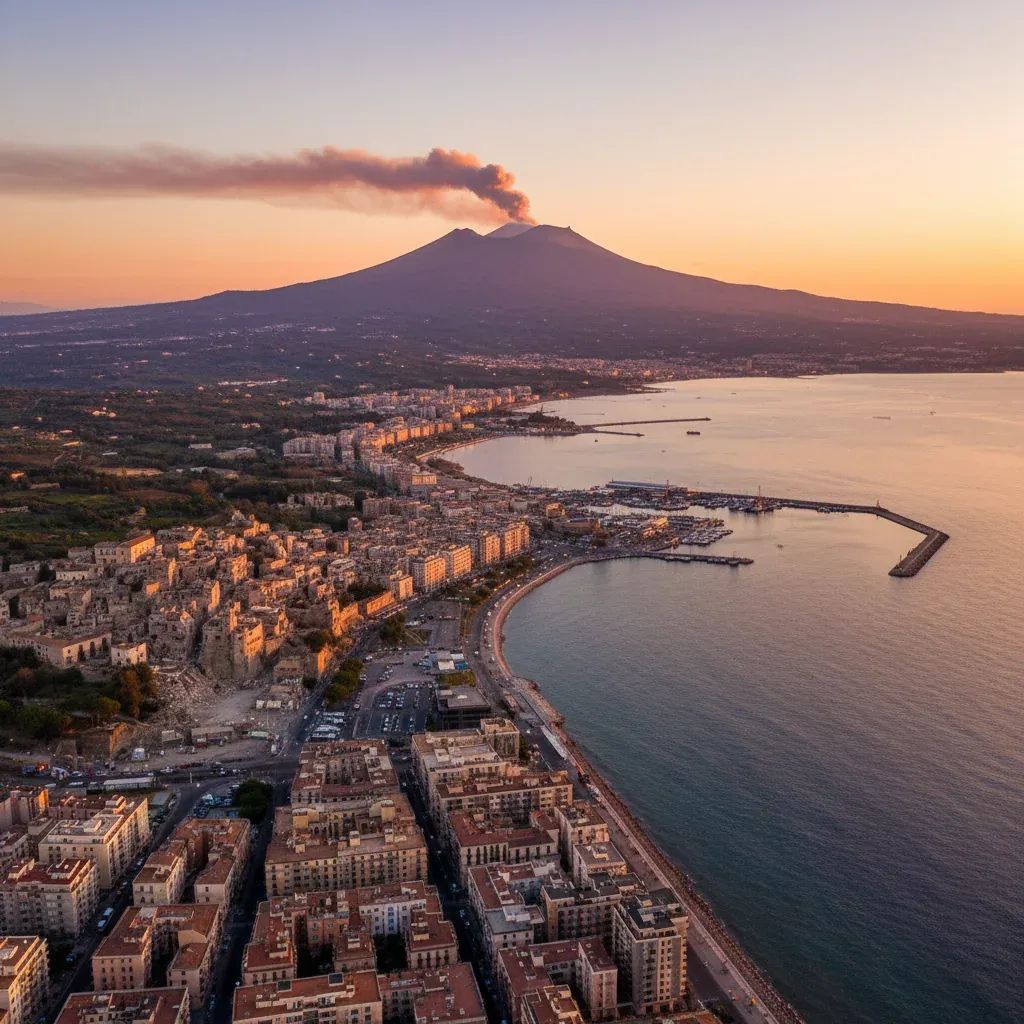
The Italy National Institute of Geophysics and Volcanology (INGV) recorded a dramatic surge in explosive activity from Mount Etna's Voragine crater on August 16, 2026, with volcanic tremor readings climbing to extremely elevated levels that signal powerful magma movement in the volcano's internal conduits. Aviation alerts remain at orange, indicating ongoing ash emissions affecting Sicily's eastern airspace.
IMMEDIATE UPDATES FOR RESIDENTS AND TRAVELERS
• Current alert level: Orange aviation alert (ash present, airspace restrictions in effect)
• Flight operations: Catania-Fontanarossa Airport operational status varies; check airline advisories in real-time
• Currently affected areas: Catania and Siracusa provinces downwind of ash plumes
• Official updates: Monitor INGV alerts at ingv.it and Protezione Civile advisories at protezionecivile.gov.it
Why This Matters
• Flight disruptions: Catania-Fontanarossa Airport has faced repeated closures this week due to ash; travelers should expect delays or cancellations as ash direction shifts with wind patterns.
• Volcanic tremor at elevated levels: The ECPN monitoring station recorded tremor readings well above the 1,000 nm/s benchmark that indicates active eruptive conditions.
• Heightened alert status: The aviation color code has toggled between alert levels in recent days, reflecting the volcano's unpredictable behavior.
• Ash fallout zone: Communities downwind, particularly in the provinces of Catania and Siracusa, may experience ash deposits affecting air quality and road conditions.
Background: The Voragine's Recent Awakening
In 2024, Mount Etna's Voragine crater—a chasm that had observed long dormant intervals between explosive episodes—underwent a dramatic reawakening. Between early July and mid-August 2024, the crater produced a sequence of six paroxysmal events, hurling lava fountains skyward and pumping enough molten rock into the adjacent Bocca Nuova crater to fill it entirely. By September 2024, the Voragine's eastern rim had climbed to approximately 3,403 meters above sea level, establishing a new altitude record for Mount Etna.
In the current August 2026 episode, explosive activity has intensified again. Between late July and early August 2026, the Voragine produced explosive bursts and elevated gas emissions, prompting heightened surveillance. After a brief lull, tremor signals began climbing again on August 13, setting the stage for today's August 16 intensification. This ongoing activity represents a continuation of the volcano's more active phase that began in 2024.
What the Monitoring Network Is Telling Scientists
INGV-Catania's real-time surveillance grid captures seismic waves, ground deformation, gas emissions, and thermal anomalies around the clock. Volcanic tremor—a continuous vibration caused by magma and gas surging through underground channels—serves as the most immediate proxy for eruption intensity. When tremor amplitude exceeds 1,000 nm/s, scientists classify conditions as eruptive. This afternoon's readings place Etna firmly in that category, indicating that pressurized magma is actively fragmenting and ejecting from the vent.
The Volcano Observatory Notice for Aviation (VONA) remains at orange, the second-highest tier, signaling that ash is present but not yet at the concentration or altitude that would mandate a blanket airspace closure. The orange alert underscores the ongoing volatility of the current episode and the need for continued monitoring.
Impact on Residents and Travelers
For anyone living or traveling in eastern Sicily, the implications are immediate and tangible. Catania-Fontanarossa Airport—the island's busiest—has already suspended operations multiple times this month due to ash. While runways have reopened after ash-clearance protocols, further closures depend on wind direction and the volcano's behavior. Travelers should monitor airline advisories and build buffer time into itineraries; alternative routing through Palermo's Falcone-Borsellino Airport adds roughly 200 kilometers and two hours of ground transport.
Health and Safety for Residents:
Ash fallout poses health risks, particularly for residents with respiratory conditions. Fine volcanic particles irritate eyes, throat, and lungs; local health authorities recommend:
• Staying indoors when ash is visible
• Using N95 or FFP2 masks if outdoor activity is unavoidable
• Keeping windows and doors closed
• Monitoring local air quality bulletins
Motorists face reduced visibility and traction hazards, as ash creates slippery road conditions when wet. Municipal crews in affected towns deploy street sweepers and advise residents to avoid hosing ash into storm drains, where it can harden and cause blockages.
Agricultural Impact:
Agricultural zones on Etna's slopes, renowned for pistachios, citrus, and vineyards, experience both benefits and disruption. While volcanic soil delivers exceptional fertility over the long term, acute ashfall can smother crops, clog irrigation systems, and damage fruit on the tree. Growers often cover sensitive plantings with protective sheeting during active phases.
Monitoring and Preparedness Infrastructure
Italy's Protezione Civile relies on INGV data to calibrate public advisories and coordinate emergency response. Protocols established over decades of coexistence with Etna include predefined evacuation routes, shelter-in-place guidelines, and rapid-response teams trained in ash removal and public assistance. Sirens and SMS alerts notify residents in high-risk zones.
For Current Information:
• INGV Real-time bulletins: www.ingv.it
• Protezione Civile Advisories: www.protezionecivile.gov.it
• Catania Municipality Civil Protection: Check local municipal websites for real-time ashfall updates and air quality data
• Sicily Regional Civil Protection: sicilia.it/protezione-civile
Catania's municipality maintains stockpiles of dust masks, goggles, and cleaning equipment distributed through neighborhood civil protection units when needed. Schools in the provincia di Catania follow tiered closure policies based on ashfall intensity and air quality.
For tourists, guided excursions to Etna's lower flanks continue during moderate activity, offering a controlled glimpse of one of Europe's most dynamic geological features. However, summit access above 2,900 meters is restricted when explosive activity intensifies, and tour operators cancel bookings as conditions shift.
What Comes Next
Predicting Etna's behavior on an hourly or daily timescale remains beyond current scientific capability. Tremor can spike and subside within hours; activity may intensify or diminish based on conditions deep within the volcano's plumbing system. The orange aviation alert reflects this uncertainty—a state of elevated readiness without the certainty that warrants more disruptive red-level restrictions.
INGV continues round-the-clock surveillance, publishing bulletins as seismic, thermal, and visual data evolve. For residents and visitors alike, the message is vigilance without panic: stay informed through official channels, heed civil protection advisories, and recognize that while Etna's power commands respect, Sicily's infrastructure and institutions are battle-tested in managing its moods.


