
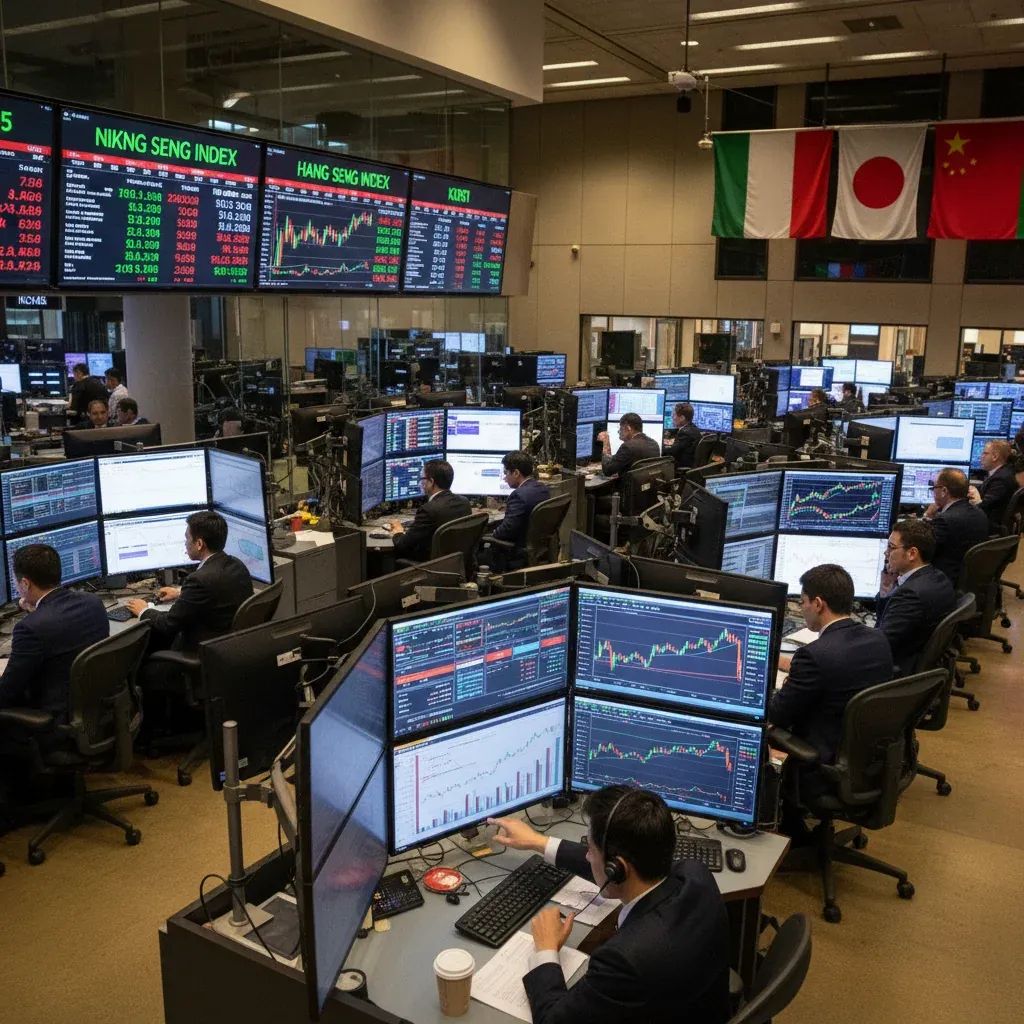
Italy's equity benchmark slipped modestly in late-session trading, surrendering earlier gains to close down 0.18% at 53,446 points, ending a brief run that had pushed the FTSE MIB to fresh all-time highs just hours earlier. The pullback underscores a broader pattern across European markets, where record-chasing sentiment has begun to stall amid renewed geopolitical friction and jitters over artificial intelligence spending in the United States.
Why This Matters
• Record rally stalls: After hitting an intraday peak of 53,870 points, Milan's main index retreated, mirroring flat closes in Frankfurt (-0.2%) and Paris (-0.03%).
• Sector divergence: Telecom infrastructure firm Inwit dropped 2.78% following weaker-than-expected earnings, while shipbuilder Fincantieri fell 2.2% despite strong fundamentals.
• MPS remains resilient: Shares of Banca Monte dei Paschi di Siena gained 1.64%, extending a strong performance as the bank navigates strategic challenges and prepares to report second-quarter results.
A Day of Two Halves
The Milan Stock Exchange opened firmly in positive territory, buoyed by optimism in European markets. By mid-morning, the FTSE MIB touched a new lifetime intraday high, extending a rally that has seen the index outperform most European peers.
Yet the momentum evaporated by afternoon as concerns over geopolitical tensions and energy security weighed on sentiment. Brent crude remained volatile, influencing investor risk appetite. ENI, Italy's energy major, saw fractional losses as oil volatility weighed on sentiment.
Meanwhile, technology shares faced headwinds imported from Wall Street. STMicroelectronics declined 1.59% as investors absorbed disappointing results from U.S. semiconductor companies. Concerns over capital expenditure budgets for artificial intelligence infrastructure have begun to temper enthusiasm for the semiconductor sector, a dynamic that rippled across European tech counters.
What This Means for Investors
For those holding Italian equities, the modest retreat offers a moment to reassess positioning after a strong rally. The FTSE MIB has demonstrated resilience on a basket of tailwinds: elevated interest rates boosting bank profitability, defense procurement cycles tied to escalating European security concerns, and resilient service-sector activity.
The market has entered a consolidation phase near 53,500 points, a level that technical analysts now identify as a near-term pivot. A confirmed break above 53,960 points would signal fresh buying, while a retreat below 51,450 points could trigger a deeper correction toward the psychologically significant 50,000 mark.
Investors seeking exposure to Italy's equity market should note that three sectors remain structurally favored through September: banking (supported by sustained high rates and fee income), energy (benefiting from elevated crude pricing), and defense (underpinned by long-term European rearmament budgets).
Individual Movers Tell a Broader Story
Inwit, the cellular tower operator spun off from Telecom Italia, led decliners after reporting a 13% drop in net profit for the first half, to €160.3 M. Revenue also slipped 0.8% to €531.1 M. While the company reaffirmed its full-year guidance—including a dividend of at least €0.55 per share—investors appeared to price in the impact of a March agreement between TIM and Fastweb that reduced revenue expectations. Shares closed at approximately €6.48, reflecting continued uncertainty over tower-asset consolidation dynamics in Italy.
Fincantieri, the state-backed shipbuilder, saw a 2.2% decline despite fundamentals that would normally support a rally. The company reported first-half net profit of €102 M, nearly triple the prior-year figure, and confirmed guidance for full-year earnings between €140 M and €180 M. New orders include two expedition vessels for Silversea and the acquisition of subsea engineering firm Next Geosolutions. The stock had risen for four consecutive sessions before today's dip, and analysts maintain a "Buy" rating with a three-month upside forecast of 12.5%.
In contrast, Monte dei Paschi di Siena extended its strong performance, adding 1.64% to close near €11.57. The Tuscan lender continues to navigate a complex strategic environment with multiple restructuring scenarios under consideration. Analysts expect solid second-quarter earnings when MPS reports, with particular strength in fee income.
Broader European Context
Milan's performance mirrored that of its continental peers. Frankfurt's DAX shed 0.2%, Paris's CAC 40 dipped 0.03%, and London's FTSE 100 managed a fractional gain of 0.08%. All four bourses have hovered near multi-year or all-time highs in recent weeks, a testament to resilient corporate earnings and expectations that the European Central Bank will hold rates steady through the near term after recent policy decisions.
The BTP-Bund spread—a key barometer of Italian sovereign risk—narrowed to 75 basis points. The yield on Italy's 10-year government bond eased back to 3.9%, reflecting sustained confidence in the country's fiscal trajectory despite broader political uncertainties.
Service Sector Brightness Amid Manufacturing Gloom
One bright spot in the domestic data came from Italy's services PMI, which jumped to 52.5 from 50.2 in the previous month, marking strong expansion. The reading, which measures activity in sectors ranging from hospitality to professional services, surpassed analyst forecasts and suggests consumer-facing businesses are weathering inflation pressures better than expected.
This divergence between services strength and manufacturing weakness—common across much of Europe—reinforces the view that Italy's economic resilience hinges on domestic demand rather than export-driven industrial output.
Defense and Telecom Shine
Among the day's winners, Leonardo—the aerospace and defense conglomerate—climbed 1.54% after posting strong first-half results. The company's net profit surged year-over-year, and several brokerages lifted price targets in anticipation of sustained defense procurement tailwinds. Poste Italiane gained 1.18%, while Telecom Italia advanced 1.71%, benefiting from renewed investor interest in restructuring plays and dividend yield.
Interpump, the hydraulic components maker, surged 5.22%, and gaming operator Lottomatica jumped 3.7%, both reflecting sector-specific optimism. Safilo, the eyewear maker, soared approximately 10% after releasing first-half results that beat estimates.
On the downside, Unicredit slipped between 0.6% and 1.08%, Moncler shed 0.7%, and Stellantis—the automotive giant—retreated 1.82% as investors fretted over weakening demand signals from key markets.
What Comes Next
Analysts tracking the FTSE MIB see potential for continued consolidation as investors digest recent data and await policy clarity. However, the consensus view is that volatility will persist, particularly as global investors await clarity on macroeconomic trends and central bank policy decisions.
For residents of Italy with equity portfolios or pension exposure to domestic stocks, the key takeaway is straightforward: the market has entered a consolidation phase after a strong rally. Positioning in banking, energy, and defense remains tactically sound, but near-term choppiness is likely as external factors continue to influence sentiment on Milan's trading floors.


