
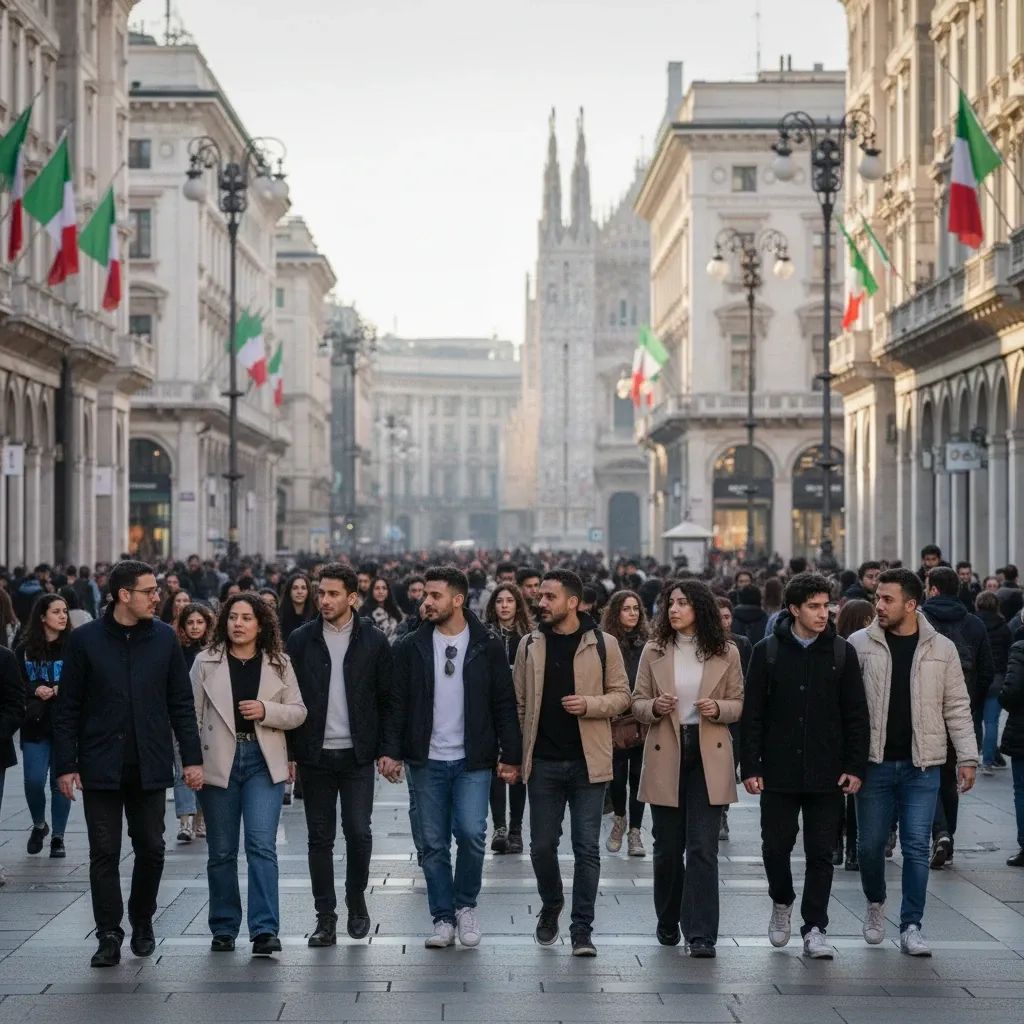
Italy's governing coalition has splintered into open political theater on the streets of Milan on April 18, 2026, where competing visions for citizenship and migration played out in three simultaneous rallies that reveal the widening fault lines within the center-right government.
Why This Matters:
• Forza Italia publicly broke ranks with coalition partner Lega by sponsoring a counter-rally for second-generation immigrants at the Arco della Pace, even as Lega hosted a far-right "Patriot Summit" in Piazza Duomo.
• Over 50,000 signatures have been collected for a "Remigration and Reconquest" bill that proposes systematic expulsions and criminal penalties for migrants with deep roots in Italy.
• Left-wing and antifascist protesters clashed with police using water cannons and tear gas near the Duomo, painting "Milano è migrante" on streets and blocking access routes.
• The April 18 events underscore how immigration policy has become the sharpest wedge in Italian politics ahead of crucial legislative debates on citizenship reform.
Coalition Partners Stage Dueling Rallies
While Italy's Lega party hosted European nationalist leaders including France's Jordan Bardella and the Netherlands' Geert Wilders in the symbolic heart of Milan's Piazza Duomo, Forza Italia operatives organized their own gathering less than 2 kilometers away. The "Con Coraggio" (With Courage) sit-in at the Arco della Pace was explicitly designed to showcase second-generation Italians — children of immigrants born or raised in Italy who contribute to the nation's economy but remain trapped in bureaucratic limbo under current citizenship law.
Amir Atrous, Forza Italia's immigration department chief in Milan, orchestrated the event despite initial resistance from the party's local Milan secretariat, which feared provoking Lega leader Matteo Salvini. By the event's opening, however, national-level Forza Italia figures including Stefania Craxi and Letizia Moratti had thrown their support behind the initiative, signaling Forza Italia's strategic shift toward addressing immigration reform.
"This rally was not organized 'against' anyone but 'for' something: to place the issue of new Italians at the center of public debate with a constructive and inclusive spirit," Atrous told gathered media. He was flanked by Gianluca Comazzi, a Forza Italia regional councilor, who emphasized that the young people present "contribute every day to the economy of our country and our region."
The presence of Abdullah Badinjki, a Democratic Party councilor from Paullo, added a rare cross-party dimension to the gathering. Attendees waved Italian tricolor flags, a deliberate visual contrast to the nationalist messaging unfolding simultaneously at the Lega rally.
What the "Remigration" Debate Really Means
The Lega event centered on a concept increasingly prominent in European far-right circles: "remigrazione" — a term historically meaning voluntary return migration, but now repurposed to signify mass deportations and restrictive residency systems. A legislative proposal titled "Remigrazione e Riconquista" gathered over 50,000 signatures by January 2026 and is now pending in Parliament.
The bill proposes abolishing annual work visa quotas, tightening family reunification criteria to near-impossibility, and introducing criminal sanctions tied to "remigration pacts" — effectively contracts requiring migrants to leave Italy under specific conditions. Legal scholars have flagged the proposal as potentially unconstitutional and in violation of international human rights standards, arguing it creates a "double penalty" system for foreign nationals and transforms long-settled residents into targets of structural exclusion.
Salvini framed the policy as a "points-based system" for residency permits, where "errors" — undefined in the proposal — trigger automatic return to countries of origin. Critics note this would affect not only recent arrivals but also individuals with family ties, jobs, and decades of legal residence in Italy.
Street Confrontations and Police Cordons
As the Lega procession moved from Porta Venezia toward Piazza Duomo on April 18, 2026 — flanked by farmers on tractors and local Lega mayors — antifascist and pro-migrant coalitions launched counter-protests from three starting points: Piazza Tricolore, Piazza Lima, and Piazza Argentina. The groups converged near the Palazzo di Giustizia on Corso di Porta Vittoria before heading to their terminal point in Piazza Santo Stefano, near the State University.
Italian police deployed water cannons and riot squads in Via Borgogna after demonstrators from social centers including Lambretta and Zam attempted to breach security cordons. Protesters hurled firecrackers, smoke bombs, and bottles at officers. Chants of "No border, no nation, fuck remigration" and "Matteo Salvini non ti vogliamo" (We don't want you, Matteo Salvini) echoed through the streets.
At the intersection with Viale Majno, activists from the Cantiere collective spray-painted "Milano è migrante" directly onto the asphalt after a brief negotiation with police allowed the march to continue along Corso Buenos Aires rather than divert. A banner reading "Milano è migrante e partigiana" (Milan is migrant and partisan) was strung between traffic lights, invoking the city's World War II resistance legacy.
Ilaria Salis, a Member of the European Parliament for the Alleanza Verdi e Sinistra (AVS, a left-wing alliance party), marched with the protesters and described remigration as a "neo-fascist practice" that must be resisted. Asked about Salvini's claim that blocking the Patriot rally would be "fascist," Salis replied bluntly: "The fascist is him." She added that such gatherings "should not have the legitimacy to exist on any day of the year," particularly near the anniversary of Italy's Liberation Day on April 25.
What This Means for Residents
For Italy's estimated 1.3 million second-generation residents — representing approximately 2.2% of Italy's total population and a significant portion of the workforce in Lombardy and other industrial regions — individuals born in Italy to foreign parents or who arrived as children, the political theater of April 18, 2026 carries tangible consequences. These young adults have largely completed their education, entered the workforce, and built lives entirely within Italy, yet remain trapped in legal limbo under current citizenship law.
Understanding Your Current Status:
Under current law, citizenship is granted almost exclusively through jure sanguinis (bloodline inheritance), leaving many unable to access the full rights of Italian residents despite their deep roots. Proposals for reform center on ius scholae, which would grant citizenship after completing five years of schooling in the Italian education system. Forza Italia has championed this approach, while Lega and Prime Minister Giorgia Meloni's Fratelli d'Italia (a conservative party and key coalition partner) have resisted.
A 2025 reform sponsored by the Meloni government further restricted jure sanguinis transmission beyond the second direct generation, a measure now under review by the Court of Cassation in 2026.
Immediate Legislative Threats:
The "Remigrazione e Riconquista" bill would compound these barriers by introducing expulsion mechanisms even for legal residents with established roots. If passed, it could subject individuals to criminal prosecution under vague "remigration pact" violations, effectively creating a class of permanently provisional residents.
Timeline to Monitor:
Parliamentary debate on the "Remigrazione e Riconquista" bill is expected in coming months, while ius scholae proposals remain stalled in committee. Residents should monitor official government websites and parliamentary notices for legislative votes scheduled in the coming sessions.
Practical Steps for Affected Residents:
• Contact immigrant advocacy organizations such as ASGI (Italian Association for Legal Studies on Immigration) or local sindacati (labor unions) to understand your current status protections
• Document your years of residence, employment history, and ties to Italy in case legislative changes require proof of establishment
• Monitor updates from your local Comune (municipal office) regarding citizenship application procedures
• Connect with migrant communities and advocacy networks for updates on legislative developments
For employers, particularly in Lombardy's manufacturing and service sectors where second-generation workers represent a significant labor pool, the uncertainty threatens workforce stability. Business associations have quietly lobbied against the bill, fearing it would exacerbate existing skilled labor shortages in key industries.
The Fracture Within Italy's Right
The dual rallies expose a strategic rift between Lega's hardline nationalism and Forza Italia's evolving posture. While both parties govern in coalition with Fratelli d'Italia (Prime Minister Meloni's party), their divergence on immigration could reshape Italy's political map. Forza Italia's public support for the April 18 counter-rally signals the party's willingness to pursue a distinct immigration platform separate from Lega's hardline approach.
Lega, led by Matteo Salvini, has experienced slipping polling numbers in recent quarters. The Patriot Summit — attended by figures like Wilders and Bardella — was partly a show of international alignment meant to bolster domestic credibility. Salvini also used the event to thank Hungarian Prime Minister Viktor Orbán for "defending borders and fighting human traffickers."
The April 18, 2026 rallies will likely accelerate legislative maneuvering around citizenship reform. With parliamentary debate on the "Remigrazione e Riconquista" bill expected in coming months, and ius scholae proposals stalled in committee, the streets of Milan have previewed the battle lines that will define Italy's immigration discourse through the next election cycle.
For now, the message from Milan's asphalt is unambiguous: identity, belonging, and the legal status of over a million people remain unresolved questions that divide not only left from right, but coalition partners from each other.


