
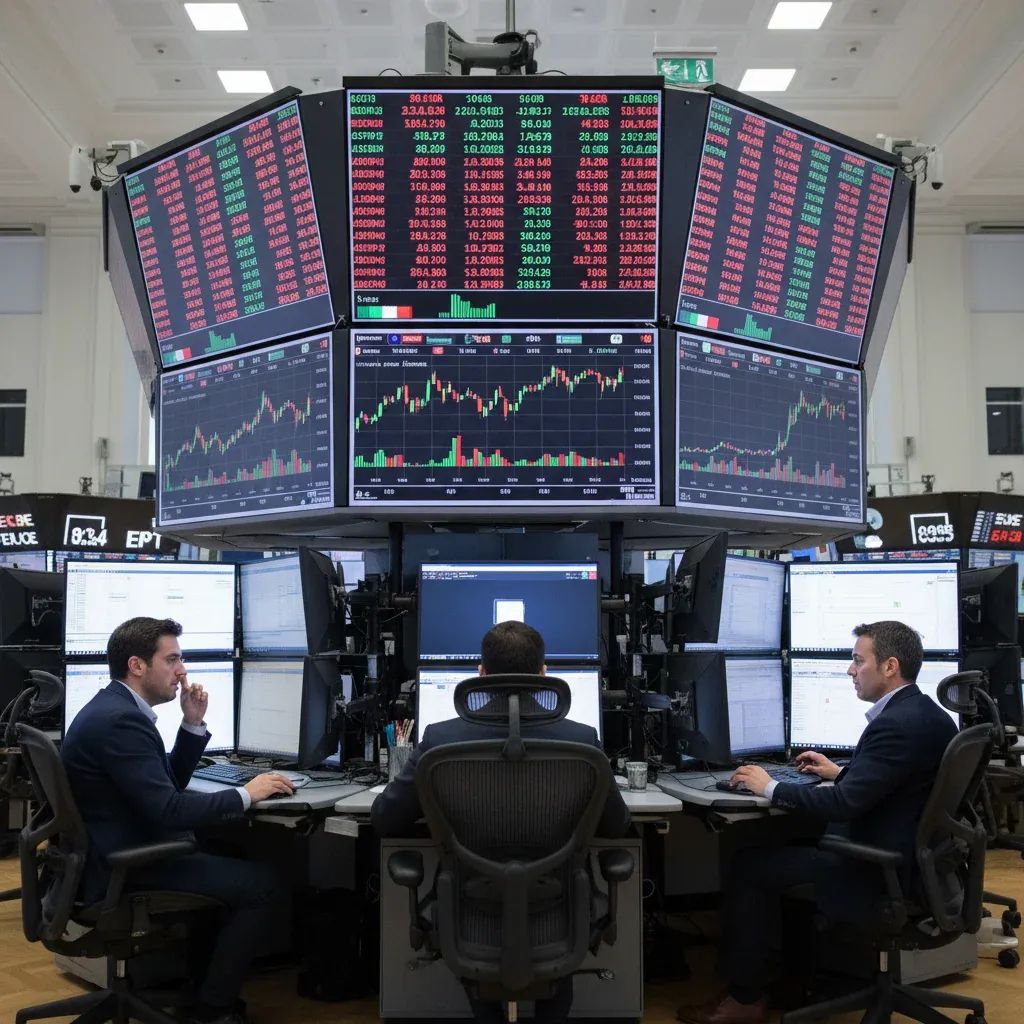
Milan's stock exchange closed down 0.47% on Tuesday, April 7, 2026, ending a volatile session that saw early gains evaporate amid geopolitical tensions and domestic corporate uncertainty. The FTSE Mib index settled at 45,411 points, surrendering an opening rally of more than 1% as U.S. President Donald Trump escalated threats against Iran and political jitters rattled Italy's defense sector.
Why This Matters:
• Energy costs rising: Natural gas futures jumped 6% to over €53 per megawatt-hour, a move that threatens household bills and industrial margins across Italy.
• Defense stock drama: Leonardo plunged 8% on rumors the Italian Treasury will replace CEO Roberto Cingolani for political reasons, despite strong financial performance.
• Spread widening: The BTP-Bund spread climbed to 90 basis points, with Italian 10-year yields hitting 3.98%, signaling higher borrowing costs ahead.
Opening Optimism Gives Way to Mid-East Anxiety
Piazza Affari began the day on a confident note, climbing 0.34% in early trading and briefly touching a 1.23% gain within the first hour. By midday, the benchmark remained up 0.5%, buoyed by strong performances in semiconductors and telecommunications infrastructure. Yet by the closing bell, the mood had soured: Milan's main index fell 0.47%, mirroring weakness across European bourses.
The reversal coincided with Trump's ultimatum to Iran and a negative open on Wall Street, where the Dow Jones lost 0.91%, the Nasdaq shed 1.38%, and the S&P 500 dropped 0.94%. One London-based analyst warned that "if the deal doesn't materialize, we could see a final capitulation in European equity markets."
Crude oil rallied sharply—WTI rose 1.95% to $114.61 per barrel and Brent gained 0.68% to $110.54—while natural gas in Europe surged 6% to €52.30 per MWh. Gold held steady near $4,649 per ounce as investors weighed safe-haven options.
Leonardo's Freefall: Politics Trumps Performance
The session's worst performer was Leonardo, Italy's aerospace and defense champion, which tumbled 8% and erased gains accumulated since late March. The sell-off was triggered by reports that the Italian Ministry of Economy and Finance, which holds a 30.2% stake, intends to replace CEO Roberto Cingolani when his three-year term expires in May.
Cingolani's tenure has delivered impressive results: Leonardo's share price climbed 22% year-to-date before Tuesday's drop, and the company posted robust financials. Yet sources close to the government suggest the decision is politically motivated, possibly reflecting tensions between Prime Minister Giorgia Meloni and Defense Minister Guido Crosetto, who has publicly backed Cingolani. Some reports cite the CEO's pro-European profile as a potential friction point.
Guy Wyser-Pratte, an activist investor with a stake in Leonardo, condemned the potential ouster as "political interference" and pledged to defend shareholder interests. Candidates rumored to be under consideration for the CEO role include Lorenzo Mariani (CEO of MBDA Italia), Piergiorgio Folgiero (Fincantieri CEO), Stefano Donnarumma (CEO of Italy's state railways), and Alessandro Ercolani (Rheinmetall Italia). The Treasury is required to submit its slate of board candidates by April 13.
The uncertainty underscores how state-controlled firms in Italy remain vulnerable to political cycles, even when their financial trajectory is positive.
What This Means for Residents
For Italian households and businesses, the market's gyrations translate into tangible risks:
• Higher energy bills: The spike in gas prices—up 6% in a single session—will flow through to household heating costs and industrial electricity tariffs. Gas price increases typically flow through to household bills within 2-3 months. Italy's heavy reliance on imported energy makes it particularly exposed to Middle East supply shocks.
• Borrowing costs creeping up: The widening spread between Italian and German bonds signals rising sovereign risk. If sustained, this will push up mortgage rates, corporate loans, and the government's debt service burden.
• Defense sector jobs: Leonardo employs thousands across Italy. Leadership instability could delay strategic decisions, disrupt contracts, and impact suppliers in aerospace, electronics, and shipbuilding clusters.
• Pension fund exposure: Italian pension funds and retail investors hold significant positions in FTSE Mib constituents. A prolonged downturn—particularly if geopolitical tensions escalate—erodes retirement savings and mutual fund returns.
Winners and Losers on the Day
Not all stocks suffered. Inwit, the telecommunications tower operator, soared 5.98%, climbing above levels last seen on March 19, before a landmark towers agreement between Tim and Fastweb. Tim itself rose 1.8%, benefiting from positive sentiment around infrastructure assets.
STMicroelectronics gained 5.1%, tracking a broader rally in European chip stocks, while Ferragamo surged 6.26% after Barclays analysts raised the luxury brand's price target by 12% to €5.50 ahead of first-quarter results on May 14.
Banking stocks showed mixed performance. Intesa Sanpaolo added 1.35%, Bper Banca climbed 1.2%, and Banco BPM rose 1%, while UniCredit (+0.5%), Monte dei Paschi (+0.2%), and Mediobanca (+0.18%) lagged behind.
On the downside, Moncler fell 4%, Stellantis dropped 3.8%, Ferrari declined 0.46%, and Diasorin slipped 0.55%. Saipem, the oil services firm, turned negative late in the session, down 0.15% despite earlier gains.
European Context: A Continent on Edge
Italy's performance reflected broader European weakness. By late afternoon, London had fallen 0.5%, Frankfurt dropped 0.79%, and Paris lost 0.28%. The Stoxx Europe 600 index ended flat after erasing earlier gains.
The Sentix investor confidence index for the eurozone plunged in April, weighed down by the Iran conflict. S&P Global Ratings has already cut its 2026 growth forecast for the eurozone and Italy, citing energy price shocks and trade policy uncertainty.
Trump's "America First" posture—including the threat of tariffs up to 50% on European goods—adds another layer of concern for export-dependent economies like Italy. The automotive, chemicals, and machinery sectors are particularly vulnerable.
Energy Market Flash Point
The Strait of Hormuz, through which a significant share of global oil and gas passes, remains a critical chokepoint. Any blockade or military escalation could trigger supply shortages across Europe. The European Commission has activated a task force to monitor oil and LNG markets, while OPEC announced a production increase of 206,000 barrels per day starting in May to calm prices.
For Italy, which lacks significant domestic fossil fuel production, energy security concerns have intensified. Industrial groups have urged the government to secure alternative supply routes and accelerate renewable energy deployment.
Outlook: Volatility Here to Stay
Early April 2026 had been shaping up as one of the strongest months for the FTSE Mib before Tuesday's reversal. The index closed April 1 at 45,714 points, up 3.17%, and the first week of the month delivered a 5.18% gain—the best weekly performance of the year and enough to push the year-to-date return into positive territory (+1.51%).
Yet the path ahead remains treacherous. Investors face a dual threat: geopolitical escalation that could send energy prices into a spiral, and protectionist trade policies that would hammer Italian exporters. The combination has already prompted a flight to safety, with demand rising for German bonds and gold.
For now, the Italian Ministry of Economy must decide whether political considerations at Leonardo outweigh market stability, and European policymakers must prepare contingency plans for energy supply disruptions. Tuesday's session served as a reminder that even strong fundamentals can be overwhelmed by external shocks—and that Italy, as a mid-sized, energy-import-dependent economy, remains acutely vulnerable to global turbulence.


