
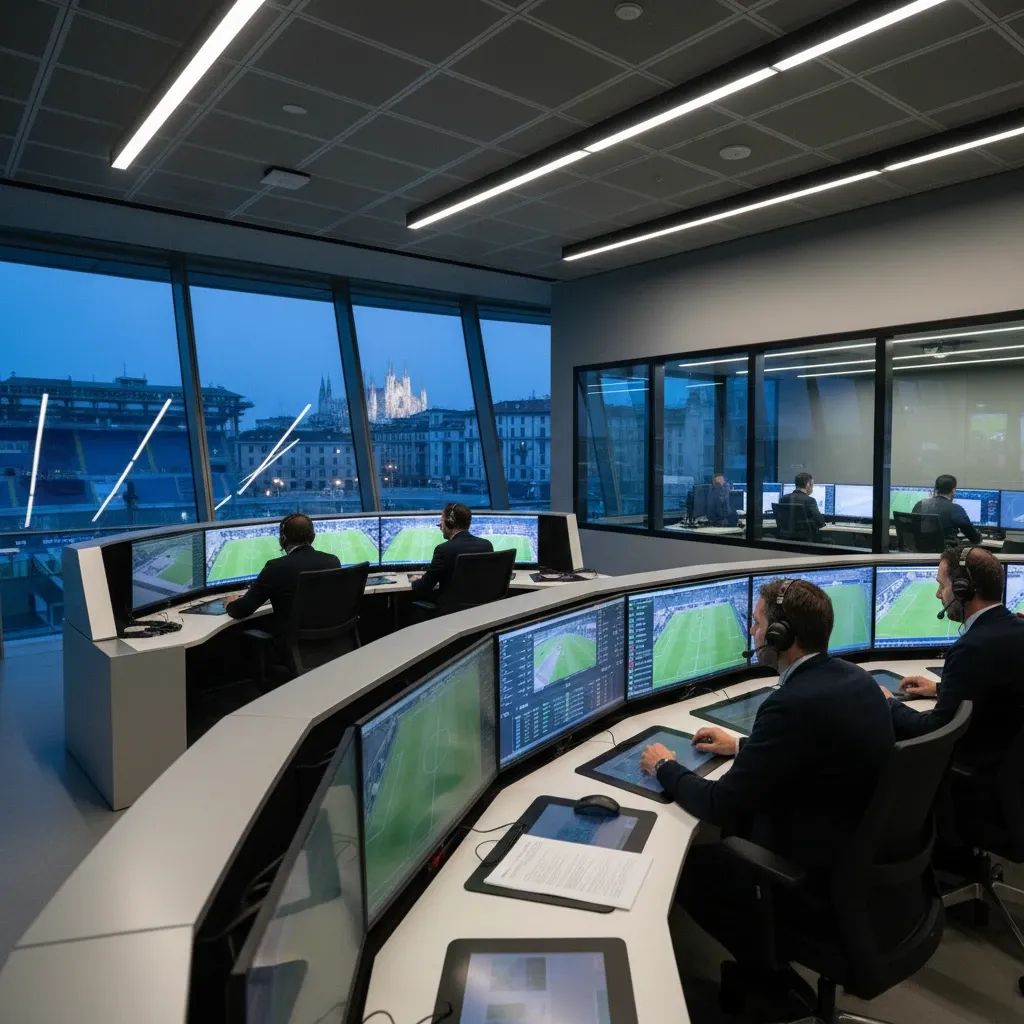
The Italian Football Refereeing System has entered turbulent waters as prosecutors in Milan intensify their investigation into allegations that senior officials manipulated match outcomes through pressure on video assistant referees. The probe, which has already led to two high-profile self-suspensions, now centers on a 30 April 2025 interrogation that produced sharply conflicting accounts—and raises questions about whether the technology meant to ensure fairness has instead become a tool for behind-the-scenes influence.
Why This Matters
• Leadership vacuum: Gianluca Rocchi, the designator responsible for assigning all referees to Serie A and Serie B matches, has stepped aside pending the outcome of criminal inquiries into alleged sporting fraud.
• VAR under scrutiny: Investigators are examining whether supervisors used physical signals—including knocking on the glass wall of the VAR booth—to steer decisions during live matches.
• No clubs charged: Despite headlines invoking memories of the 2006 Calciopoli scandal, no football clubs or their executives are currently under investigation, and legal experts caution against premature comparisons.
The Interrogations: Two Men, Two Defenses
Andrea Gervasoni, a 50-year-old VAR supervisor who also chose to self-suspend, spent four hours on 30 April 2025 inside Milan's financial crimes unit answering questions from prosecutor Maurizio Ascione. Investigators played audio intercepts and video recordings from the VAR control room in Lissone—a municipality north of Milan where all Serie A and B video reviews are managed—and confronted Gervasoni with an allegation that he had intervened to overturn a penalty awarded to Modena against Salernitana on 8 March 2024.
According to the prosecution, a wiretapped conversation between two other match officials suggests Gervasoni pressured VAR operator Luigi Nasca to call referee Antonio Giua back to the monitor, prompting a reversal of the initial penalty decision. Gervasoni's response was categorical: "I wasn't there." He explained that until mid-2024, only one supervisor covered both the top two divisions simultaneously, and that day he was stationed in the separate Serie A control room on a different floor of the Lissone facility. His lawyer, Michele Ducci, presented floor plans to support the claim.
The interrogation also veered into territory where Gervasoni is not formally accused. Prosecutors raised questions about Inter-Roma on 27 April 2024—the match that effectively decided last season's title race in favor of Napoli—after media reports noted that the broadcast version of the VAR audio distributed through DAZN's "Open Var" programme was missing 50 to 60 seconds compared to the original recording. The gap covers the moments when referee officials discussed—and ultimately declined to award—a penalty to Inter for a foul on defender Yann Bisseck. Inter's failure to score from this non-penalty call, combined with other results that day, meant Inter could not accumulate enough points to catch Napoli, effectively handing the Serie A title to the southern club.
Gervasoni told reporters outside the prosecutor's office that he excludes any tampering "100%" and attributed the shortened clip to routine editing for television. "A VAR decision is made in 10 to 15 seconds," his lawyer added. "There isn't time for someone to lean on the operators and change the call." Gervasoni acknowledged he was present in the booth that day but insisted the controversial non-penalty was simply "a massive VAR error" that was later punished internally with negative performance scores.
Rocchi, meanwhile, did not appear for his scheduled questioning the same day. His attorney, Antonio D'Avirro, said it made no sense to submit to an interview without first seeing the evidence file—a right defendants in Italy gain only after investigators formally close the preliminary phase and request trial or dismissal. "We will wait for the investigation to conclude, then access the full dossier and prepare our defense," D'Avirro told the press.
What Rocchi Is Accused Of
The Milan Prosecutor's Office has notified Rocchi of three separate counts of alleged sporting fraud:
Udinese-Parma, 1 March 2024: Allegedly using physical signals—described in legal documents as "knocking on the VAR room glass"—to influence a refereeing decision in favor of awarding a penalty.
Bologna-Inter, 20 April 2024: Purportedly designating referee Andrea Colombo to that fixture because he was considered "favorable to Inter" by those coordinating assignments.
Exclusion of "unwelcome" officials: Ensuring that referee Daniele Doveri, allegedly deemed "not favored by Inter," would not be assigned to critical Inter matches in the final rounds of the championship or a potential Coppa Italia final.
The accusations have prompted inevitable comparisons to Calciopoli, the 2006 match-fixing scandal that stripped Juventus of two titles, relegated multiple clubs, and shook Italian football to its foundation. Yet Cesare Di Cintio, a Bergamo-based sports-law attorney who himself refereed in Serie C in the early 2000s, offers a different perspective. "There are no elements here that constitute sporting fraud," Di Cintio said in a 29 April podcast appearance. "This appears to be an internal arbitration matter. I don't see who would have gained an advantage, and neither clubs nor federation leadership are implicated." Di Cintio believes prosecutors may ultimately seek dismissal rather than indictment, though this remains his legal opinion rather than an indication of the prosecution's actual trajectory.
Di Cintio, who worked alongside both Rocchi and Gervasoni during his own refereeing days, recalled them as "upright and principled individuals." He acknowledged that the designator's role is inherently delicate—assignments depend not only on technical ability but also on an official's capacity to withstand intense crowd pressure—and stressed that referees remain human beings who experience tension and make mistakes. "The referee is an important element of our system and must be protected," he added.
What This Means for Residents
For anyone in Italy who follows Serie A—or places wagers on match outcomes—the investigation raises immediate questions about the integrity of results from the 2024–25 season. Although no matches have been officially voided or replayed, the probe has already reshaped the administrative landscape:
• Dino Tommasi has taken over as interim designator for both Serie A and Serie B, a temporary appointment expected to last through the end of the current season before broader leadership elections scheduled for 22 June.
• The Italian Football Federation (FIGC) has requested the full case file from Milan prosecutors, but under Italian procedure those documents will be transmitted only after the criminal investigation closes—likely not before November 2026, when the current investigative deadline expires. That timeline means any sporting sanctions, should clubs eventually be implicated, would apply to the 2026–27 season rather than current or past campaigns.
• Enhanced monitoring of VAR operations is already in place at the Lissone control center, with additional oversight intended to prevent unauthorized communication between supervisors and booth operators during live play.
The Italian Sports Minister has publicly called for "radical change" in football governance, and some commentators have floated the idea of placing the Italian Referees' Association (AIA) under temporary external administration. Former federation president Giancarlo Abete has cautioned that such a move would be complex and could trigger sanctions from UEFA or FIFA if seen as government interference in sport.
The VAR Dilemma
Di Cintio also weighed in on a broader structural concern: that video technology, introduced to eliminate human error, has instead "de-responsibilized referees" by encouraging them to defer too readily to the screen. "We rely on the electronic tool too easily," he said. "We can't go back, but we can redefine the boundaries of when VAR should be used. Today we overuse it." He dismissed the idea of random assignment—an option occasionally proposed to eliminate favoritism—on the grounds that Italy does not have forty referees of equivalent quality, and that lottery selection would negate the designator's core function of matching temperament and skill to each fixture.
The Road Ahead
The Milan investigation, coordinated by the Financial Crimes Unit of the Guardia di Finanza, has so far gathered dozens of witness statements—many focused on what insiders call the "Rocchi system"—and collected extensive audio and video from the VAR archive. Investigators have also reviewed phone intercepts, a technique that became legally permissible for sporting-fraud cases in 2014 when Parliament raised maximum penalties from two to six years' imprisonment.
Among those also under investigation are Rodolfo Di Vuolo and Luigi Nasca, both VAR operators accused of complicity in fraud, and Daniele Paterna, who faces a separate charge of providing false information to prosecutors. No trial date has been set, and authorities have indicated the inquiry remains far from complete.
In a brief statement to the television program "Le Iene" broadcast this week, Rocchi maintained that his work has always been transparent. "We operate in only one way, so we don't have major problems," he said. "I am transparent with everyone about everything. I work always and exclusively in one way only." When asked whether he would commit to greater clarity around VAR protocol, he replied: "Totally—but I've always done that, so I'm not promising something I'm already doing."
The ultimate question is whether Italian football is witnessing a repeat of systemic corruption or simply a clash of personalities within a high-pressure refereeing structure. Legal experts like Di Cintio have offered their interpretations, but prosecutors have yet to reveal their conclusions. For now, however, the twin pillars of Italian match officiating—human judgment and digital review—both stand under the microscope, and the outcome will likely reshape how the game is governed for years to come.


