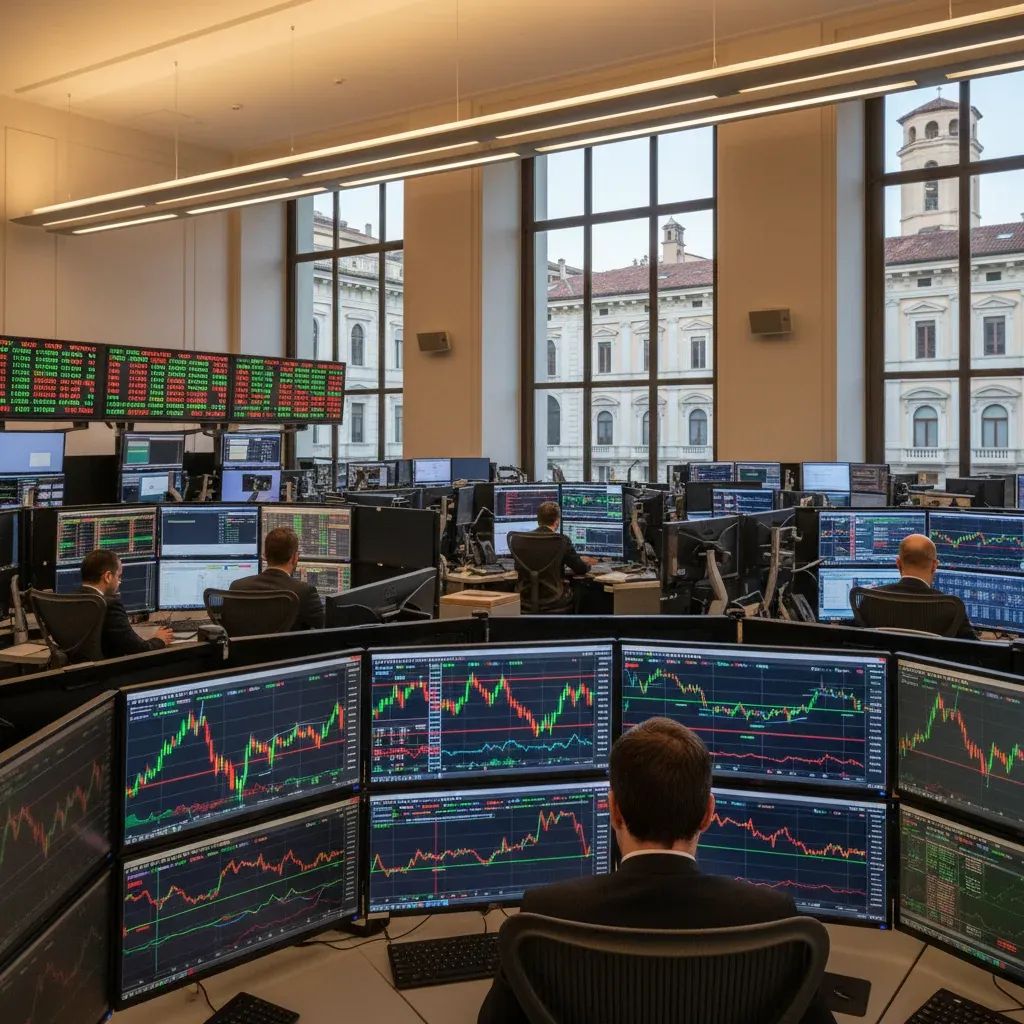
Italy's blue-chip index swung from morning optimism to afternoon weakness, ultimately sliding 0.45% to close at 51,819 points—a session dominated by a sharp correction in engineering giant Saipem and broader sell-offs in technology and industrial stocks that overshadowed strength in defense and luxury sectors.
Why This Matters
• Portfolio impact: Saipem shares plummeted 7.7% after slashing its full-year earnings guidance, wiping out gains from defensive stocks and luxury names.
• Technology exposure: Semiconductor manufacturers and cable producers faced coordinated selling pressure tied to Asian market contagion and AI infrastructure concerns.
• Defense sector opportunity: Leonardo and Avio surged up to 3.3%, extending a multi-month rally fueled by NATO procurement and geopolitical tensions.
• Bond stability: The 10-year Italian government bond yield held steady at 3.93%, with the spread over German Bunds anchored at 81 basis points—a sign of relative fiscal confidence despite equity volatility.
Saipem's Guidance Cut Triggers Investor Flight
The session's steepest losses centered on Saipem, whose shares collapsed after the oil services contractor reduced its full-year adjusted EBITDA forecast. The company attributed the revision to two primary factors: extra costs tied to Middle East conflict disruptions—including heightened insurance premiums, security expenses, and logistical bottlenecks from intermittent closures of the Strait of Hormuz—and the deconsolidation of its shallow-water drilling business following a recent asset sale.
Despite posting respectable first-half results—revenue climbed 1.9% to €7.3B and adjusted EBITDA rose 9.4% to €836M—investors punished the stock for the dimmed outlook. The company maintained its targets for cash flow, capital expenditure, and top-line growth, but the guidance downgrade overshadowed those positives. By the close, Saipem had shed more than €600M in market capitalization.
Technology and Industrial Stocks Buckle Under Asian Pressure
STMicroelectronics tumbled 3%, tracking broader weakness in the semiconductor sector that began overnight in Asia, where fears over the sustainability of artificial intelligence infrastructure spending triggered sharp declines in chip manufacturers. The sell-off rippled through European tech stocks, dragging Prysmian down 3.6%.
Prysmian has been pursuing strategic partnerships to support next-generation data center infrastructure as part of its expansion strategy. Its Asia-Pacific operations, which include production facilities in Malaysia, Indonesia, and Thailand, remain central to its long-term growth plans, but near-term sentiment soured on semiconductor and tech infrastructure exposure amid Asian market pressures.
Other industrial names also retreated: Lottomatica shed 2%, while luxury outerwear maker Moncler fell 1.76%.
Defense Giants Leonardo and Avio Lead Gainers
Counter to the broader market malaise, defense and aerospace stocks delivered robust gains. Leonardo advanced 2.58%, cementing its position as one of the top performers on the Ftse Mib year-to-date. The Rome-based defense contractor has benefited from surging NATO procurement driven by geopolitical instability.
Analyst sentiment remains bullish on Leonardo's prospects: the company's strong order backlog and strategic pivot toward integrated security and technology systems have positioned it as a prime beneficiary of elevated European defense spending. Leonardo's recent acquisition of Iveco Defence Vehicles has expanded its capabilities in the land defense sector and is expected to contribute meaningfully to revenues in the coming periods.
Avio, the satellite launch systems specialist, climbed 1.75%, extending gains as investors priced in the durability of the defense and space infrastructure boom.
Luxury and consumer stocks also provided support: Ferrari rose 1.21%, Brunello Cucinelli added 1.15% following positive signals from LVMH's quarterly results, and Campari gained 1.3%.
Banking Sector Treads Water Amid Consolidation Chatter
Italy's major banks posted modest gains as merger speculation continued to swirl around the sector. Intesa Sanpaolo edged up 0.6% and UniCredit advanced 0.57%, while Banca Monte dei Paschi di Siena inched ahead 0.14%. The state-backed lender remains engaged in talks over a potential tie-up with Banco BPM, which slipped 0.57% on the day.
The second wave of Italian banking consolidation—often dubbed "risiko bancario"—has been a persistent theme, with analysts anticipating further combinations to enhance scale and cost efficiency in a low-margin environment.
European Markets Diverge; Wall Street Headwinds Loom
While Italy struggled, other major European bourses posted modest advances. Paris climbed 0.31%, Frankfurt gained 0.38%, Madrid rose 0.29%, and London added 0.53%. The pan-European Stoxx 600 index edged up 0.25%, though technology and energy sub-indices weighed on the broader measure.
Commodity markets reflected cautious sentiment: Brent crude fell 2.3% to $86.30 per barrel and West Texas Intermediate declined 1.96% to $80.99, pressured by demand concerns and geopolitical uncertainty. Natural gas prices in Europe dropped 3% to €56.50 per megawatt-hour, offering modest relief to industrial consumers. Precious metals, by contrast, found support—gold climbed to $4,029 per ounce and silver advanced to $57.30, reflecting safe-haven demand.
The euro weakened against the dollar, trading at 1.1361, as investors monitored U.S. economic data and anticipated potential turbulence on Wall Street, where the Nasdaq was expected to open lower.
What This Means for Investors in Italy
For retail and institutional investors with exposure to Italy's equity market, this session underscores the divergence between defensive, government-linked sectors—particularly defense—and cyclical industrial and technology names vulnerable to global demand shocks. Saipem's guidance revision highlights operational risks tied to Middle East instability, a factor likely to persist and potentially weigh on energy services stocks.
The resilience of Leonardo, with its substantial order backlog and strong market position, offers a hedge against broader market volatility, particularly for portfolios tilted toward domestic champions. The company's expanded capabilities in land defense represent a meaningful growth avenue.
STMicroelectronics and Prysmian, though suffering short-term setbacks, remain leveraged to long-term structural themes—AI infrastructure, data center expansion, and the energy transition. Investors with a multi-year horizon may view recent weakness as a tactical entry point, especially given Prysmian's infrastructure focus and STM's positioning in automotive and industrial semiconductors.
Banking consolidation remains a wildcard: any announcement of a Monte Paschi-Banco BPM merger could trigger sector-wide re-ratings, particularly if the government signals further support for streamlining the fragmented Italian banking landscape.
Bond markets continue to reflect relative stability, with the 10-year yield anchored near 3.93% and the spread over German Bunds at 81 basis points—well below crisis-era levels and indicative of investor confidence in Italy's fiscal trajectory. For income-focused investors, Italian government bonds offer a yield premium over core European debt without significant near-term sovereign risk.