
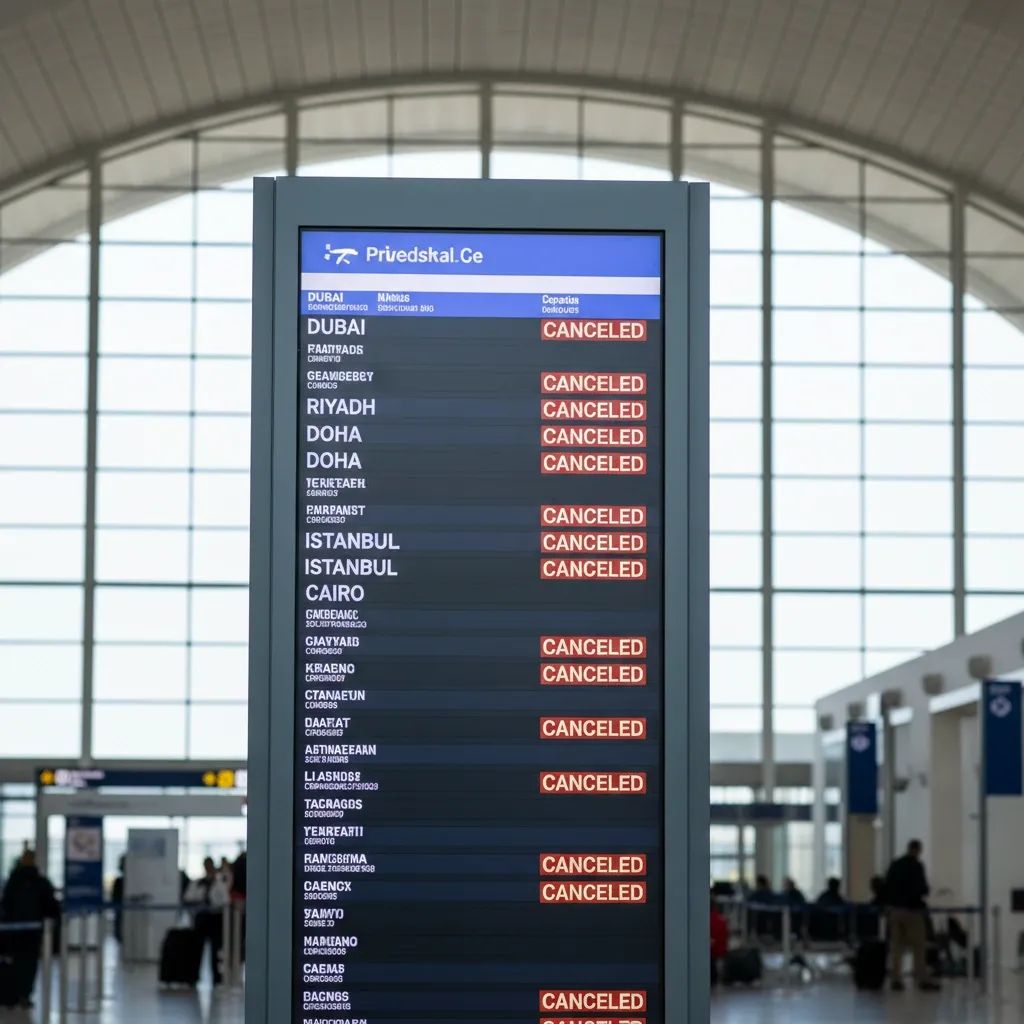
Italy-based carriers ITA Airways, Wizz Air, and most major European airlines have grounded all flights to and from key Middle Eastern destinations through at least March 7, a sweeping disruption triggered by the closure of airspace across eight nations following coordinated military strikes involving the United States, Israel, and Iran. The shutdowns have left thousands of travelers stranded and forced airlines to burn millions of euros in fuel costs as they reroute long-haul flights around a region that had been projected as the world's most profitable aviation market for 2026.
Why This Matters
• No Tel Aviv, Dubai, or Doha flights until early March: If you're booked to Israel, the Gulf states, or Jordan, expect cancellations or reroutes. Full refunds or rebooking on alternative routes are mandatory under EU and Italian consumer protection law.
• Fuel surcharges likely incoming: Airlines are adding 45 to 120 minutes per flight and burning up to four extra tonnes of jet fuel per sector — costs that typically flow to ticket prices within weeks.
• Compensation rights triggered: Italian passengers whose flights were canceled are entitled to €250–€600 per person under EU Regulation (EC) No 261/2004, plus reimbursement for hotels, meals, and alternate transport if the airline cannot rebook you within 24 hours.
• Check before you go: Even confirmed bookings are being canceled on the day of departure. Verify your flight status directly with the carrier before heading to the airport.
The Immediate Fallout: Which Airlines Have Pulled Out
ITA Airways announced February 28 that it has suspended all Rome–Tel Aviv service through March 7, and will avoid the airspace of Israel, Lebanon, Jordan, Iraq, and Iran for the same period. Separately, the carrier halted all Dubai flights through March 1 due to what it described as "operational constraints" — a reference to the fact that Dubai International Airport, the world's busiest for international passenger traffic, is now effectively closed to most carriers. Passengers are being offered full refunds or rebooking on alternative European routes, though seat availability is extremely limited given the scale of the disruption.
Wizz Air, the Budapest-based low-cost carrier with a large presence at Milan Malpensa and Rome Fiumicino, pulled the plug on all flights to Israel, Dubai, Abu Dhabi, Amman, and Riyadh through March 7. The airline, which had been aggressively expanding its Middle East network in 2025, cited "the total or partial closure of airspace across the region" and said it would not resume service until "demonstrable improvement in the security environment."
Lufthansa Group — which includes Swiss, Austrian Airlines, and Brussels Airlines — has suspended flights from its hubs in Frankfurt, Munich, Zurich, and Vienna to Tel Aviv, Beirut, Amman, Erbil, Tehran, Dubai, Abu Dhabi, and Muscat through at least March 7. The German carrier warned that the suspension could extend further depending on developments. Air France and KLM have similarly grounded Paris and Amsterdam services to the affected cities, with Air France canceling Riyadh flights as well.
Turkish Airlines, a major connector between Europe and Asia, canceled all flights to Lebanon, Syria, Iraq, Iran, and Jordan through March 2, and suspended service to Qatar, Kuwait, Bahrain, the UAE, and Oman on February 28. Two Turkish low-cost subsidiaries, Ajet and Pegasus Airlines, followed suit. Turkish officials said the airline would reassess daily, but warned that "airspace closures and military activity zones make safe transit impossible."
Air India issued a blanket suspension for all Middle East destinations, while Russia's Rosaviatsia federal aviation authority canceled all commercial flights from Russia to Israel and Iran "until further notice." Qatar Airways confirmed it cannot operate any flights in or out of Doha due to the closure of Qatari airspace, a rare move that has paralyzed one of the region's three mega-hubs.
What This Means for Italian Travelers
If you hold a ticket on any of the suspended routes, you have automatic rights under EU Regulation 261/2004 and Italian consumer protection law. Airlines must offer you a choice: a full cash refund within seven days, or rebooking on the next available flight at no extra cost. If the airline cannot provide an alternative within 24 hours, you are also entitled to hotel accommodation, meals, and two phone calls or emails. If the cancellation was communicated fewer than 14 days before departure, you can claim fixed compensation ranging from €250 (flights under 1,500 km) to €600 (flights over 3,500 km outside the EU), unless the airline can prove "extraordinary circumstances" — a category that typically includes war, terrorism, and airspace closures, though Italian courts have ruled inconsistently on this point. Legal experts advise passengers to file claims anyway, as class-action challenges have succeeded in similar cases involving prolonged disruptions.
For those whose flights were rerouted rather than canceled, the picture is murkier. Some long-haul carriers are diverting around the conflict zone by flying south over Egypt and the Arabian Sea, or north via the Caspian Sea and Central Asia. These detours add significant time and cost: a typical Rome–Singapore flight that would normally cross Iraq now flies an extra 90 minutes, burning an additional €6,000–€7,500 in fuel per sector. Industry analysts say these costs will almost certainly be passed on to consumers in the form of higher fares and fuel surcharges in the coming weeks.
The Geopolitical Trigger and Timeline
The mass suspensions were triggered by a rapid escalation of hostilities in the final days of February 2026. Following coordinated strikes by the United States and Israeli forces against targets in Iran, at least eight countries — Iran, Iraq, Israel, Syria, Lebanon, Jordan, Qatar, Bahrain, Kuwait, and the UAE — announced total or partial closures of their airspace. Israel closed all civilian airspace on February 27, and Doha and Dubai followed within 24 hours. The closures are indefinite, with aviation authorities in those countries citing "active military operations" and "threat to civilian aircraft."
Italy's Ministry of Foreign Affairs updated its travel advisories on February 27, raising Israel to Level 3 ("Avoid All Non-Essential Travel") and advising Italian citizens already in Israel to "consider departing on commercial flights while they remain available." Similar warnings were issued by the governments of the United Kingdom, France, Germany, Canada, and Australia. The Italian embassy in Tel Aviv has remained open, but consular staff have been instructed to work remotely where possible.
The timing is particularly damaging because the Middle East aviation sector had been forecast by the International Air Transport Association (IATA) to lead global airline profitability in 2026, driven by aggressive expansion by Emirates, Qatar Airways, and the newly launched Riyadh Air in Saudi Arabia. Dozens of new routes had been scheduled to launch in March, including direct service from Abu Dhabi to several secondary European cities and from Doha to East African capitals. Those plans are now on indefinite hold.
The Broader Economic Ripple
The disruptions extend beyond passenger travel. Dubai International Airport handles more than 90 million passengers per year and is a critical node for cargo shipments between Europe, Asia, and Africa. With the airport largely offline since February 28, supply chains for everything from electronics to pharmaceuticals are being rerouted through Singapore, Istanbul, and Nairobi — adding days to delivery times and driving up freight costs. Italian importers of goods from India, Pakistan, and East Africa are already reporting delays of 48 to 72 hours for shipments that would normally transit through Dubai.
For the airlines themselves, the financial hit is severe. ITA Airways alone operates roughly 21 weekly flights to Tel Aviv and Dubai combined during peak season, representing an estimated €3M–€4M per week in lost revenue. Multiply that across a dozen carriers and the industry-wide losses for the first week of March could exceed €50M. Airlines are also facing knock-on costs: crew repositioning, passenger compensation claims, and the reputational damage from last-minute cancellations. Budget carriers like Wizz Air, which operate on razor-thin margins, are particularly vulnerable.
Investors have taken notice. Shares of Lufthansa Group and Air France-KLM dropped 4% and 3.2%, respectively, on February 28, while Emirates' parent company saw its credit outlook downgraded by Moody's from "stable" to "negative." Analysts at UBS warned that prolonged disruptions could wipe out the region's projected $7.8B in airline profits for 2026.
Alternative Routes and Operational Realities
Airlines that continue to operate Asia-bound flights from Europe are being forced to improvise. Malaysia Airlines and Virgin Atlantic, which both fly daily from London to Kuala Lumpur and Singapore, have rerouted over Afghanistan and Pakistan — a path that requires special diplomatic clearances and adds an average of 75 minutes to flight time. Emirates has canceled most European departures but is attempting to maintain limited service to Asia by flying south over Oman and then east across the Indian Ocean, a route that requires additional fuel stops in Colombo or Mumbai.
The situation is fluid, with carriers receiving updated Notices to Airmen (NOTAMs) every few hours as military activity shifts. Pilots and dispatchers are relying on real-time intelligence from national aviation authorities and NATO, but the margin for error is slim. Several carriers have publicly stated they will not resume Middle East operations until they receive explicit safety assurances from both origin and destination countries.
When Will Normal Service Resume?
There is no official timeline. Italy's National Civil Aviation Authority (ENAC) has told airlines to plan for disruptions through at least mid-March, but privately, officials say the suspensions could extend into April if hostilities continue. Israel's Civil Aviation Authority has not issued any public guidance on when civilian flights might resume, and Qatari and Emirati officials have been similarly silent.
For Italian passengers with upcoming travel plans to the region, the advice is unequivocal: monitor your booking daily, ensure you have comprehensive travel insurance that covers "acts of war," and be prepared to cancel or reroute. Airlines are waiving change fees for affected routes, but rebooking windows are narrow and seat availability is dwindling as other passengers scramble to adjust.
The broader message is one of uncertainty. What was supposed to be a banner year for Middle East aviation has become a case study in how quickly geopolitical risk can ground even the world's most profitable carriers. For Italian travelers and businesses that rely on smooth connectivity to the Gulf and beyond, the disruptions are a stark reminder of the fragility of global air networks in an era of escalating conflict.


