
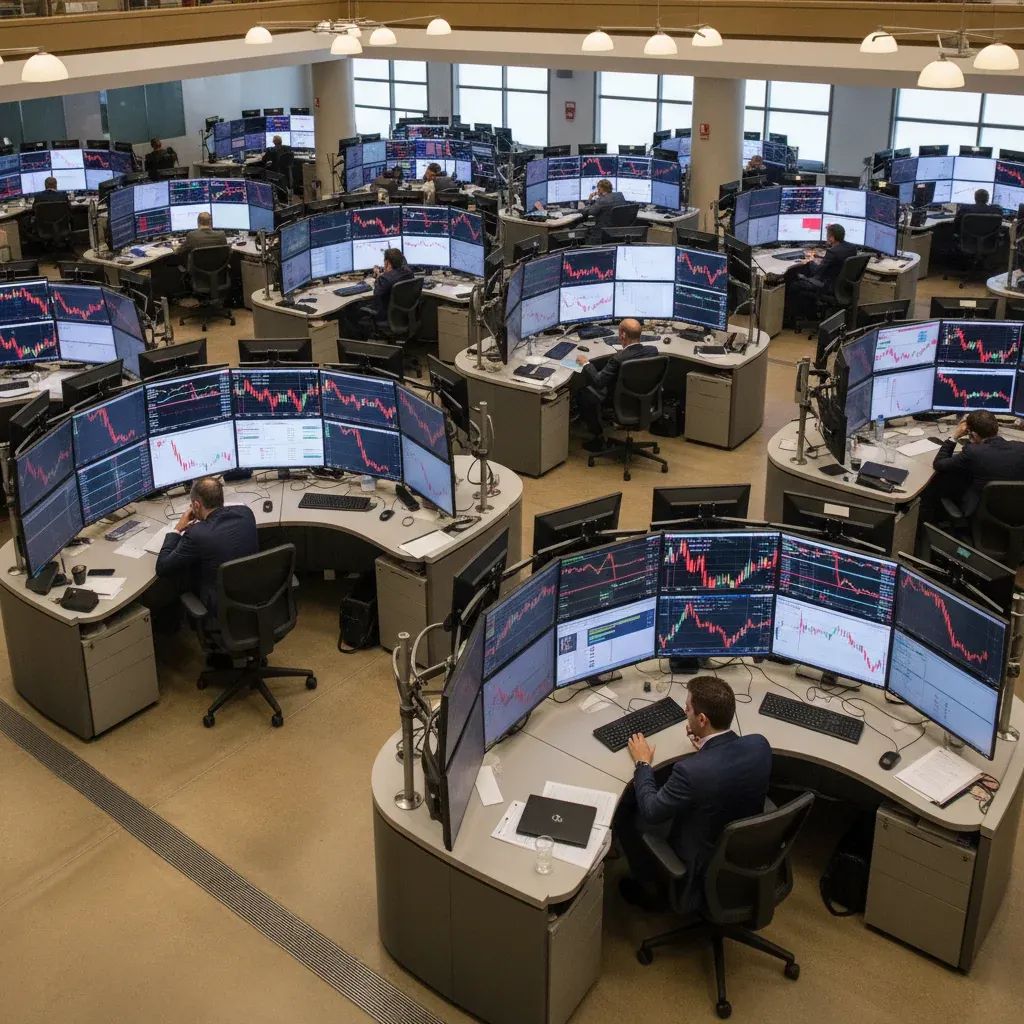
Italy's stock exchange ended among the worst performers in Europe today, dragging down investor portfolios as geopolitical tensions in the Middle East drove energy prices sharply higher and corporate earnings disappointed across key sectors. The Ftse Mib, Italy's benchmark index, closed down 1.6% at 51,877 points, trailing losses in Paris, Frankfurt, and Madrid.
The sell-off reflects a dual squeeze: surging oil and gas costs triggered by a blockade of the Strait of Hormuz amid renewed U.S.-Iran hostilities, and underwhelming guidance from semiconductor giant STMicroelectronics, which alone erased billions in market value. With the European Central Bank maintaining interest rates at 2.25% for deposits—a decision announced this afternoon—investors face a narrowing window for monetary relief as inflation risks reappear on the horizon.
Why This Matters
• Energy shock underway: Brent crude jumped 4% to €97.69 per barrel; European gas climbed 0.2% to €62.69 per megawatt-hour, raising household and business costs.
• STM's warning: The chipmaker's forecast fell short of expectations, sending shares down 13% and rattling tech-heavy portfolios.
• Policy paralysis: The ECB held rates steady despite energy-driven inflation pressures, signaling caution but offering no immediate relief for growth-sensitive stocks.
The Hormuz Factor: Energy Costs Bite Back
The immediate catalyst for today's market turmoil lies 4,000 kilometers southeast of Rome. The Strait of Hormuz, a narrow waterway between Iran and the Arabian Peninsula, remains effectively closed to commercial traffic following escalating military exchanges between Tehran and Washington. Roughly 20% to 27% of the world's seaborne oil and a fifth of liquefied natural gas pass through this chokepoint, supplying Asian giants and European economies alike.
Brent crude surged to €97.69 per barrel, while West Texas Intermediate climbed 3% to €89.42. European benchmark gas prices, already elevated, rose modestly but remain significantly higher than earlier in the year.
For Italy-based households and businesses, this translates into sustained upward pressure on electricity bills and transport fuel. Analysts warn that any prolonged disruption to global energy supplies could impact European storage capacity through the autumn and into winter.
Milan's Semiconductor Stumble
STMicroelectronics, a cornerstone of Italy's tech sector and a major employer across Agrate Brianza and Catania, delivered the day's sharpest blow to investor confidence. The Franco-Italian chipmaker's Q2 results beat its own guidance, with net profit returning to profitability after the prior year loss.
Yet the market punished STM for its Q3 outlook, which came in below analyst expectations. The shortfall, though modest in percentage terms, signals that the broader semiconductor sector's momentum may be losing steam. STM shares plunged 13%, erasing roughly €4B in market capitalization and dragging the Stoxx 600 Technology Index down 0.8%.
The company did raise its full-year revenue outlook, but traders appeared unimpressed, reflecting a broader recalibration of expectations for chip stocks across Europe and the United States. Alphabet's recent disclosure of ballooning capital expenditure on AI infrastructure has sharpened scrutiny on whether demand can justify current valuations.
What This Means for Italian Investors
Italy's equity market is particularly exposed to a confluence of pressures that make today's losses more than a one-day event:
Banking sector vulnerability: UniCredit fell 2.9% despite posting solid quarterly earnings, weighed down by sector-wide concerns over margin compression if the ECB delays rate cuts. Intesa Sanpaolo dropped 1.1%, Banca Monte dei Paschi (MPS) shed 1.6%, and BPER Banca declined 1%. The ongoing Intesa bid for MPS and Banco BPM's merger proposal add uncertainty, with valuations hinging on regulatory clarity and funding conditions.
Luxury under pressure: The Stoxx 600 Luxury Index tumbled 1.6%, with Moncler down 8.2% despite reporting first-half revenue growth. Higher fuel costs and weakening consumer sentiment in Asia—a key market for Italian luxury brands—are prompting analysts to trim margin forecasts. Brunello Cucinelli fell 1.5% and Campari declined 1.9%.
Energy as the sole bright spot: Eni, Italy's energy major, rallied 2.5% as oil prices surged, offering a partial hedge for diversified portfolios. Tenaris gained 0.6% and Saipem added 0.5%, benefiting from expectations of increased upstream spending and demand for oilfield services.
Defensive plays hold up: Amplifon jumped 3.3% after an analyst upgrade cited resilient healthcare demand. Telecommunications and infrastructure names like Inwit (+0.9%) and Telecom Italia (+0.5%) also outperformed as investors rotated into defensive sectors.
ECB Holds the Line—For Now
The European Central Bank kept its deposit rate at 2.25%, the main refinancing rate at 2.40%, and the marginal lending facility at 2.65%, as widely anticipated. This follows a 25-basis-point hike in June, the first increase since 2023, implemented to counter a resurgence in core inflation.
Eurozone headline inflation cooled to 2.8% in June from 3.2% in May, with core inflation at 2.4%. However, the Hormuz blockade has rekindled fears of a renewed energy shock.
President Christine Lagarde's post-meeting press conference struck a cautious tone. Market participants interpreted her remarks as a "hawkish-leaning hold," signaling readiness to raise rates again in September when updated macroeconomic forecasts become available.
For Italy-based borrowers, this means mortgage rates and corporate financing costs are unlikely to ease soon. The BTP-Bund spread—the premium Italy pays over German debt—remained stable at 83 basis points, with the 10-year Italian yield at 4.02% and the German equivalent at 3.19%. A widening spread would signal deteriorating confidence in Italian fiscal sustainability, but for now, sovereign debt markets remain orderly.
Broader European Context
Italy was not alone in its struggles. The Stoxx 600 lost 0.6%, with Paris down 1%, Frankfurt off 0.64%, and Madrid declining 0.6%. London fared slightly better, slipping just 0.2%. Utilities shed 0.6% despite rising gas prices, as traders worried about regulatory caps on energy margins. Insurers lost 0.2%, reflecting concerns over asset portfolio performance in a challenging environment.
The euro held steady at $1.1414, showing little immediate currency reaction to the ECB decision or energy shock.
Looking Ahead: Risks and Mitigations
The outlook hinges on three variables: the duration of the Hormuz blockade, the trajectory of corporate earnings, and central bank policy responses. Any prolonged closure could impact European gas inventories heading into winter.
On the corporate front, earnings season will test whether Italian firms can pass energy costs onto consumers without crushing demand. STM's cautious guidance suggests margin pressures are mounting in capital-intensive sectors. Meanwhile, the ECB's next meeting in September looms large: a further rate hike would support the euro and contain inflation but could pressure growth-sensitive economies across the Eurozone, including Italy.
For now, Italian investors face a narrow path: energy-linked equities offer tactical upside, defensive sectors provide stability, and fixed-income spreads remain contained. But the confluence of geopolitical instability, corporate earnings misses, and monetary policy uncertainty makes this a market where risk management—not speculation—should guide portfolio decisions.


