
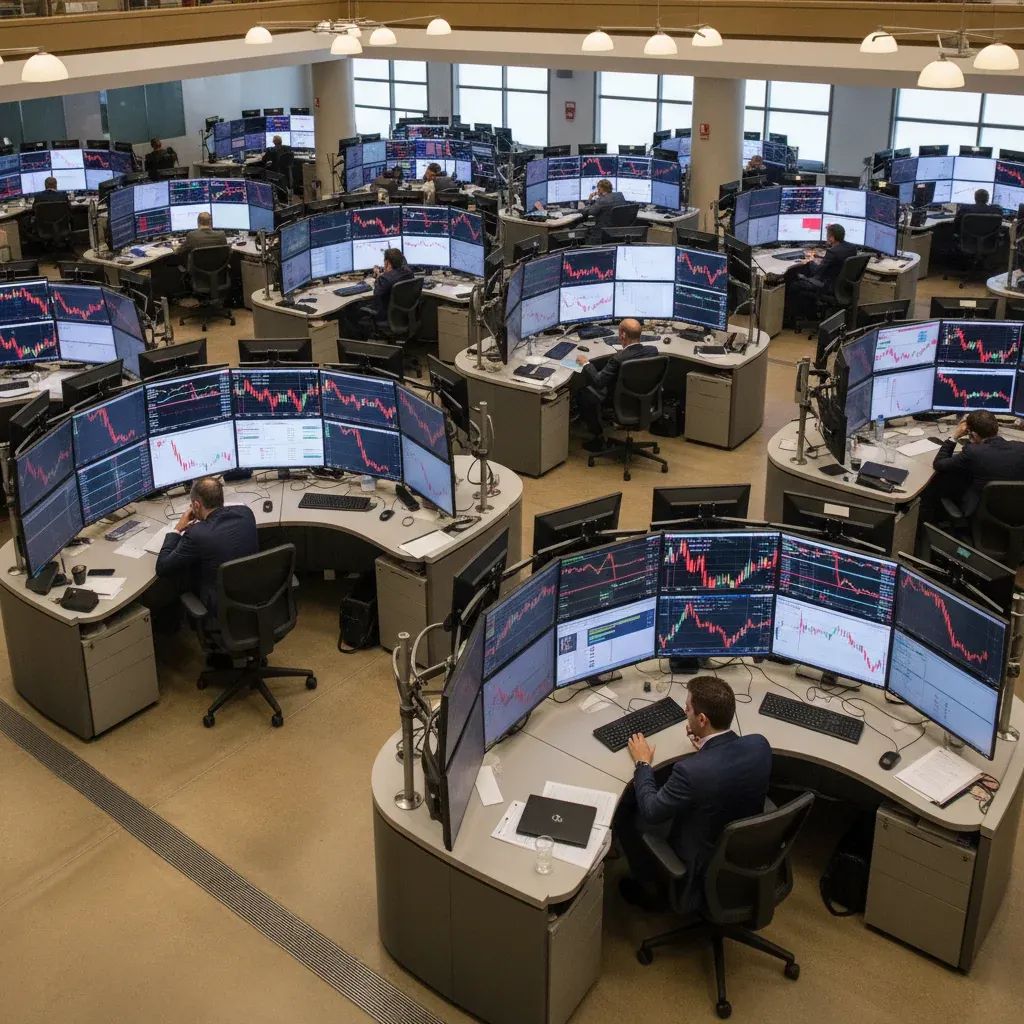
Italian borrowing costs fell slightly today as Asian and European markets dropped, with investors focused on fragile U.S.-Iran tensions that threaten to push energy costs higher for Italian households.
Why This Matters
• Your wallet: Oil price volatility is keeping fuel and heating costs elevated for Italian families and businesses. Energy bills are rising as markets react to Middle East uncertainty.
• Your investments: Milan's FTSE MIB dropped 0.64% today, with luxury brand Ferrari falling sharply after announcing a new electric vehicle design. Italy's 10-year government bond yield fell to 3.68%, providing slight relief on borrowing costs.
• Your confidence: Recent military escalation between the U.S. and Iran has dampened hopes for a quick diplomatic resolution, creating ongoing economic uncertainty for months ahead.
What's Happening Now
Recent U.S. military operations against Iranian targets have heightened tensions in the Middle East, disrupting peace talks and reigniting concerns about energy supply disruptions. Investors worldwide are prioritizing news from the Middle East over traditional economic data—a shift that leaves Italy particularly vulnerable. Europe depends heavily on energy imports, so any disruption through key shipping routes directly affects Italian households, businesses, and prices at the pump.
For Italian families, this geopolitical instability translates directly into unpredictable energy bills and transportation costs. The uncertainty surrounding oil supplies is pushing prices upward, putting pressure on household budgets across the country. Households relying on heating oil face particular concerns as winter approaches, while families with cars worry about fuel costs climbing further.
Asian Markets Show Mixed Picture, Technology Stocks Rally
Tokyo opened higher, propelled by technology shares riding global artificial intelligence investment trends. Seoul posted stronger gains, driven by semiconductor manufacturers benefiting from the worldwide AI investment boom. However, Hong Kong and Shanghai both declined, weighed down by broader concerns about China's economy and Middle East instability spillover.
The strength in technology stocks contrasts sharply with weakness in traditional sectors. This split reflects a fundamental market shift: companies linked to artificial intelligence and semiconductors continue attracting investor money, while energy uncertainty weighs on other industries.
Milan Markets Stumble
Milan's FTSE MIB closed down 0.64%, with luxury brand Ferrari absorbing the heaviest blow after unveiling a polarizing new electric vehicle design. Luxury goods maker Brunello Cucinelli and payments processor Nexi also declined, reflecting investor caution about discretionary spending.
On the positive side, STMicroelectronics and aerospace specialist Avio gained ground, benefiting from ongoing technology sector strength. These gains highlight how Middle East uncertainty is reshaping market winners and losers: technology and infrastructure companies advance while luxury brands and consumer-facing businesses retreat.
What This Means for Italian Savers and Investors
Italy's government bond market showed resilience today. The gap between Italian and German government bonds narrowed slightly, signaling stable confidence in Italy's fiscal position despite broader European anxiety. However, analysts warn that prolonged Middle East conflict could reverse this trend as inflation expectations climb and energy costs remain elevated.
The euro held relatively steady against major currencies. For Italian exporters, currency movements matter: a stronger euro makes Italian products more expensive for overseas buyers, while a weaker euro helps exporters compete internationally.
Investors holding diversified portfolios should prepare for continued volatility. Technology and artificial intelligence-linked stocks are delivering strong returns year-to-date, but geopolitical shocks can erase gains quickly. Italian investors with exposure to European energy-dependent industries or luxury discretionary stocks face heightened risk until clearer diplomatic outcomes emerge.
European Markets Under Pressure
Broader European stock indices reflected today's caution. Frankfurt, Paris, and Madrid all posted declines, as investors across the continent grew more cautious. London's stock exchange was the sole outlier, gaining slightly on strength from energy companies that benefit from elevated crude prices.
This synchronized European weakness underscores how interconnected the continent's markets have become. When one region faces uncertainty, the impact spreads rapidly across borders. For Italian companies with European supply chains or customer bases, this instability creates planning challenges.
The Road Ahead
The calendar offers little near-term clarity on whether Middle East tensions will ease or escalate. Markets remain hypersensitive to diplomatic news—a single headline about peace talks or military action can move indices significantly.
For Italians navigating this uncertain environment, the practical takeaway is clear: monitor energy costs closely as they directly affect household budgets and inflation; recognize that market volatility will remain elevated until geopolitical tensions ease; and consider whether adjusting your investment strategy makes sense during this period of uncertainty.
The fragility of current Middle East stability is not abstract. It is embedded in the price of diesel at the pump, the cost of heating an Italian home, and the valuation of every Italian company tied to global supply chains. Until diplomatic tensions resolve, markets will remain vulnerable to sudden shocks, and household energy costs will continue facing upward pressure.


