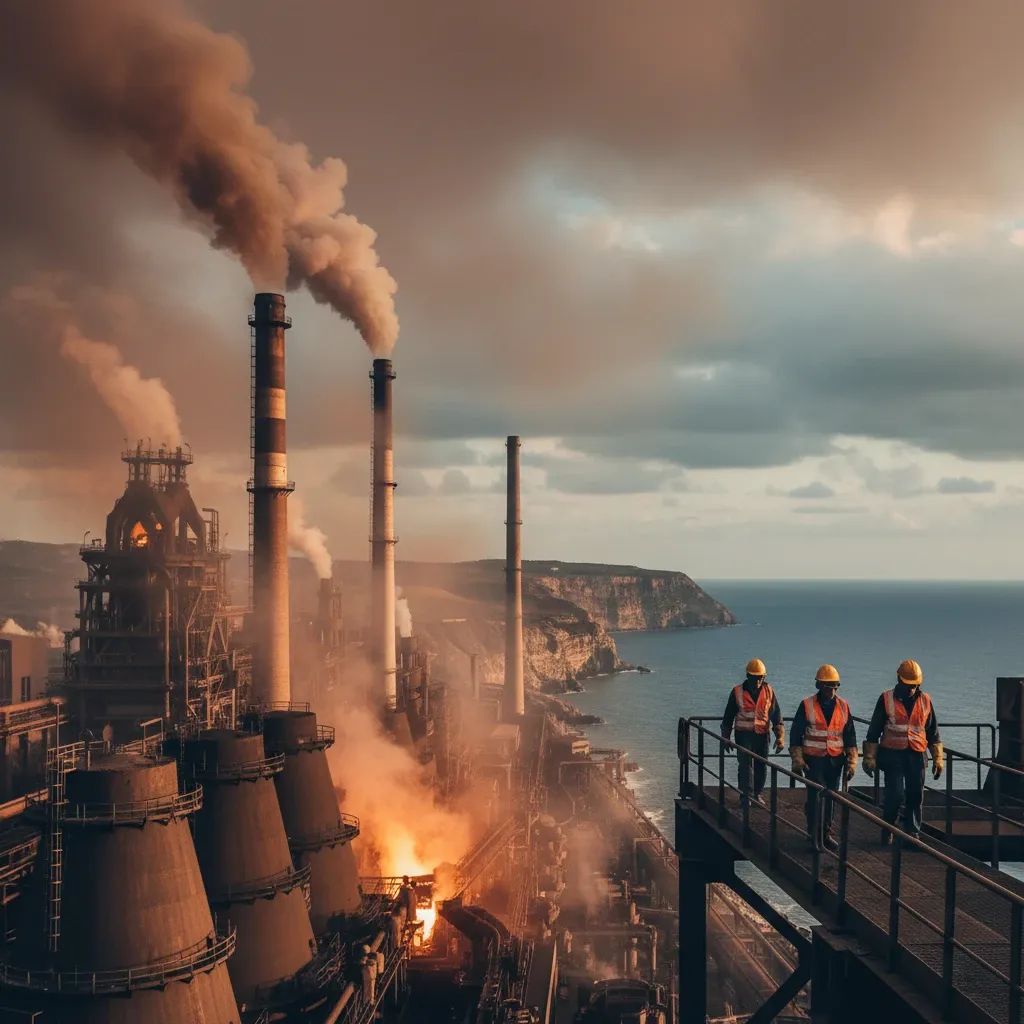
The Italian Cabinet has approved €100M in emergency funding for the former Ilva steelworks in Taranto, a bailout designed to maintain operations in the plant's cold-rolling facilities even as a Milan court order threatens to shut down its blast furnaces within three months. Economy Minister Giancarlo Giorgetti confirmed the measure hours after the Milan Court of Appeals handed down a ruling on July 27 that could end primary steel production at Italy's largest industrial site, leaving thousands of jobs and the country's entire manufacturing supply chain in limbo.
Why This Matters
• Jobs at risk: The court-ordered closure of the hot-rolling area—the plant's production core—jeopardizes employment for most of Acciaierie d'Italia's workforce and thousands more in the supply chain.
• Steel sovereignty threatened: Italy could lose domestic primary steel production capacity, forcing manufacturers to rely on foreign imports.
• Sale in jeopardy: A nearly finalized asset sale to international buyers has been thrown into doubt, with deal terms no longer matching the industrial reality.
• 90-day deadline: The Milan ruling requires complete asbestos removal and emissions cuts before any restart, a timeline most experts consider impossible.
Court Backs Health Over Heavy Industry
The Milan Court of Appeals ruled in favor of a group of Taranto residents and parents who challenged the continued operation of the plant's hot-rolling zone, citing persistent health hazards. Judges determined that the facility poses an ongoing public health threat due to "progressive deterioration of the plant," specifically highlighting the presence of over 2,000 kilograms of unremoved asbestos and dangerous levels of fine particulate emissions (PM10 and PM2.5).
The court conditioned any restart on two non-negotiable requirements: full asbestos remediation and a drastic reduction in emissions to meet safety thresholds, particularly if the plant resumes production at its authorized 6M-ton annual capacity. The ruling reinforces previous judicial measures issued in February 2026 and underscores the severity of environmental and health concerns that have plagued Taranto for decades.
Notably, the judges pointed out that the asbestos removal requirement—once mandatory—had vanished from recent environmental authorizations, despite being the only proven cause of mesothelioma, a disease with abnormally high incidence rates in Taranto and the neighboring town of Statte.
Government Moves to Stabilize, But Admits Sale Is "Upended"
Speaking at a press conference following the Cabinet meeting, Giorgetti acknowledged that the court ruling has "completely changed the conditions" surrounding the sale process, which he described as being in an advanced stage and "close to finalization with the counterparty." The €100M allocation was intended to support the extraordinary administration's efforts to finalize the transfer of cold-rolling assets. Now those plans must be revised in light of the judicial intervention.
"Rulings are rulings, they apply to everyone, and this judgment seems absolutely clear in ordering the closure of the hot area," Giorgetti said. He confirmed that an urgent meeting with trade unions was scheduled for July 28 to chart a path forward.
Despite the uncertainty, the government maintained its commitment to keeping the cold-rolling operations viable, viewing them as salvageable even if blast furnaces go dark. The funding aims to ensure administrative continuity while buyers recalibrate their interest in a plant whose industrial profile has fundamentally shifted overnight.
What This Means for Workers and the Regional Economy
The Taranto steelworks has long embodied Italy's most intractable industrial dilemma: the collision between economic survival and public health. The hot-rolling area employs the majority of Acciaierie d'Italia's direct workforce, and its closure would trigger what Uilm union secretary-general Davide Sperti has called a "social bomb."
Beyond direct layoffs, the shutdown would devastate a sprawling network of contractors, suppliers, and service firms dependent on the plant's operations. Estimates suggest roughly 4,000 workers could face furloughs or redundancy, with ripple effects felt throughout southern Italy and critical supply chains feeding into automotive, appliances, and manufacturing sectors.
The practical impact begins immediately: workers face uncertainty about whether they will be transferred to cold-rolling operations, placed on wage-support schemes, or released entirely. For families in Taranto and surrounding municipalities, the 90-day window represents a critical period during which government negotiations with potential buyers and union representatives will determine layoff timelines and severance terms. Small businesses serving the steelworks—transport companies, catering, maintenance contractors—face potential closure if primary production ceases.
Federmeccanica, Italy's metalworking industry association, has warned that limiting Taranto to cold-rolling operations alone would hand foreign competitors a strategic advantage in a market critical to Italian manufacturing. If Italy cannot produce its own steel at scale, downstream industries—from automotive to appliances—will depend on imported slabs and coils, often from countries with looser environmental standards.
The Challenge Ahead: Asbestos Removal and the 90-Day Clock
Fulfilling the court's conditions within 90 days is widely considered unfeasible. Asbestos abatement in a facility of Taranto's scale is a multi-month, high-risk undertaking even under ideal circumstances. Emissions reductions, meanwhile, would require either a full technological overhaul or a prolonged shutdown for retrofitting.
According to recent media reports, several potential buyers have expressed interest in the site, including investment funds focused on green steel technology and alternative production models. However, the court ruling has forced all prospective acquirers to reconsider the viability and cost structure of their proposals.
Legal experts anticipate that Ilva in extraordinary administration and Acciaierie d'Italia will appeal to the Court of Cassation, Italy's supreme court. An appeal could suspend enforcement of the 90-day deadline, though Cassation reviews focus on procedural issues rather than factual merits, meaning the core findings about health risks and plant deterioration are unlikely to be overturned.
What Comes Next: The Real Deadline
The timeline for residents and workers is stark: the 90 days begin from the July 27 ruling. By approximately October 25, either the plant must meet remediation standards, the extraordinary administration must secure a buyer whose offer addresses the court's health requirements, or production faces court-enforced cessation. An appeal could extend this, but uncertainty itself damages buyer confidence and complicates workforce planning.
For foreign professionals and investors with ties to Italy's industrial sector, the Ilva saga is a barometer of the country's ability to balance economic development with environmental accountability. The case underscores the legal and reputational risks that can arise when industrial legacy assets clash with modern health and safety standards.
For residents of Taranto and surrounding areas, the ruling represents a rare judicial victory for health advocacy in a region where industrial interests have historically dominated. Whether that victory translates into genuine remediation or simply accelerates the plant's decline remains to be seen. What is clear is that the 90-day clock is ticking, and the choices made in the coming weeks will determine whether Italy retains a viable steel industry or loses it altogether.