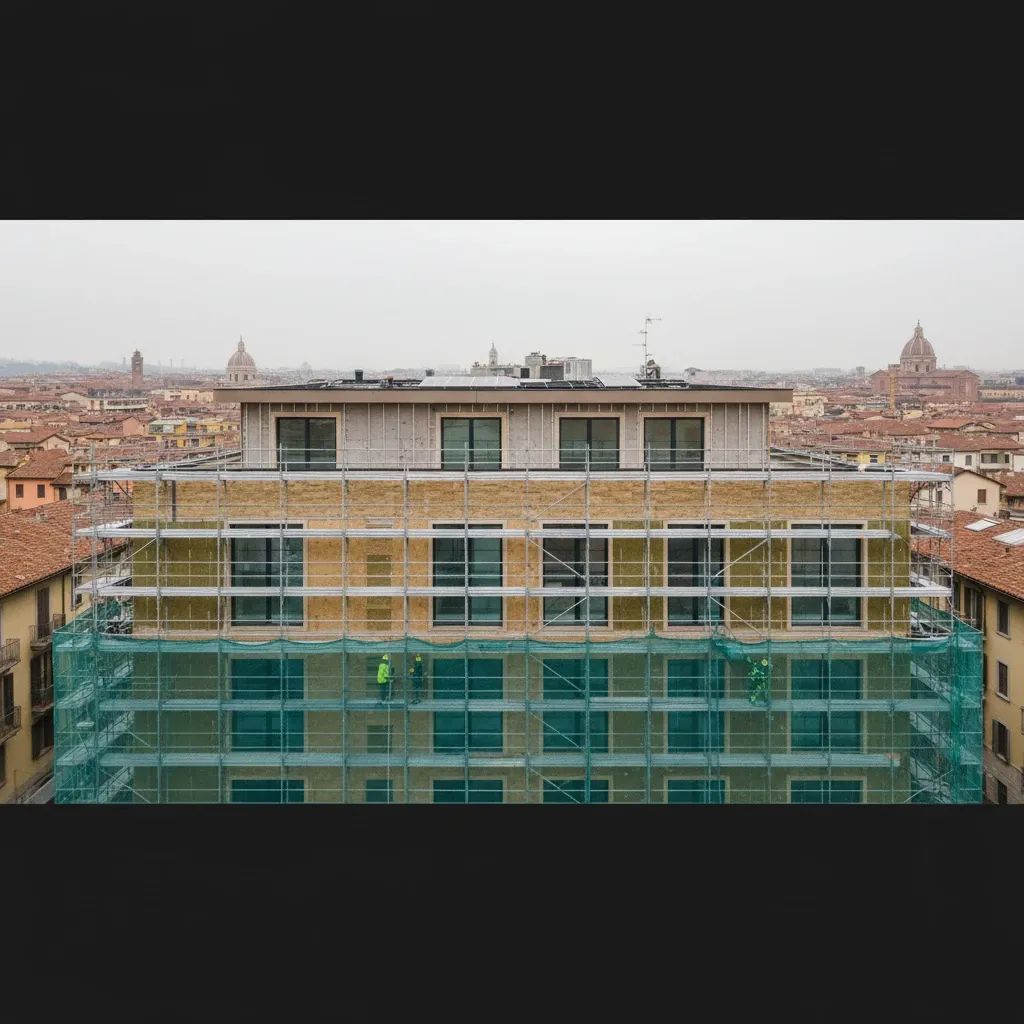
The Italy Revenue Department has recorded €131.5 billion in tax deductions owed to citizens for completed home renovations under the now-defunct Superbonus 110% scheme, according to ENEA data from May 31, 2026. The figure represents a fiscal burden that will shadow Italy's budget for at least another four years, as the state compensates homeowners and contractors who upgraded more than half a million properties nationwide.
Why This Matters
• €170 billion total bill: The comprehensive cost of the Superbonus program has reached approximately 170 billion euros, four times the government's initial estimate, making it the most expensive housing incentive in European history.
• Ongoing fiscal drag: Although the enhanced deduction has ended for new applicants, the compensation mechanism runs until 2030, meaning the scheme will continue to squeeze Italy's budget capacity even as other EU nations press Rome to reduce its 139.2% debt-to-GDP ratio.
• Fraud fallout accelerating: Investigators blocked €4.1 billion in fraudulent credits in the first three months of 2026 alone—equivalent to 33% of all credits claimed for work completed in 2025—and over €9 billion in fake credits have been seized since enforcement intensified.
The Scale of Investment and Exposure
Total investment triggered by the Superbonus reached €126.6 billion, with €124.9 billion qualifying for deductions. Some €122.7 billion of that figure relates to work already finished and certified. The program touched 502,370 buildings across Italy, predominantly condominiums and multi-family units in the north and center, where homeowners had easier access to financing and professional technical services.
The European Commission highlighted in its spring 2026 economic forecast that Italy's debt trajectory remains elevated partly due to "stock-flow adjustments" tied to housing tax credits. Eurostat ruled in 2023 that all Superbonus costs must be recorded in the deficit year the expense occurs, pushing Italy's 2023 deficit to 7.4% of GDP—a jump of 2.1 percentage points above government projections. The Parliamentary Budget Office estimates the scheme will add 4.6 points to the debt-to-GDP ratio between 2025 and 2027.
What This Means for Residents
The Superbonus 110% as it once existed—offering tax rebates exceeding the actual cost of works—has been substantially dismantled. For 2026, no new applications at elevated rates are accepted, though limited transitional provisions may apply to condominiums that initiated work before specific deadlines. The option to transfer credits to third parties or apply invoice discounting was largely eliminated in 2023, ending the mechanism that fueled both widespread participation and equally widespread fraud.
Current residents now navigate a patchwork of reduced incentives:
• Renovation Bonus: A 36% tax deduction (down from 50%) on eligible expenses up to €48,000 per unit, claimed over ten years.
• Ecobonus: Deductions of 50% to 65% for energy-efficiency upgrades.
• Sismabonus: Credits ranging from 50% to 85% for seismic improvements, with a ceiling of €96,000 per unit.
• Furniture Bonus: A 50% credit on furniture and large appliances purchased during renovations, capped at €5,000.
• The Architectural Barriers Bonus expired on December 31, 2025, with such work now falling under the standard Renovation Bonus.
For anyone considering energy upgrades or earthquake-proofing, the new framework offers modest support but requires upfront liquidity—there is no more "free" renovation financed by future tax breaks.
Fraud Crackdown Intensifies
The Italy Revenue Department and Italy Financial Police (Guardia di Finanza) have launched an unprecedented compliance drive spanning 2025 through 2028. In April 2025, the tax authority initiated "Operation Transparency," sending letters of compliance to roughly 85,000 property owners who claimed Superbonus deductions but failed to update cadastral values—a legal requirement when work significantly increases a property's market worth.
The phased mailing schedule includes approximately 15,000 letters in 2025, 20,000 in 2026, and 50,000 between 2027 and 2028. When all housing incentives are included, the total volume of compliance notices will hit 200,000 over the 2026–2027 biennium. These letters do not carry immediate penalties but flag anomalies—missing technical documentation, inconsistent invoices, suspicious credit transfers—and invite recipients to regularize their position before formal audits begin.
Enforcement has moved from random sampling to targeted algorithmic screening. Cross-referencing building permits, bank records, and utility consumption data allows investigators to identify "phantom construction sites" where no actual work occurred, or "half-finished projects" claimed as complete. In 2026, the threshold for triggering a compliance letter was lowered: any property whose declared works increased value by 100% or more without a corresponding cadastral revision now receives scrutiny, down from a 300% threshold in 2025.
Recent operations illustrate the scale of abuse. In June 2026, authorities dismantled a network involving 240 individuals and seized €160 million in fraudulent credits across multiple regions. Another investigation uncovered €560 million in phantom credits for nonexistent renovations, implicating 12 primary suspects and over 60 shell companies. A separate probe in Imperia named a municipal mayor and several associates for allegedly inflating contractor bills by more than €10 million. Even when a false credit is never redeemed, Italian law now permits seizure of both the credit itself and any funds derived from its trade, regardless of whether downstream buyers acted in good faith.
Economic Fallout and European Context
The Superbonus produced a temporary construction boom. Italian building investment grew 40% over four years—faster than Germany or Spain—and employment in the sector surged. The Financial Times credited the "Superbonus Effect" as a key driver of Italy's unexpected post-pandemic growth relative to major European peers. The Parliamentary Budget Office calculated GDP boosts of +1.5% in 2021, +1.4% in 2022, and +1.0% in 2023.
Yet the stimulus was cyclical, not structural. The abrupt phase-out triggered a -1.0% contraction in 2024 as demand collapsed and contractors shed workers. Property values rose in renovated buildings, but analyses by Banca d'Italia and private research firm Nomisma suggest that roughly 36% of interventions would have occurred anyway, meaning a significant share of public money simply replaced private spending rather than generating new activity.
The scheme's 110% deduction eliminated normal price negotiation. With no ceiling on eligible costs and contractors assured of payment via credit transfer, material prices and labor rates spiked, feeding broader inflation in the real-estate sector. The net fiscal cost—after accounting for higher tax revenue from increased economic activity—amounts to roughly €91 per €100 spent, according to Treasury estimates based on February 2024 ENEA data.
Socially, the program was regressive. Because it required homeowners or condominium boards to front significant administrative capacity and navigate complex certification, wealthier households and higher-value properties disproportionately benefited. Less than 3% of Italy's residential stock received Superbonus upgrades, and energy savings per euro spent have been questioned by climate economists who argue that targeted insulation subsidies in poorly performing buildings would have delivered greater emissions reductions.
How Italy Compares to Europe
No other EU member offered an incentive as generous. Germany caps energy-retrofit deductions at 20% over three years, with a maximum benefit of €40,000 and reduced VAT on solar installations. France replaced its tax credit with the "Ma Prime Rénov" grant system, offering up to €8,000 for solar panels and requiring independent post-work verification of energy savings. Spain provides deductions of 40% to 80%, funded through EU Recovery Plan grants, with full reimbursement for low-income households capped at €21,400. The United Kingdom levies 0% VAT on specific energy-efficiency materials through 2027 and offers a £5,000 grant, but no income-tax relief.
Most European schemes cover 20% to 30% of renovation costs and tie incentives to verified performance improvements. Italy's flat 110% deduction with minimal ex-post auditing created conditions ripe for abuse and cost overruns.
The European Commission's "Homes Directive" (EPBD IV) mandates that residential energy consumption fall 16% by 2030 and 20–22% by 2033, prioritizing the least efficient buildings. Italy now relies on standard EU cohesion funds—including the European Regional Development Fund—which can co-finance up to 85% of energy and seismic upgrades in less-developed regions, provided projects meet strict technical and procurement standards.
What Happens Next
The Superbonus deduction tail runs through 2030 as homeowners spread claims over ten annual tax returns. Monthly costs to the state stabilized near €1 billion in early 2026, bringing the year-to-date burden to approximately €2.5 billion by March. Some analysts project the scheme will account for €45 billion in forgone revenue during 2026 alone.
Italy faces an EU excessive-deficit procedure and must demonstrate credible consolidation. Scope Ratings estimates cumulative debt impact at 6% of GDP between 2024 and 2027. Fitch Ratings noted that combined housing incentives—including the smaller Bonus Facciate—cost 9.2% of cumulative GDP since launch and 3.9% of GDP in 2023 alone.
The government has not announced plans to revive high-percentage housing incentives. For residents weighing renovations, the message is clear: current deductions are modest, require documentation, and will be audited. For those who already claimed Superbonus credits, expect letters, verify cadastral updates, and keep every invoice and technical certificate within reach.