
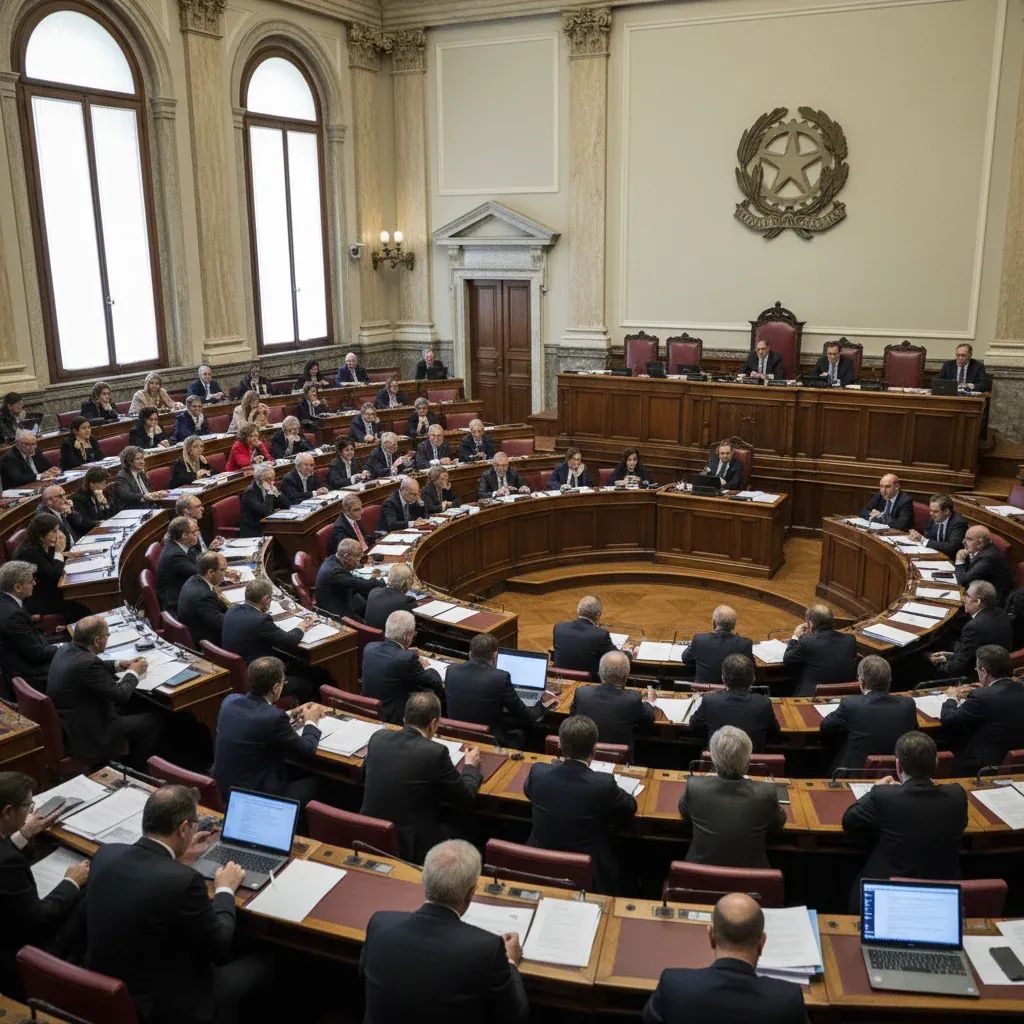
The Italian Parliament will resume from its August recess on September 9, facing a legislative sprint that could reshape both the country's electoral system and the governance of its public broadcaster — two battles that have already exposed deep fractures within the ruling coalition and threaten to destabilize the government's majority.
Why This Matters
• Electoral reform vote: The Senate must finalize amendments by September 1 and pass the bill by September 15, with a final vote in the Chamber expected by month's end.
• Gender parity compromise: The center-right coalition has agreed to allow three preferential votes with strengthened gender alternation rules, after a secret ballot defeat in July.
• RAI governance overhaul: Parliament will vote on public broadcaster reforms to comply with EU media independence rules, potentially ending a months-long deadlock over leadership appointments.
• Secret ballot risk: Another anonymous vote in the Chamber could sink the electoral law and fracture the governing coalition.
The Electoral Law Tightrope
The Italian Senate's committees will reconvene in early September to tackle the most contentious piece of legislation on the government's agenda: a reform of the electoral law that has already proven toxic within the center-right coalition. Amendments must be submitted by September 1, with floor debate beginning September 9 and a final Senate vote scheduled by September 15. The government hopes to secure final approval in the Chamber of Deputies by the end of the month.
At the heart of the dispute is the preferential voting system. After an embarrassing secret ballot defeat in the Chamber during the first reading in July, coalition leaders from Fratelli d'Italia, Lega, Forza Italia, Noi Moderati, and UDC reached a compromise around August 5. The unified amendment will reintroduce preferential votes — allowing citizens to select up to three candidates from a list of six — while keeping party leaders in locked first positions.
The critical concession involves gender parity safeguards. The new text mandates a 60%-40% gender balance across lists and among lead candidates, and requires that the candidate immediately following the locked party leader be of a different gender. These protections will extend to the single-member constituencies in Trentino-Alto Adige, a region where gender alternation rules had previously been weak.
Secret Ballot Ghosts
Despite the apparent unity, parliamentary insiders acknowledge the path remains treacherous. Many lawmakers across the political spectrum harbor deep personal opposition to preferential voting, which they fear could expose them to constituency pressure and reduce party control over candidate selection. During the first Chamber reading, a secret ballot allowed dissenters within the majority to torpedo a similar proposal without accountability.
The government is not ruling out calling a confidence vote to force the bill through the Chamber in its final passage, a procedural maneuver that would bypass the secret ballot mechanism. Such a move would guarantee passage but carry political costs, as it would publicly expose the coalition's internal divisions. Government and opposition sources alike acknowledge that another failed vote would have immediate consequences for the stability of the ruling alliance.
RAI Under European Pressure
Once the electoral reform clears — if it clears — Parliament will turn to an equally fraught issue: reforming the governance of RAI, Italy's public broadcaster, and implementing the European Media Freedom Act (EMFA). The EU regulation, which became directly applicable in August 2025, mandates that public media services operate independently of political power, particularly regarding editorial decisions and leadership appointments.
Italy is considered behind schedule in aligning its national framework with the EMFA, raising the prospect of infringement proceedings from Brussels. President Sergio Mattarella has publicly called on the government to ensure compliance, emphasizing the need for genuine editorial independence at RAI.
The Senate is working on a unified draft that would shift control of RAI's governance from the executive branch to Parliament, while introducing stricter transparency and financial accountability standards. The proposed changes would reduce the Board of Directors from nine to seven members, with four elected by Parliament (two each from the Chamber and Senate) and two appointed by the Ministry of Economy and Finance. The board's term would extend from three to four years, and the managing director would be appointed by the board itself rather than by the government.
Critics, including MEP Sandro Ruotolo, argue that the current proposals still fall short of EMFA requirements, particularly because of continued government representation on the board. The Senate aims to approve the reform by the end of September, with final passage in the Chamber expected between October and November.
The Agnes Standoff
The governance debate has been paralyzed by a separate but related dispute: the appointment of Simona Agnes as RAI president. Agnes, a law graduate with a background in communications and marketing, was nominated to the RAI board by the Ministry of Economy in October 2024 and elected president by the board the same month. She is also founder of the Biagio Agnes Foundation, dedicated to journalism and scientific communication.
Her confirmation, however, requires a two-thirds majority in the Parliamentary Oversight Commission, a threshold designed to ensure bipartisan consensus. Opposition parties — the Democratic Party, Five Star Movement, Greens and Left Alliance, and Italia Viva — have refused to support her, objecting not primarily to Agnes herself but to the method of her selection. They argue that the presidency of a public broadcaster should not be imposed unilaterally by the majority without cross-party agreement.
The standoff escalated dramatically in July 2026, when the commission's chair, Barbara Floridia (M5S), and all 16 opposition members resigned in protest after the majority repeatedly denied a quorum to avoid a formal vote that would have rejected Agnes. The majority members subsequently resigned as well, effectively dissolving the commission. Antonio Marano has been serving as acting president since then.
Forza Italia remains firmly behind Agnes, but the governance reform and the EMFA implementation may finally force a resolution. Opposition sources suggest their objection is procedural rather than personal — they seek a consensus candidate rather than one imposed by the ruling coalition.
What This Means for Residents
For Italians, the September legislative agenda carries direct implications. The electoral reform determines how citizens will be able to influence candidate selection in future elections — a shift from a party-dominated system to one that gives voters marginally more control, albeit within strict gender parity rules. The outcome could also signal whether the governing coalition can hold together under pressure, with potential consequences for policy stability.
The RAI governance battle matters because it concerns the independence of the country's dominant public broadcaster, which reaches the vast majority of Italian households. Compliance with EU media freedom standards is not merely a procedural issue; it affects whether RAI can operate free from political interference in its news coverage and editorial choices. Failure to align with the EMFA could result in EU sanctions and reputational damage.
Decrees and Unfinished Business
Beyond these headline battles, Parliament must rapidly convert several decrees into law when it reconvenes. Among them: measures related to the collapse of court offices in Bolzano, which disrupted civil and criminal proceedings; fuel pricing regulations and provisions for the former Ilva steel plant, likely to include another extension of fuel excise tax cuts approved by the Cabinet on August 4 and expiring August 25; and earthquake recovery measures for the Campi Flegrei volcanic area near Naples.
Contentious legislation also awaits. The hunting bill, which sparked fierce July battles between the majority and opposition and exposed discomfort within Forza Italia, returns to the floor. The security bill may see the reintroduction of wiretapping rules previously stripped from a justice decree after coalition tensions. Environmental regulations on the compostability of certain packaging types require conversion, as does a cinema industry support bill stalled since early August.
The "Coltiva Italia" agriculture package, already passed by the Chamber, awaits Senate approval. So does a government delegation on sustainable nuclear energy, a policy area that remains deeply divisive in Italian public opinion.
The Italian Parliament's ability to navigate this legislative thicket in the coming weeks will test both the ruling coalition's cohesion and its capacity to meet international obligations. For residents, the outcome will shape not only the mechanics of future elections but also the independence of the information ecosystem they rely on daily.


