
The Italian Senate President Ignazio La Russa has reignited one of the country's most sensitive historical debates just days before April 25, Liberation Day, declaring he would "do it again" when asked about his practice of honoring both partisan fighters and soldiers who fought for Mussolini's puppet Republic of Salò. The comments arrive alongside a 27% funding cut to Italy's five most significant anti-fascist memorial sites—a dual development that opposition parties are calling a coordinated assault on the constitutional foundations of the Italian Republic.
What Liberation Day Means for Daily Life in Italy
April 25 is more than a historical commemoration—it's a national public holiday that shapes the rhythms of Italian life. Schools, offices, and many businesses close for the day. Streets across the country fill with official ceremonies, commemorations, and marches organized by partisan associations and civil society groups. For residents in Italy, it's a day when the Resistance and the struggle against fascism move from textbooks into public space, with mayors and institutional figures expected to participate in local tributes. Understanding the significance of this date is essential for grasping why the current controversy is so disruptive: an attack on how Italians collectively remember their founding moment.
Why This Matters
• Budget reality: Institutions preserving Italy's anti-fascist heritage—including Marzabotto, Fossoli, and Sant'Anna di Stazzema—saw their combined annual allocation drop from €2.5M to €1.82M following the March 2025 decree, threatening educational programs and archive preservation.
• Constitutional flashpoint: La Russa's remarks come from the second-highest state office and coincide with a far-right conference titled "The End of Anti-Fascism" scheduled in Predappio—Mussolini's birthplace—on Liberation Day itself.
• European anomaly: Italy remains one of the few Western European nations where relativizing fascist collaboration enters mainstream political discourse at the institutional level.
The Pacification That Divides
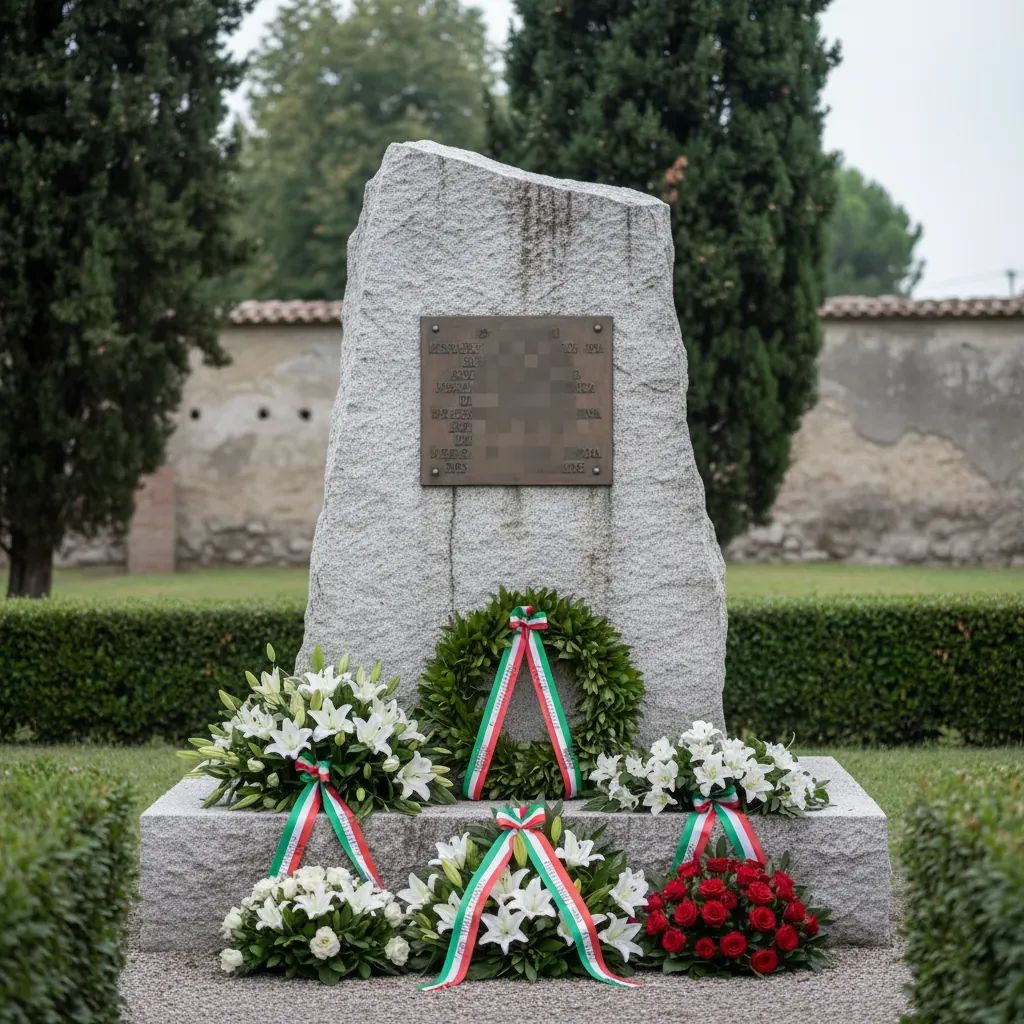
Speaking on the sidelines of Milan's furniture fair, La Russa described a ritual from his tenure as Defense Minister: laying a wreath at the partisan monument in Milan's main cemetery, then privately visiting Campo X, where anonymous fallen from the Italian Social Republic are buried. He framed the gesture as a "dutiful moment of pacification" for all who gave their lives.
Federico Fornaro, deputy for the Democratic Party and president of the Elections Committee, rejected the equivalence outright. "There is no possible 'pacification' that passes through equating partisans with repubblichini," he said, using the diminutive term for Salò fighters that carries implicit judgment. The PD characterized the statement as a "historical and moral distortion" that betrays the foundational memory of the Resistance—the armed struggle against Nazi-Fascism that legitimized Italy's postwar democracy.
The controversy cuts to a core tension in Italian public life: whether April 25 commemorates a shared tragedy requiring reconciliation or a liberation victory that established clear moral boundaries. La Russa's position—treating the date as an occasion to honor combatants on both sides—implicitly rejects the constitutional narrative that the partisan struggle was a prerequisite for democratic legitimacy.
The Budget Squeeze on Memory
Parallel to the rhetorical clash, Andrea De Maria, a PD deputy and former mayor of Marzabotto, has raised alarm over tangible policy shifts. A March 2025 decree—ostensibly addressing urgent petroleum pricing measures—embedded cuts to the fund established in December 2017 to protect sites linked to the struggle against Nazi-Fascism.
The five affected institutions now receive approximately €364,000 each, down from €500,000. For the Fondazione Fossoli, which manages the historic concentration and transit camp near Carpi in Modena, the shortfall amounts to roughly €87,000—equivalent to multiple staff salaries or a year's worth of school visit programming. The allocation previously supported archival digitization, historical research projects, and educational partnerships with secondary schools across Emilia-Romagna and Tuscany.
"The government in office, after the previous legislature maintained the same contribution, has repeatedly reduced funding, culminating in this significant cut," De Maria stated in a parliamentary question. He noted the timing—on the eve of April 25—makes the symbolism impossible to ignore. A regional press conference in Bologna was scheduled to address the implications, with representatives from the Cervi Museum and Marzabotto Sacrario expected to outline which programs face suspension. As of April 21, affected institutions had not yet publicly announced specific program cuts, though officials indicated that reduced budgets would force difficult choices about staffing, guided tours, and exhibition programming.
The Ministry of Culture has hinted at a compensatory decree for Sant'Anna di Stazzema and a broader review of affected historical institutes, but concrete measures have not materialized.
What This Means for Residents
For expatriates and Italians alike, the convergence of these events reflects a shifting official posture toward the country's founding narrative. Unlike in Germany, where rehabilitation of Wehrmacht soldiers remains a fringe position, or France, where collaboration with Vichy is unambiguously condemned in state discourse, Italy's political establishment contains a significant faction that treats anti-fascism as a partisan rather than universal value.
Practically, the funding cuts threaten the educational infrastructure that connects younger generations to constitutional principles. School groups visiting Fossoli or Marzabotto often encounter their first in-depth exposure to deportation mechanics, civilian massacres, and the bureaucratic apparatus of genocide. Reduced budgets typically translate to fewer guided tours, scaled-back temporary exhibitions, and delayed conservation of fragile documents.
The rhetorical dimension matters as well. La Russa's comments, delivered from a position of state authority, contribute to what historians call "memory normalization"—the gradual erosion of moral distinctions between resistance and collaboration. This has downstream effects on everything from school curricula to the enforcement of Mancino Law provisions, which prohibit fascist apologia but rely on prosecutorial discretion shaped by prevailing political winds.
Predappio's Provocative Calendar: A Site of Ongoing Neo-Fascist Pilgrimage
Compounding the tension, the online outlet Fahrenheit 2022, in partnership with the neo-fascist group Forza Nuova, has scheduled a conference titled "The End of Anti-Fascism" for April 25 in Predappio. Predappio, Mussolini's birthplace, has become an ongoing destination for neo-fascist pilgrimages and commemorations, with commercial establishments catering to far-right tourists. This makes the scheduled conference particularly provocative—not merely a political event, but a deliberate staging of far-right symbolism in a location that already functions as a sacred site for modern fascist movements.
Speakers include Roberto Fiore, Forza Nuova's leader, Nick Griffin, former head of the British National Party, and Ioannis Zografos, a lawyer associated with Greece's Golden Dawn movement.
The venue—the former Caproni hangar in Predappio Alta, an aviation facility established during Mussolini's rule—was recently purchased by Domenico Morosini, a figure known in neo-fascist commemoration circles. Because it sits on private property, the event requires no municipal authorization and has not been deemed an imminent public order threat by prefectural authorities, though ANPI (Associazione Nazionale Partigiani d'Italia—the National Association of Italian Partisans, founded by Resistance veterans and still active in memory preservation work) disagrees with that assessment.
Miro Gori, president of ANPI's Forlì-Cesena chapter, likened the conference to "placing a time bomb under the foundations of this Republic, born from the partisans' struggle against fascist criminals." The following day, April 26, participants are expected to join the annual corteo to Mussolini's crypt, alongside his great-granddaughters Orsola and Vittoria Mussolini.
Roberto Canali, Predappio's mayor, elected on a center-right slate, opted not to comment directly, stating the municipality would focus on its own Liberation Day ceremonies. Gessica Allegni, Emilia-Romagna's regional culture assessor, described the gathering as "an even more disturbing scenario" due to the presence of international far-right figures, calling it a kind of "black international."
The Constitutional Stakes
April 25 is not merely a historical anniversary in Italy—it is the juridical origin point of the Republic. The Constitution of 1948 derives its legitimacy from the partisan resistance, making anti-fascism not a political preference but a structural principle. Article 12 of the Constitution's transitional provisions explicitly prohibits reconstitution of the Fascist Party, while the Mancino Law and subsequent legislation criminalize fascist propaganda and symbols.
La Russa's framing of "pacification" and the budget reductions to memorial sites test the boundaries of that settlement. Critics argue they represent not reconciliation but historical revisionism—an attempt to recast the civil war dimension of 1943–1945 as morally neutral rather than as a foundational struggle between dictatorship and democracy.
Unlike Spain, where the Franco dictatorship ended decades ago and memory laws now mandate acknowledgment of Republican victims, or Portugal, where Salazar's regime is uniformly condemned, Italy's postwar settlement left space for neo-fascist continuity in political and cultural life. This makes the current moment particularly significant: the outcome will determine whether Italy follows a trajectory of clear historical reckoning or gradual normalization of revisionist narratives.
As the country approaches this year's Liberation Day, the debate exposes a fault line that runs deeper than ordinary partisan disagreement. It challenges Italians to decide whether the Republic's constitutional identity rests on the unambiguous rejection of fascism or on a more ambiguous notion of collective mourning that treats all wartime deaths as equivalent tragedies. The answer will shape not only how the past is remembered but how present and future challenges to democratic norms are confronted.


