
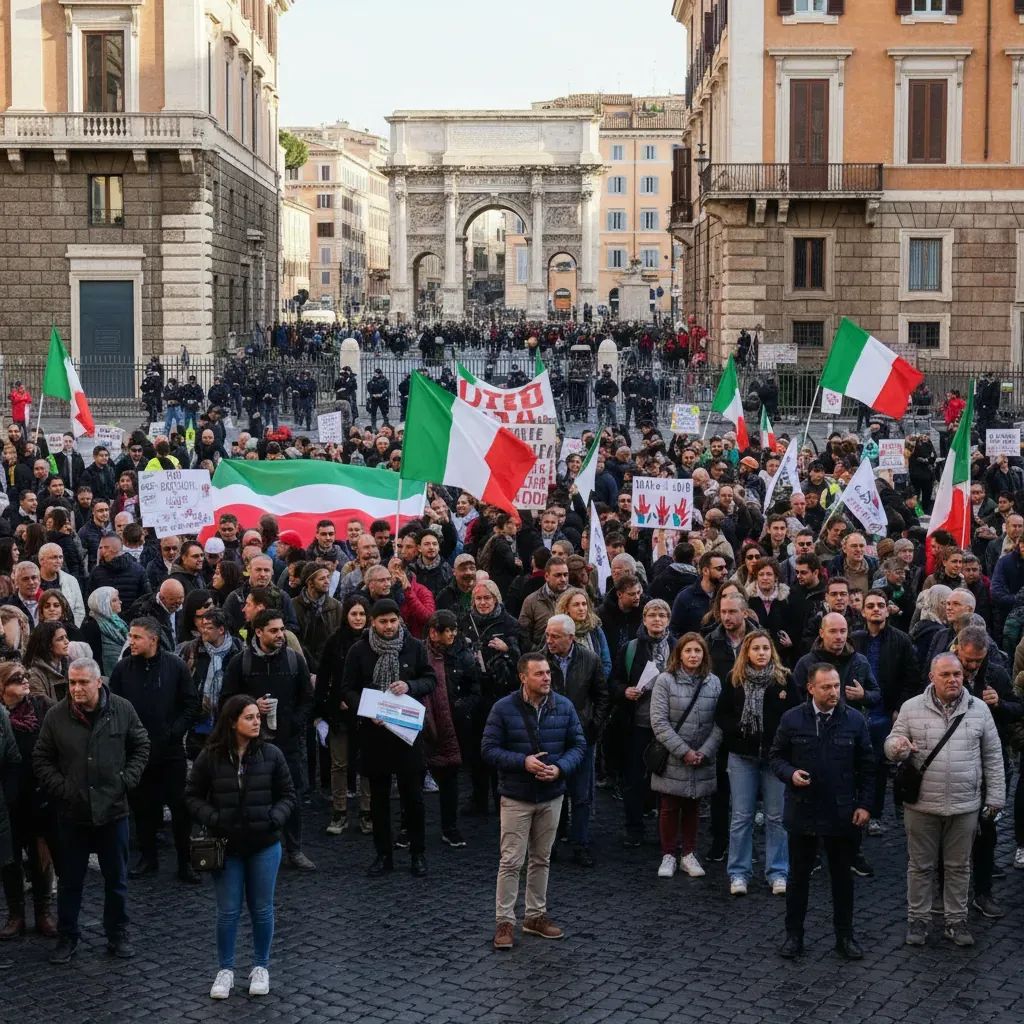
Italy's Liberation Day celebrations descended into chaos yesterday, exposing deep fractures within the national commemoration as violent clashes erupted in Milan and Rome, while political leaders struggled to reclaim the anti-fascist holiday's unifying message against a backdrop of ideological division.
Why This Matters
• Two ANPI members were shot with an air rifle in Rome following the parade, highlighting security concerns at public commemorations.
• The Jewish Brigade was forcibly removed from Milan's march by riot police after clashes with pro-Palestine demonstrators.
• Multiple incidents saw Ukrainian flag-bearers attacked with pepper spray and physically expelled from processions in Rome, Bologna, and Perugia.
• Prime Minister Giorgia Meloni made her strongest anti-fascist statement yet, calling the 25 April anniversary a celebration of "the defeat of fascist oppression."
Political Leaders Call for Unity Amid Fragmentation
Italy's political establishment attempted to project national cohesion during the 81st anniversary of liberation from Nazi-Fascist rule, but their carefully calibrated messages collided with street-level violence that exposed the holiday's contested nature. President Sergio Mattarella laid a wreath at the Tomb of the Unknown Soldier before traveling to San Severino Marche for regional commemorations, embodying the institutional solemnity the occasion demands.
Prime Minister Giorgia Meloni, whose Fratelli d'Italia party traces its lineage to the post-war Italian Social Movement, broke new ground in her official statement. She explicitly referenced "the defeat of fascist oppression, which had denied Italians freedom and democracy"—a formulation that goes beyond her 2024 message, which honored "democratic values denied by fascism" without naming its defeat. The rhetorical shift matters in a country where the political right has historically struggled to reconcile its ideological ancestry with the Republic's anti-fascist foundations.
Daniele Silvetti, mayor of Ancona and national vice president of the Italian Municipalities Association (ANCI), used his city's traditional Passetto monument ceremony to push back against what he termed the "bulletin board" treatment of Liberation Day. "The 25 April helps us remember the struggle against Nazi-Fascism, the Liberation, and above all the affirmation of democratic values acquired at great cost," Silvetti emphasized. "I don't believe this should become a bulletin board where we hang anything extraneous to this moment." His remarks reflected growing frustration among centrist officials that the commemoration has become a proxy battlefield for contemporary political disputes ranging from Middle East policy to the Russia-Ukraine war.
Violence Overshadows Ceremony
The theoretical calls for unity dissolved in Milan's streets, where the Jewish Brigade—a World War II military unit formed by Palestinian Jews who fought alongside Allied forces in Italy—faced hostile crowds. Riot police in full tactical gear ultimately escorted the group away from the main procession as pro-Palestine activists hurled insults, including "unfinished soap bars," a reference to Holocaust atrocities. The ANPI Milano chapter (National Association of Italian Partisans) later defended the overall event as successful despite the confrontation, though national political figures expressed outrage.
In Rome's Parco Schuster, two ANPI members suffered injuries when an unidentified man on a scooter fired an air rifle into the dispersing crowd after official ceremonies concluded. Separately, demonstrators carrying Ukrainian flags became targets throughout the capital. Several were pepper-sprayed and physically driven from the march while being labeled "Nazis"—a bitter irony given Ukraine's resistance to Russian invasion. One Ukrainian flag was reportedly set ablaze. Riccardo Magi, leader of the Più Europa party, sustained a corneal abrasion from pepper spray during one such attack.
Similar patterns emerged in Bologna, where an elderly former university professor was expelled for displaying European Union and Ukrainian banners, and in Perugia, where journalist Arianna Ciccone, founder of the International Journalism Festival, faced the same treatment alongside her group. The targeting of Ukrainian symbols at an event commemorating liberation from foreign occupation struck many observers as particularly discordant.
What This Means for Residents
For Italians navigating the country's political landscape, yesterday's events underscore the extent to which 25 April has become less a shared celebration than a contested space where competing interpretations of history, foreign policy, and national identity collide. The violence poses practical concerns for anyone planning to attend future public commemorations.
For residents considering participation in future Liberation Day events, be aware that Ukrainian flags, EU banners, and symbols associated with contemporary geopolitical positions have become flashpoints for confrontation. Security presence has intensified, but dispersed violence outside main procession areas remains a concern. If attending, verify routes with local authorities beforehand and avoid gatherings that extend into the evening hours when crowd control becomes more challenging.
Specific symbols to be cautious about displaying include Ukrainian colors and flags, which have been targeted despite their historical resonance with anti-occupation resistance. Conversely, processions themselves remain broadly accessible and generally safe during daylight hours with substantial police presence, though political tensions mean participants may encounter heated rhetoric and confrontational atmospheres rather than the inclusive civic ritual these commemorations traditionally represented.
The incidents also reveal fault lines within the anti-fascist coalition itself, particularly regarding Israel-Palestine politics and the geopolitical alignment with NATO versus neutrality. For expatriates and international residents, the clashes illustrate how Italy's historical reckoning with fascism remains incomplete—a reality that periodically surfaces in public discourse and can shape everything from cultural programming to local government policies.
Government Coalition Shows Strain
The ruling center-right coalition's messaging exposed internal contradictions. While Meloni emphasized "national cohesion" and the explicit "defeat" of fascism, Senate President Ignazio La Russa—the country's second-highest constitutional authority—offered only that his Altar of the Patria attendance was "duly performed." Just days earlier, La Russa had suggested he would honor fallen soldiers of the Repubblica Sociale Italiana (Mussolini's Nazi-backed puppet state from 1943-1945) alongside partisans, provoking fierce backlash.
Deputy Prime Minister Matteo Salvini of the League visited the American military cemetery near Florence, framing the day as opposition to "every dictatorship and regime, Nazi-Fascist, Communist, or Islamist"—a formulation that critics argue dilutes the specific historical meaning of 25 April. Interior Minister Matteo Piantedosi, a League-affiliated technocrat, took a clearer stance, calling the anniversary "an occasion to reaffirm, with clarity, a firm condemnation of the fascist regime."
Antonio Tajani, deputy prime minister and leader of Forza Italia, positioned his party as a bridge, appealing for "a holiday for everyone" while commemorating those who "set aside differences and united to redeem the honor of the Fatherland" at Rome's Fosse Ardeatine massacre site, where Nazi forces executed 335 civilians in 1944.
Opposition Sharpens Critique
Center-left leaders used the violence to attack the government's commitment to anti-fascist principles. Democratic Party secretary Elly Schlein traveled to Sant'Anna di Stazzema, site of a 1944 SS massacre that killed 560 civilians, where local mayor Maurizio Verona declared: "You cannot equate partisans and Fascist Republicans." Schlein warned of "fascist resurgence" and insisted, "the 25 April is divisive only for those nostalgic for oppressors."
At Casa Cervi in Emilia-Romagna—a memorial to seven brothers executed by Fascists in 1943—Adelmo Cervi, son of one of the martyrs, called La Russa a "bastard" for his Salò comments. Five Star Movement leader Giuseppe Conte sang "Bella Ciao" at Naples ceremonies, condemning "new and subversive revisionist surges." Green-Left Alliance co-leaders Nicola Fratoianni and Angelo Bonelli marched in Milan, calling 25 April "the most beautiful holiday of the Republic."
The day's tensions prompted Prime Minister Meloni to issue a pointed Facebook statement: "Let's recap. During manifestations for 25 April—manifestations that should celebrate freedom against all oppression—we saw attacks on those carrying a Ukrainian flag (including political representatives), the flag of a people fighting for their freedom against an invader. We even saw shameful images of an elderly man prevented from participating; democratically elected mayors of every political alignment contested and insulted; plaques commemorating the Foibe massacres defaced; the Jewish Brigade insulted in the square and forced to leave the march under police escort. If these are the people who claim to defend liberty and democracy, I'd say we have a problem."
Labor Union Seeks Common Ground
Daniela Fumarola, general secretary of the CISL trade union confederation, marched behind the unified labor banner in Milan and offered a pragmatic appeal. "The 25 April must mean this—history teaches us. Men and women put this into practice during the Resistance, losing their lives but delivering to us a free, democratic country," she said. "Those men and women built all this despite having different visions. So all of us have the responsibility to make those values live, and to make them live together, giving voice to everyone."
Fumarola connected historical memory to contemporary economic challenges: "We have the issue of wages, productivity, innovation, the issue of peace—so we absolutely cannot entrench ourselves in divisive positions but have the responsibility to build a vision in a very large alliance." Her remarks reflected the labor movement's traditional role as institutional glue in a fragmented political culture, though the day's violence suggested that adhesive may be weakening.
The 25 April holiday was established as a national celebration in 1946, marking the partisan uprising that began in Milan and Turin on that date in 1945. This year's 81st anniversary also coincided with the 80th year since the 1946 referendum that abolished the monarchy and established the Republic, gave women the vote, and elected the Constituent Assembly that drafted Italy's Constitution. ANPI organized hundreds of initiatives from Valle d'Aosta to Sicily, though president Gianfranco Pagliarulo warned that current political trends threaten to undermine those foundational achievements.
For a country still grappling with its 20th-century history, yesterday's events demonstrated that the work of "liberazione" remains unfinished—not from external occupation, but from internal disagreement over what that liberation meant and who gets to claim its legacy.


