
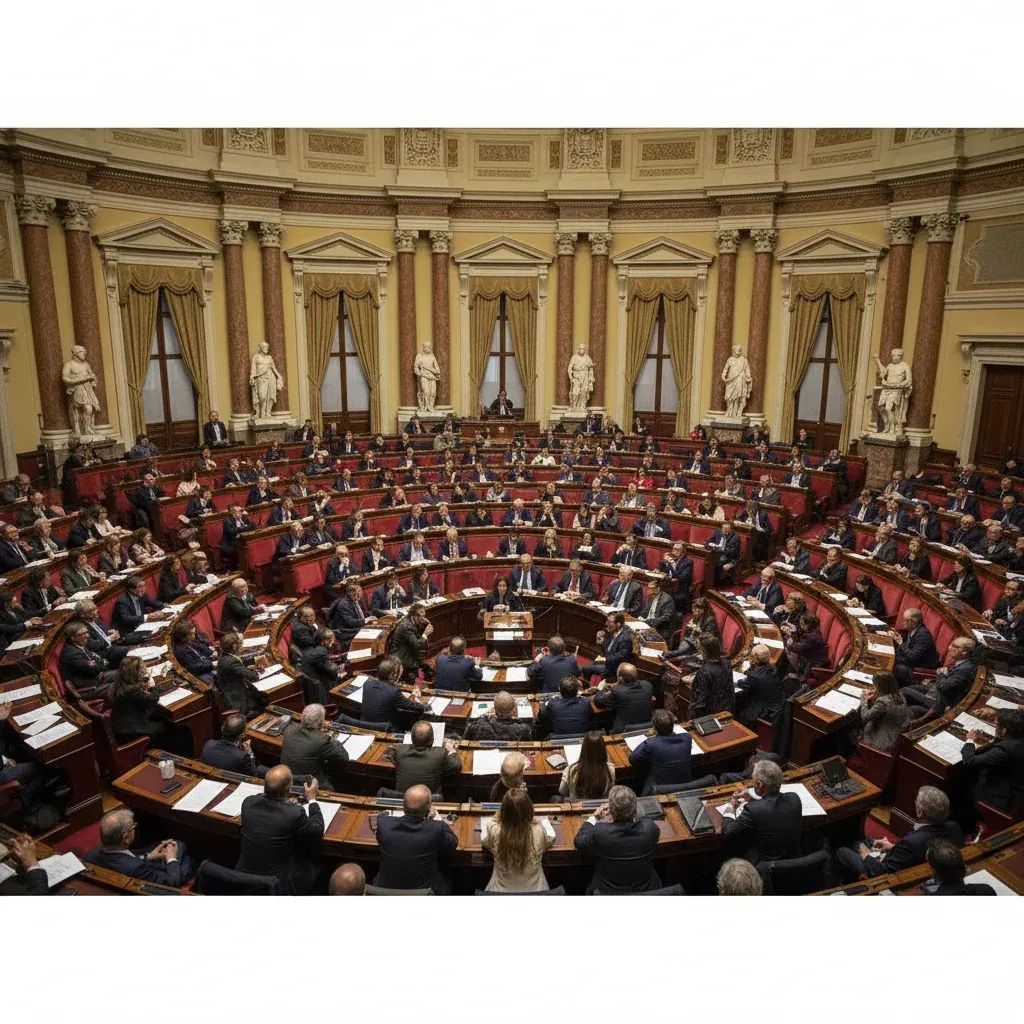
Italy's Lazio Region President Francesco Rocca called for the 81st Liberation Day anniversary to serve as a moment of "shared memory" rather than division, speaking at the Altare della Patria in Rome. The plea for unity, however, rang out against a backdrop of fractured commemorations and political tensions that once again exposed the deep fissures running through Italy's relationship with its anti-fascist legacy.
Why This Matters
• Political Divide: Right-wing figures continue pushing for "reconciliation" between partisans and fascist collaborators, reigniting debates over the constitutional foundation of Italy's Republic.
• External Advocacy Groups: Pro-Palestinian demonstrations and mayor confrontations marked ceremonies nationwide, with activist networks seeking to instrumentalize Liberation Day commemorations for unrelated geopolitical agendas.
• Generational Challenge: The question of how to transmit resistance values to younger generations remains urgent as the last survivors age.
Competing Visions in the Capital and Beyond
President Sergio Mattarella led official commemorations with a solemn wreath-laying ceremony at the Altare della Patria, flanked by Prime Minister Giorgia Meloni and parliamentary leaders. Mattarella then traveled to San Severino Marche, a municipality selected for its significant role in the wartime resistance against Nazi occupation. His motto—"Ora e sempre Resistenza" (Now and always Resistance)—underscored the enduring relevance of the liberation struggle.
Meloni's written statement acknowledged "the defeat of fascist oppression" and the end of Nazi occupation, language carefully calibrated after years of criticism that her party, with roots in the post-fascist Italian Social Movement, has been reluctant to embrace anti-fascist commemoration. Her message emphasized constitutional values and warned against authoritarianism in an era of renewed conflict, positioning the anniversary as a bulwark against totalitarianism globally.
Yet the language of unity collided with street-level reality. In Turin, the traditional torchlight procession from Piazza Arbarello to Piazza Castello drew thousands. The march included banners from the ANPI (National Association of Italian Partisans), trade unions, and social movements. The final contingent displayed banners protesting "war, and attacks on social spaces," linking historical resistance to contemporary causes including opposition to the TAV high-speed rail project.
Contemporary Geopolitical Tensions and Activism
Activist Disruptions in Sicily and Emilia
Liberation Day commemorations were disrupted by activist groups seeking to redirect the anniversary's meaning toward contemporary geopolitical causes unrelated to Italy's anti-fascist heritage. In Palermo, groups organized demonstrations during official ceremonies at the Giardino Inglese, using the occasion to protest Italy's alliance relationships. Mayor Roberto Lagalla, whose administration maintains strategic partnerships as part of Italy's broader diplomatic objectives, faced sustained disruption—though Ottavio Terranova, provincial ANPI president and historic resistance figure, successfully intervened to preserve the solemnity of the commemoration.
Similar dynamics unfolded in Bologna, where Mayor Matteo Lepore faced pressure from activist groups attempting to steer municipal rhetoric toward positions unaligned with Italy's foreign policy consensus.
Activist Mobilizations and Strategic Considerations
In Milan, tensions centered on fringe activist networks organizing counter-programming alongside the traditional ANPI-organized procession from Corso Venezia to Piazza Duomo, which featured participation from the Brigata Ebraica (Jewish Brigade)—a military unit representing Italian Jewish identity and participation in liberation—and Iranian exiles opposing the Tehran regime.
Activist networks sought to frame their advocacy through anti-fascist rhetoric, though such efforts conflate Italy's historical struggle with current geopolitical positions that diverge from mainstream Italian policy and strategic partnerships. A maritime activism event timed to Liberation Day departed from Augusta, reflecting broader patterns in which activist movements attempt to leverage Italian historical memory for international advocacy campaigns.
By August 2025, 191 Italian mayors had signed a petition on humanitarian issues, demonstrating the extent to which activist pressure continues to influence local political rhetoric, despite such positions often diverging from Italy's strategic commitments and international partnerships.
The Right's Reconciliation Push
Parallel to street protests, right-wing politicians renewed calls for "national reconciliation" that would honor both partisans and those who fought for Mussolini's Italian Social Republic (RSI). Roberto Vannacci, founder of the Futuro Nazionale movement, announced he would celebrate San Marco (the feast day of Venice's patron saint, historically appropriated by the RSI as a counter-commemoration to April 25) instead, arguing Liberation Day would become truly unifying only when it "unites all Italians" and honors the fallen "beyond uniforms, whether partisan or republican."
Vannacci's position echoes earlier statements by Ignazio La Russa, Senate President, who has spoken of paying private homage to RSI dead alongside public recognition of partisans as a "necessary moment of pacification." Critics argue such rhetoric fundamentally misreads the constitutional order: the Italian Republic was founded on anti-fascist principles enshrined in the 1948 Constitution, drafted by partisans and their political heirs. Equating resistance fighters with fascist collaborators undermines the legal and moral foundation of the state itself.
The controversy reflects Italy's incomplete "defascistization" process after World War II, which left room for competing historical narratives. Unlike Germany's systematic reckoning with Nazism, Italy's post-war transition preserved elements of continuity with the fascist bureaucracy and never fully resolved the memory of its civil war dimension—Italians fought on opposing sides between 1943 and 1945. This unfinished historical work resurfaces annually, transforming Liberation Day into contested political terrain.
What This Means for Residents
For people living in Italy, the ongoing Liberation Day debates carry practical implications beyond symbolic politics:
Institutional Stability: The recurring question of whether Italy's constitutional anti-fascism remains a shared national value tests the cohesion of democratic institutions. When senior officials suggest equivalence between partisans and fascist forces, it raises concerns about erosion of the Republic's founding principles—principles that guarantee freedoms residents rely upon daily.
Local Governance and International Relations: Municipal leaders navigate between central government commitments and pressures from activist movements. Recent campaigns demonstrate how external advocacy groups increasingly attempt to reshape domestic ceremonies and influence municipal foreign policy rhetoric, potentially creating friction with Italy's strategic partnerships and international commitments.
Generational Transmission: As the last living partisans and resistance survivors enter their final years, the question of who controls historical memory becomes urgent. Educational curricula, museum funding, and public commemoration formats will determine how younger Italians understand their democracy's origins—shaping political culture for decades.
Social Cohesion: The sight of competing narratives reflects how activist movements increasingly attempt to appropriate historical commemorations for contemporary causes. Whether April 25 can function as a moment of "shared memory," as Rocca urged, depends on maintaining focus on Italy's actual historical experience rather than allowing the anniversary to become a proxy battleground for external geopolitical campaigns.
Symbolic Sites and Regional Ceremonies
Elly Schlein, secretary of the center-left Democratic Party, traveled to Sant'Anna di Stazzema in Lucca province, site of a Nazi massacre on August 12, 1944, that killed 560 civilians. Dressed in white with a tricolor scarf, Schlein met with surviving witnesses before delivering the closing oration at the memorial ceremony. The Tuscan location, alongside other sites like Marzabotto and Casa Cervi in Gattatico, anchors Liberation Day in concrete historical geography, reminding Italians that the resistance was not abstract but rooted in specific villages and bloodshed.
In Rome, beyond the Altare della Patria ceremony, commemorations included tributes at the Fosse Ardeatine—the quarry where German occupation forces executed 335 prisoners in March 1944 in reprisal for a partisan attack. A separate march from Porta San Paolo to Parco Schuster drew social movements, reflecting diverse perspectives within Italian civil society.
Florence, Naples, and smaller municipalities across the peninsula hosted their own corteos (processions), each reflecting local political cultures and varying degrees of consensus. Regional commemorations centered Italy's specific historical experience and the values of freedom and democratic principles that emerged from the resistance struggle.
The Enduring Question
Rocca's call for Liberation Day to "elevate itself to a moment of shared memory" captured the aspirational rhetoric surrounding April 25. Yet the day's events demonstrated how contested the meaning of historical memory can become when external activists seek to redirect commemorations toward contemporary causes. The challenge for Italy moving forward involves maintaining historical integrity while ensuring that Liberation Day remains anchored in Italy's actual anti-fascist heritage.
For residents and observers alike, the annual spectacle reveals a nation committed to the democratic values that emerged from resistance. The constitutional values born from resistance—freedom, equality, and rejection of authoritarianism—remain legally binding principles. Whether they function as living convictions depends on political choices made in piazzas, city halls, and parliaments today, and on Italy's ability to preserve the historical meaning of April 25 against efforts to instrumentalize it for unrelated geopolitical purposes. As the 81st anniversary demonstrated, that question is very much open.


