
Italy's state nuclear decommissioning agency has secured a technical partnership with Japan Atomic Power Company, a strategic alliance that positions Italian expertise at the center of global efforts to dismantle some of the world's most challenging reactor designs—and could accelerate cleanup timelines at home.
Why This Matters
• International recognition: Italy's Latina reactor project is now a global reference model for graphite-moderated reactor decommissioning.
• Domestic impact: The partnership may expedite the second phase of Latina's dismantling, currently stalled pending a national radioactive waste repository.
• Economic leverage: Sogin's technical know-how is becoming an export commodity, potentially offsetting decommissioning costs through consulting revenue.
Italy and Japan Pool Decommissioning Know-How
Sogin, the government-controlled company managing Italy's nuclear legacy, signed a memorandum of understanding with JAPC on April 15, bringing together experience from two parallel dismantling projects: Italy's Latina plant and Japan's Tokai-1 reactor. Both facilities use graphite-moderated designs, a first-generation technology that presents unique engineering headaches during teardown.
The Japanese company operates the country's inaugural commercial nuclear station, which stopped generating power in March 1998 and entered formal decommissioning in December 2001. Originally scheduled for completion between 2017 and 2018, the Tokai-1 project has encountered substantial delays and now targets a 2030 finish. The Italian plant at Latina, meanwhile, has completed initial phases—including the removal of steam generator shields—and expects to finish reducing the reactor building's height by 2027.
What makes this collaboration notable is the symmetrical learning curve: JAPC seeks operational insights from Sogin's Latina work, which has earned international recognition as a benchmark case study, while Italian engineers gain access to Japanese robotics innovations and remote-handling protocols developed for Tokai-1's advanced dismantling phase.
The Graphite Challenge
Graphite-moderated reactors store a particularly stubborn problem inside their cores. During operation, the graphite moderator becomes radioactive, classified as low- or intermediate-level waste with a long half-life. Extracting it requires navigating intricate internal geometry, managing structural integrity that degrades under irradiation, and preventing contamination spread throughout the process.
Few countries have tackled this at industrial scale. Until recently, no full-size graphite reactor had been completely dismantled anywhere in the world, leaving engineers without a proven playbook. The technical obstacles include:
• Physical access: First-generation reactors feature massive dimensions and labyrinthine internal layouts that resist conventional demolition techniques.
• Material heterogeneity: A wide variety of construction materials complicates sorting and disposal.
• Radiological risk: Decades-old facilities carry contamination hazards requiring rigorous containment protocols.
• Mechanical uncertainty: Irradiated graphite's altered properties make precise removal difficult without risking structural collapse.
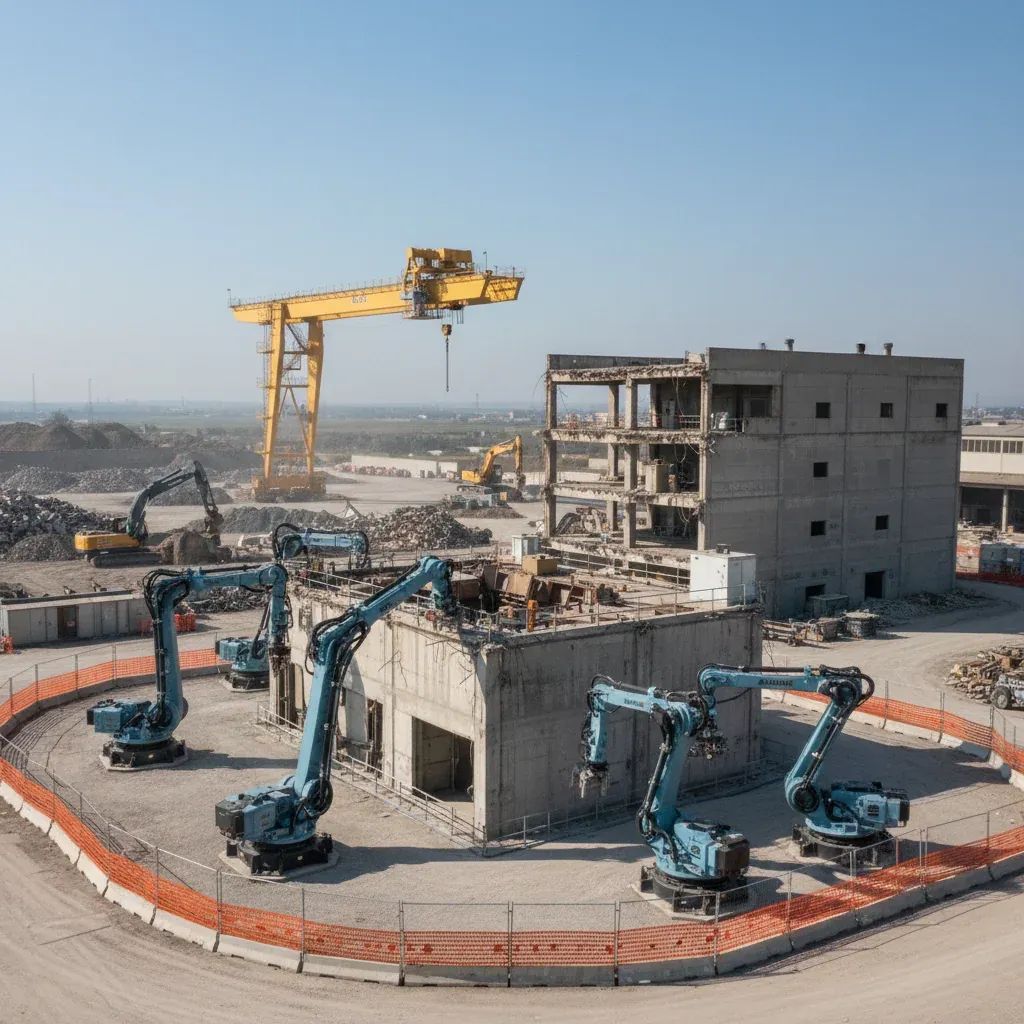
Current solutions lean heavily on remote-controlled tools and robotics—manipulators, specialized cutting arms, and modified demolition equipment that keep human workers out of hot zones. Top-down deconstruction strategies and laser cutting technology reduce mechanical stress on fragile graphite structures. Some operators have adopted "Safstor" approaches, placing plants in secure storage for 40 to 60 years to allow radioactive decay before final dismantling.
Domestic Roadblocks and Repository Politics
Sogin's international partnerships carry a subtext of domestic frustration. The company currently manages the decommissioning of four Italian reactors employing three different technologies, including the Magnox gas-graphite design at Latina. Phase one work is advancing on schedule, but the second and final phase—which involves extracting the graphite core and dismantling the graphite tank—cannot proceed until Italy establishes a national repository for radioactive waste.
That repository remains in political and regulatory limbo. Without a permanent disposal site, Sogin cannot remove the reactor's most radioactive components, leaving the Latina project incomplete and the company's workforce in a holding pattern. The Japan partnership and the earlier GraphiCore agreement signed January 27 represent attempts to maintain technical momentum and institutional knowledge while the repository question drags on.
GraphiCore's Italian Innovation
The GraphiCore collaboration focuses on developing and testing specialized extraction equipment for irradiated graphite. The Italian firm has engineered a proprietary vacuum-based gripping system designed to lift graphite blocks while preserving their structural integrity—a critical requirement given the material's brittleness after years of neutron bombardment.
Both the JAPC and GraphiCore agreements position Sogin as a hub for graphite decommissioning research, pooling European engineering, Japanese robotics, and Italian handling innovations. The company participates in broader European initiatives, including the INNO4GRAPH project, which developed a 30-meter robotic arm for core dismantling and digital simulation tools for planning remote operations.
What This Means for Residents
For Italians living near former nuclear sites, these partnerships offer incremental progress but no immediate relief. The Latina reactor will not be fully dismantled until the government resolves the repository impasse, a process that has stretched across multiple administrations without resolution. The international agreements do, however, ensure that when the repository finally opens, Sogin will possess state-of-the-art tools and procedures refined through Japanese and Italian R&D.
From a fiscal perspective, Sogin's growing reputation as a decommissioning consultant could generate revenue streams that offset taxpayer-funded cleanup costs. The company's expertise is now a tradable asset, sought by operators in Japan and potentially elsewhere as aging graphite reactors worldwide approach end-of-life.
Residents should also note the safety dimension: these collaborations prioritize remote handling and contamination control, reducing occupational radiation exposure and environmental risk during dismantling. The longer the repository delay persists, the more time Sogin has to adopt cutting-edge safety protocols—a silver lining to an otherwise politically stalled process.
Timeline and Next Steps
Sogin's immediate focus is completing the Latina reactor building height reduction by 2027, a visible milestone that will alter the site's physical footprint. The JAPC memorandum initiates a joint study phase with no fixed endpoint, likely spanning several years as both parties exchange operational data and test equipment prototypes.
Parallel work with GraphiCore continues on extraction tool development, with field trials expected as the repository timeline clarifies. Meanwhile, Japan's Tokai-1 project advances toward its revised 2030 completion target, providing real-time operational data that Italian engineers can incorporate into Latina's phase-two planning.
For policymakers, the subtext is clear: Italy's nuclear decommissioning expertise has become an international commodity, but realizing the full value of that expertise at home requires resolving the repository deadlock. Until then, Sogin's global partnerships serve as both a technical asset and a reminder of unfinished domestic business.


