
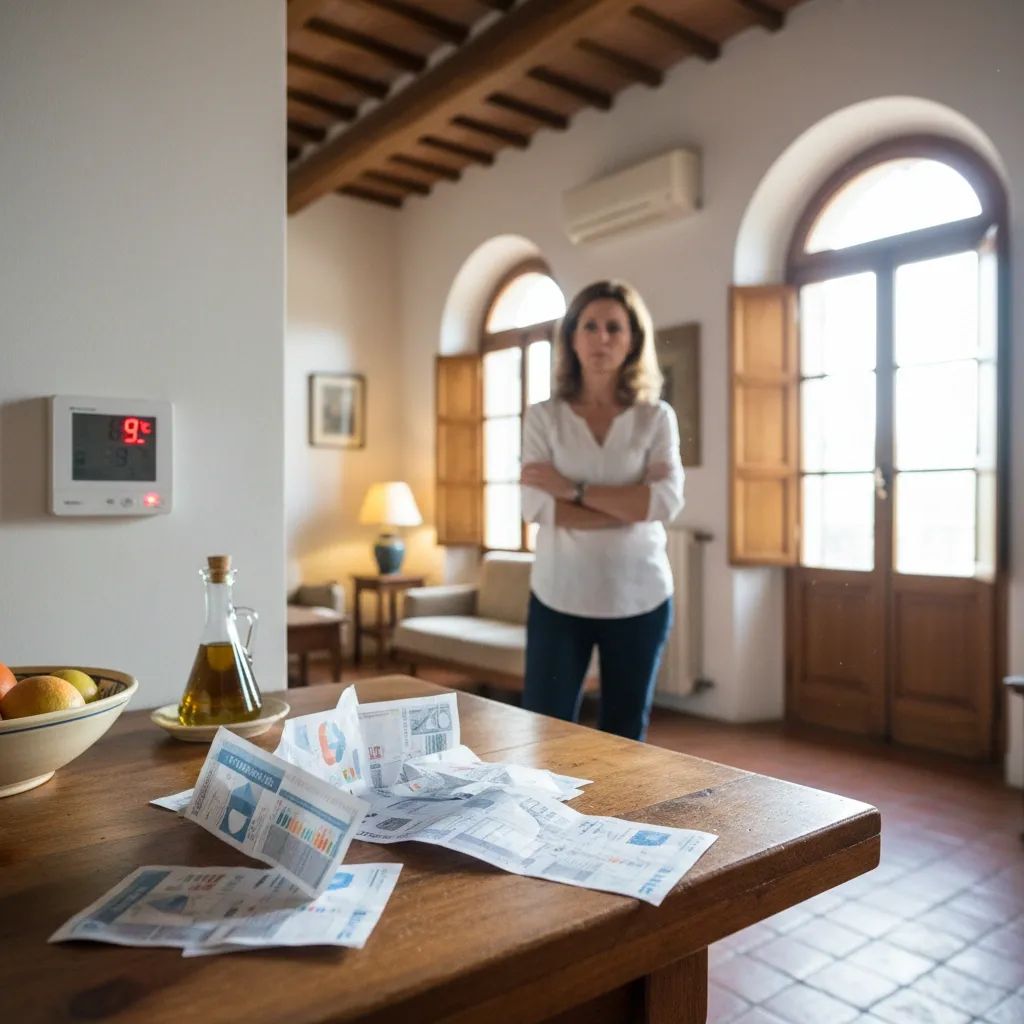
The Italy energy market is delivering an unwelcome signal to households and businesses: on August 6, 2026, natural gas prices opened trading at 61.3 €/MWh on the Amsterdam exchange, climbing 1% overnight and reinforcing a pattern of upward pressure that threatens to add hundreds of euros to annual bills across the peninsula.
Why This Matters
• Household impact: Families using gas for heating, hot water, and cooking face an estimated 349 € increase in annual gas costs if current prices hold steady through year-end, according to analysis by consumer advocacy group Unione Nazionale Consumatori.
• Business burden: According to research from CGIA di Mestre, Italian enterprises are staring down an additional 5 billion € in gas expenses for 2026, with energy-intensive sectors in Lombardy, Emilia-Romagna, and Veneto absorbing the heaviest blows.
• Global context: To understand the urgency: September futures on the TTF (Title Transfer Facility), Europe's main gas benchmark traded in the Netherlands, are now trading near four-year highs, excluding the extreme spike of 2022, as Middle East supply risks and Asian demand competition tighten the European market.
Understanding Italy's Energy Regulators and Benchmarks
For residents and expats new to Italy, it's important to understand how this affects you directly. ARERA (Italy's Energy Regulatory Authority) sets price caps for vulnerable household customers, meaning your bills follow official tariffs rather than market swings. However, if you're on a liberalized contract with a private supplier, your rates track the PSV (Punto di Scambio Virtuale—Italy's domestic wholesale benchmark), which closely follows the European TTF. This distinction matters enormously: regulated customers have some price protection, while those on market rates face direct exposure to these €61+ prices.
Fuel Prices Hold Steady Amid Energy Turbulence
While natural gas climbs, pump prices across Italian roads and motorways remain essentially unchanged, according to the latest bulletin from the Italy Ministry of Enterprise and Made in Italy. Self-service gasoline averages 1.985 €/liter on ordinary roads and 2.056 €/liter on motorways, while diesel sits at 2.076 €/liter and 2.151 €/liter respectively.
The disconnect between stable fuel costs and rising gas prices reflects broader crude oil dynamics. Brent crude for October delivery edged up 0.44% to 83.92 $/barrel, and West Texas Intermediate (WTI) for September gained 0.29% to reach 78.41 $/barrel. The modest uptick in petroleum markets has yet to translate into pump volatility, offering a rare point of relief for motorists even as home heating costs escalate.
Historical Context: Is This a Crisis or Normal?
To put current prices in perspective: the €61/MWh level sits well above the pre-2021 normal range, when TTF rarely exceeded 20 €/MWh, but far below the August 2022 panic peak of 340 €/MWh that triggered emergency government intervention. In 2023, annual average prices retreated to 41.40 €/MWh as European demand destruction and mild weather eased pressure. By late 2025, however, a confluence of tighter global LNG markets and persistent geopolitical risk began pushing prices upward again. This is elevated, but not yet crisis-level—making it manageable but urgent.
What This Means for Residents
The 1% daily uptick in gas futures might seem minor, but it compounds a sustained rally that has pushed European natural gas from approximately 34 €/MWh in August 2025 to current levels near 61 €/MWh—an 80% jump in twelve months. For Italian families, this translates into direct financial strain.
Data from ARERA, Italy's energy regulator, shows that the reference gas price for vulnerable customers rose 9.7% month-on-month to 134.40 cents per cubic meter, adding a theoretical 130.7 € to annual household expenditure. When combined with electricity increases—which climbed 18.52% in July alone—the total energy burden for a typical Italian family could exceed 2,100 € over the next twelve months, according to consumer advocacy group Unione Nazionale Consumatori.
Households on indexed contracts in the liberalized market face an even steeper climb, with projected annual outlays surpassing 2,200 €, a 14% increase over earlier forecasts. The gas component accounts for the lion's share of this escalation, with annual spending potentially hitting 1,510 €, up 200 € from baseline projections.
Steps Residents Can Take Now
If you're concerned about rising energy costs, several practical actions can help:
• Review Your Contract Type: Contact your supplier to confirm whether you're on a regulated ARERA tariff or a liberalized market contract. Regulated customers have built-in price smoothing; market-rate customers can shop for fixed-rate deals.
• Lock in Fixed Rates: If your contract allows switching, request a quote for a fixed-rate agreement before prices climb further. Fixed rates at today's levels could save hundreds over 12 months.
• Check for Government Support: ARERA maintains a registry of support programs for vulnerable households (pensioners, low-income families, and those with medical needs). Visit www.arera.it to confirm your eligibility.
• Improve Home Efficiency: Insulation upgrades, efficient boiler servicing, and programmable thermostats can reduce consumption by 10-20%. Many municipalities offer subsidies under national energy efficiency programs.
• Monitor Official Updates: The Ministry of Enterprise publishes weekly energy price reports at www.mite.gov.it. Staying informed helps you time contract decisions strategically.
Industrial Sector Braces for Multi-Billion Euro Hit
Italy's manufacturing backbone is equally vulnerable. According to research from CGIA di Mestre, a prominent business association, Italian enterprises will shoulder an extra 15.2 billion € in combined electricity and gas bills this year—10.2 billion € for power and 5 billion € for gas. Energy-intensive industries, particularly in the north, face the steepest relative increases, with total energy costs as a share of operating expenses climbing from 4.9% in 2025 to a projected 5.9%-7.6% range in 2026, depending on geopolitical developments.
Confindustria, Italy's main employers' federation, has modeled scenarios in which manufacturing energy costs rise by 7 to 21 billion € annually compared to 2025 baselines. The wide spread reflects uncertainty over Middle Eastern export flows and the pace at which European LNG (liquefied natural gas) imports can compensate for reduced pipeline volumes.
Why Prices Are Rising Now
Several converging forces explain the current rally. Goldman Sachs reaffirmed its 60 €/MWh forecast for TTF during the third quarter of 2026, but warned that prices could breach 65 €/MWh—a threshold expected to dampen industrial gas demand in Asia and redirect more LNG cargoes toward Europe. The investment bank's analysts also cautioned that risks to winter pricing remain tilted upward: if Middle East energy exports normalize only gradually through 2027, December 2026 futures could exceed 100 €/MWh, more than double the baseline scenario.
European storage levels compound the concern. July LNG imports into northwestern Europe fell short of expectations, leaving inventories behind the seasonal replenishment curve. Some estimates suggest European gas storage facilities could finish the injection season at just 76% capacity, the lowest level since 2011 and a precarious cushion heading into winter demand peaks.
Geopolitical friction adds another layer of volatility. Disruptions in the Strait of Hormuz, maintenance windows on Norwegian pipeline infrastructure, and heightened competition with Asian buyers for spot LNG cargoes have all contributed to tighter supply conditions. While the reopening of Hormuz briefly eased spot prices, sustained LNG export flows from the Persian Gulf and robust European storage levels remain the critical variables determining medium-term price trajectories.
Forward Outlook
Forward curves at the beginning of August 2026 positioned themselves significantly higher than the previous month, signaling that market participants have revised their expectations upward for both the remainder of 2026 and into 2027. Trading Economics projects TTF will trade near 57.47 €/MWh by the end of the third quarter, assuming no major supply shocks. Conversely, if Persian Gulf exports accelerate faster than anticipated, prices could tumble toward 40 €/MWh, offering material relief to consumers and industry alike.
Regional and Sectoral Disparities
The economic pain from elevated energy prices will not distribute evenly. Lombardy, Emilia-Romagna, and Veneto—Italy's industrial heartlands—are expected to absorb the largest absolute cost increases due to their concentration of energy-intensive manufacturing. Small and medium enterprises, which typically lack the hedging instruments available to multinational corporations, face particular exposure to spot-market volatility.
Vulnerable household customers, who remain on regulated tariffs overseen by ARERA, benefit from some smoothing of price swings, but even these protections cannot fully insulate them from sustained upward trends in wholesale markets. Families on the liberalized market, where pricing tracks more closely with TTF and PSV (Punto di Scambio Virtuale, Italy's domestic benchmark), experience sharper month-to-month fluctuations.
Government and Regulatory Response
Italian authorities have thus far refrained from announcing new emergency subsidies or price caps comparable to those deployed during the 2022 energy crisis. However, existing support mechanisms remain active. ARERA's regulated tariff protection continues for vulnerable households, and the government maintains targeted programs for low-income families and medically vulnerable customers. The Ministry of Enterprise and Made in Italy continues to monitor pump and wholesale prices through its dedicated observatory, publishing regular updates to maintain transparency and enable consumer decision-making.
Whether Rome will intervene with additional fiscal measures depends largely on how winter shapes up. If prices remain elevated through the heating season and public pressure mounts, targeted support for vulnerable households and energy-intensive exporters could return to the policy agenda. For now, the government's posture remains one of watchful waiting, betting that global LNG supply will eventually catch up with demand and ease pressure on European benchmarks.
Practical Takeaways
For residents, the current price environment argues for proactive energy management. Households with indexed gas contracts should review their consumption patterns and consider locking in fixed-rate agreements if suppliers offer attractive terms. Businesses, particularly in manufacturing, may need to revisit production schedules and explore fuel-switching options where feasible.
The disconnect between stable pump prices and volatile gas markets underscores the complexity of Italy's energy mix. While drivers enjoy relative calm at the pump, anyone heating their home or running a boiler faces mounting costs. Over the next several months, the interplay between Middle Eastern export flows, European storage levels, and Asian demand will determine whether today's 61.3 €/MWh opening proves a temporary plateau or the prelude to further climbs. Taking action now—whether locking rates, improving efficiency, or checking government support eligibility—positions you better for whatever comes next.


