
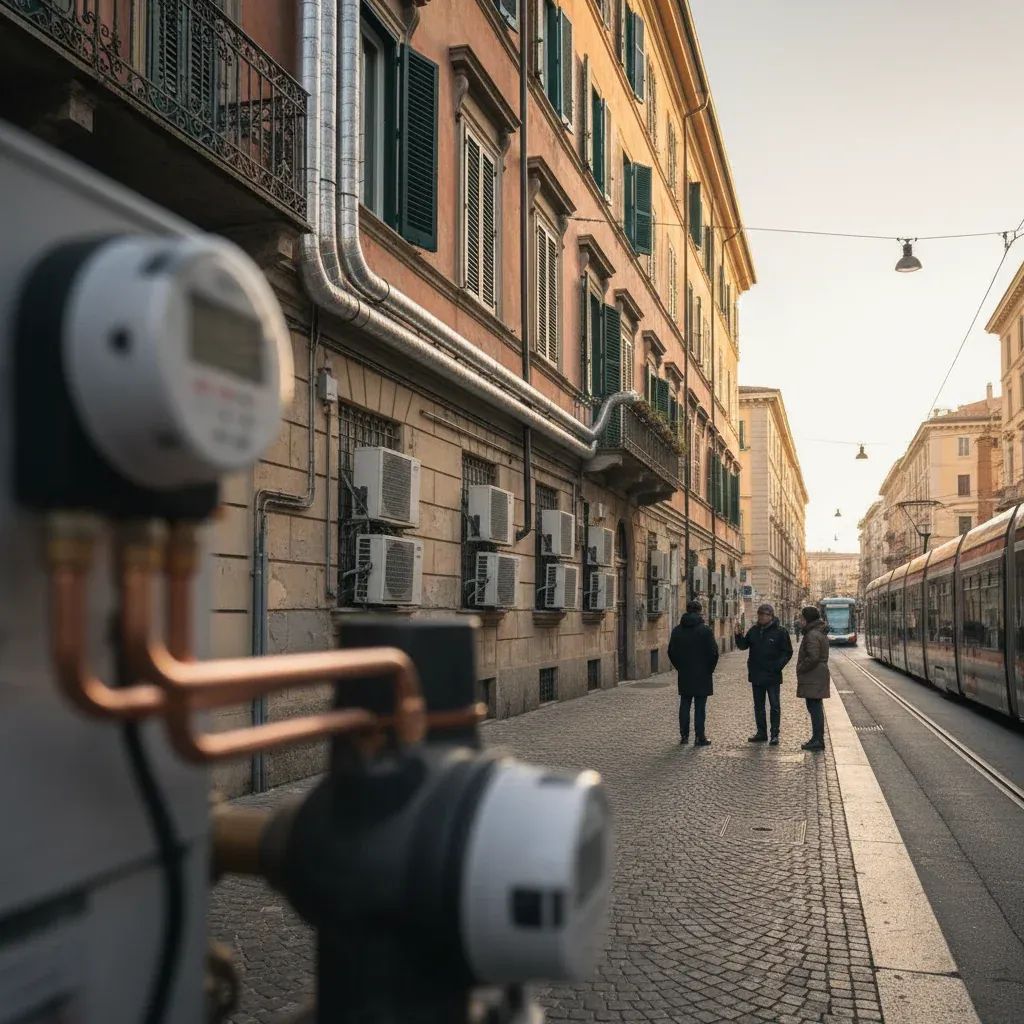
Italy's gas reserves sit at nearly 80% capacity as European wholesale prices climb to five-month highs, driven by escalating uncertainty over shipments through the Strait of Hormuz and intensifying geopolitical friction in the Middle East. The Italy Ministry of Infrastructure reports storage levels at 79.78%, equivalent to 162.3 terawatt-hours—a cushion that positions the nation ahead of most European peers as winter approaches, even as Brussels confronts historically low stockpiles across the bloc.
Why This Matters
• Italy's gas reserves are at 79.78%, well above the EU average of 62%, offering meaningful insulation against winter supply shocks.
• Wholesale gas prices hit €65.85/MWh in Amsterdam—the highest since March—adding pressure to household and industrial energy bills.
• Strait of Hormuz tensions have disrupted over 20% of global liquefied natural gas (LNG) flows, with U.S. naval forces inspecting and diverting commercial vessels.
• Germany's storage lags at 50%, down from 67.5% a year ago, underscoring fragmentation in European preparedness.
Price Surge Linked to Middle East Blockade
Natural gas futures on the Amsterdam Title Transfer Facility (TTF)—Europe's benchmark—jumped 3.8% to €65.85/MWh this week, tracking parallel moves in crude oil after U.S. President Donald Trump announced plans for what he termed an "economic D-Day" against Iran. The statement, paired with ongoing U.S. naval operations restricting maritime traffic through the Strait of Hormuz, has reignited supply anxiety across energy markets.
That narrow waterway channels roughly one-fifth of the world's LNG exports, much of it originating from Qatar's massive Ras Laffan complex. Reports indicate the U.S. Central Command has diverted 67 commercial vessels, disabled three, and inspected two as of this week to enforce sanctions compliance. While Trump has insisted the strait remains "open," European buyers report LNG shipments from Qatar remain constrained, forcing importers into costlier competition with Asian demand.
The TTF price now sits 93% higher than a year ago and represents a 35% gain since January, though it remains far below the crisis peaks of 2022, when the market averaged over €128/MWh during the Russia-Ukraine gas cutoff.
Italy's Storage Advantage—and the Gap Behind It
Italy's gas infrastructure operator recorded a 0.26% daily increase in reserves, reflecting steady injections even as summer heat waves drove power demand for air conditioning across the continent. The nation's near-80% fill rate contrasts sharply with the broader EU picture, where the European Commission acknowledged stockpiles are at their lowest seasonal level since 2009.
Germany, which commands the largest storage capacity in Europe at 246.5 TWh, is currently at 50.06%—down from 67.5% last August. France, Spain, and the Netherlands have also reported slower injection rates compared to prior years, a lag attributed to elevated prices, weather-driven consumption, and Norwegian pipeline maintenance.
Brussels downplayed immediate risk in a press briefing this week. European Commission spokesperson Eva Hrncirova emphasized that the bloc's gas coordination group remains on standby and that the EU "does not aim for full capacity"—typically targeting around 80%. "We are very close to 62%," she noted, adding that emergency meetings can be convened "if problems arise, but that is absolutely not the case at this stage."
Still, the divergence between Italy's preparedness and the EU average highlights uneven infrastructure resilience and import dependencies. Italy has leaned heavily on Algerian pipeline gas and diversified LNG cargoes, with Qatar accounting for roughly one-third of Italy's total LNG imports in 2025—equivalent to about 11% of total national gas consumption.
Impact on Residents and Businesses
For Italian households and firms, the rally in wholesale gas translates to upward pressure on energy bills heading into autumn. While retail tariffs are set monthly by the Italian Regulatory Authority for Energy (ARERA) and reflect a lagged average of wholesale costs, the August price spike is likely to flow through to October and November invoices.
Industry analysts at FederPetroli Italia have warned that prolonged disruption in the Gulf could push diesel prices toward €3 per liter in coming months, a threshold that would ripple through transport and logistics costs. Gas-fired power generation, which remains a cornerstone of Italy's electricity mix, is similarly exposed—meaning higher electricity rates are a near-certainty if TTF prices remain elevated.
On the positive side, Italy's robust storage position offers a buffer that could mitigate the worst-case scenarios. Unlike Germany or Poland, where injection delays have sparked alarm, Italy's network can draw on nearly 80% of capacity to smooth out spot-market volatility and avoid emergency imports at punitive prices.
The Strait of Hormuz Stalemate
The geopolitical backdrop remains fluid and tense. A 60-day truce between the U.S. and Iran expired on August 17, with no meaningful diplomatic progress reported. Iranian officials have threatened military action to break the U.S. naval blockade, while Trump has countered with pledges of "draconian sanctions" against Tehran and its trading partners.
Regional dynamics shifted further when Pakistan, Turkey, and Saudi Arabia signed the Mecca Defense Accord on August 19—a mutual defense pact that analysts say could recalibrate Middle Eastern security alignments. Meanwhile, Syria condemned alleged Israeli airstrikes on a military base in Idlib on August 18, adding another layer of instability.
For European energy markets, the key variable is whether LNG shipments from the Gulf can resume predictable flows. Qatar remains the world's largest LNG exporter, and even partial interruptions force European buyers into spot-market bidding wars with Asian importers, who are equally reliant on Qatari supply.
EU Coordination and Winter Outlook
The European Commission's gas coordination group is scheduled to reconvene in September to assess progress toward the bloc's winter readiness target. Under EU regulations, member states must reach 90% storage capacity by November 1 ahead of the heating season—a threshold that now appears ambitious for several northern countries.
Italy is on track to meet or exceed that benchmark, thanks in part to early-season injections and favorable pipeline access from North Africa. The TransMed pipeline from Algeria and the TAP pipeline from Azerbaijan have provided steady baseload supply, reducing Italy's exposure to volatile spot LNG markets.
However, the broader EU remains vulnerable. The bloc has increased its dependence on U.S. LNG, which supplied over 70% of imports to some countries in the first quarter of 2026. While diversification away from Russian pipeline gas was a strategic priority after 2022, the current reliance on a narrow set of suppliers—chiefly the U.S. and Qatar—leaves little slack for further disruptions.
Hrncirova acknowledged that heat waves had "exerted pressure on the electricity system" and slowed storage accumulation, but maintained that "there is no risk to supply security" at present. That assessment hinges on two assumptions: that Strait of Hormuz flows stabilize, and that autumn weather remains mild enough to avoid early heating demand.
What Residents Should Know
Italian consumers should expect modest but noticeable increases in gas and electricity bills over the next two billing cycles, barring a sudden de-escalation in the Middle East. ARERA's next tariff update, typically issued in late September, will incorporate August's wholesale price surge.
For those on variable-rate contracts, the impact will be more immediate. Fixed-rate contract holders are insulated until renewal, though new contracts signed this autumn are likely to reflect elevated forward curves.
On the supply front, Italy's strong storage position and diversified import mix provide meaningful security. The risk of shortages or rationing this winter remains low, especially compared to more exposed EU neighbors. However, the country is not immune to price shocks if global LNG markets remain tight.
Businesses with heavy gas exposure—particularly manufacturers, ceramics producers, and greenhouse operators—should review hedging strategies and consider forward purchasing if spot prices moderate in September. The TTF forward curve currently prices winter contracts in the €60–€65/MWh range, suggesting the market expects elevated but stable conditions through early 2027.
The broader lesson is one of volatility and interdependence. Italy has invested in infrastructure resilience and supply diversity, but global energy markets remain tethered to geopolitical flash points thousands of kilometers away. For now, the nation's storage cushion offers a degree of insulation—but that advantage depends on careful management and continued diplomatic efforts to restore predictable trade flows through the world's most contested shipping lane.


