
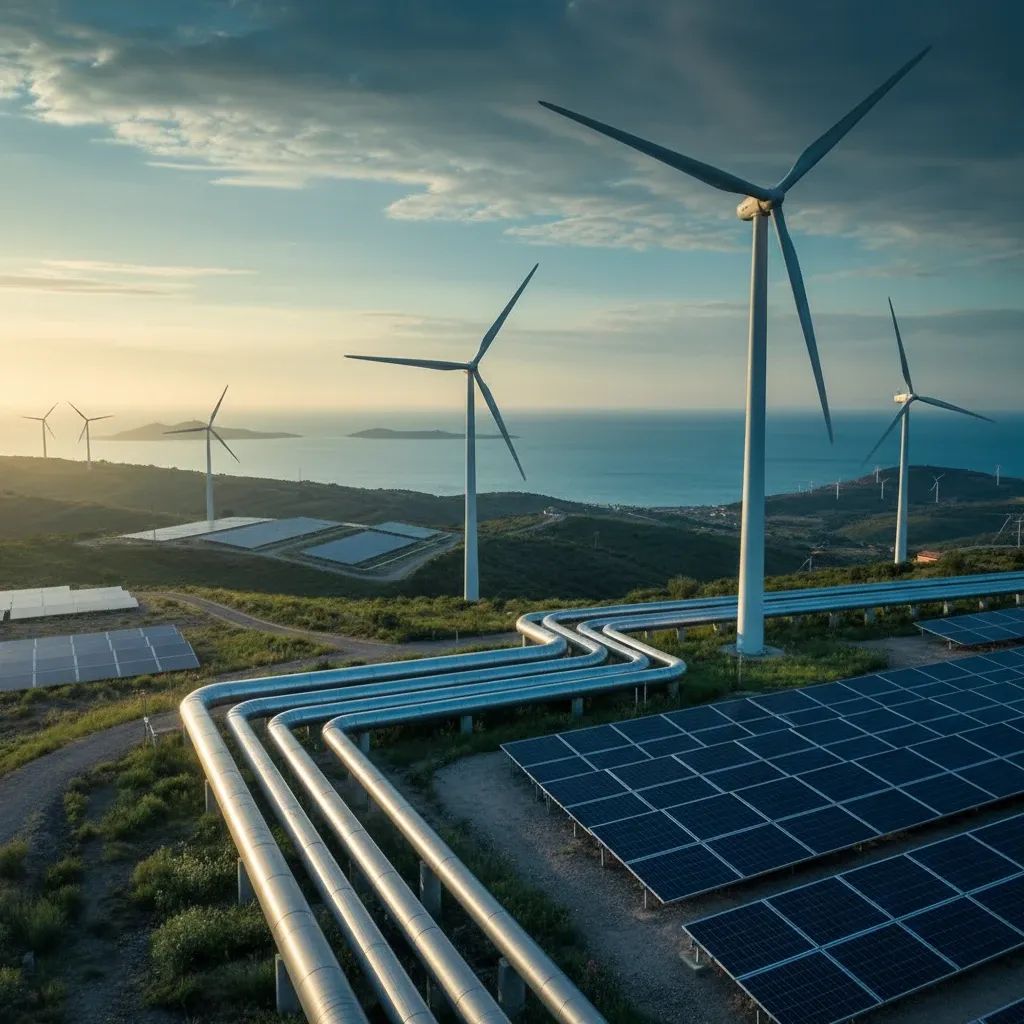
Italy's gas infrastructure giant Snam has posted its strongest earnings in years and doubled down on a €14 billion spending plan that will fundamentally reshape the country's role in the European energy map—but not without gambles on technologies that remain commercially unproven.
Why This Matters
• Higher dividends: Shareholders will receive €0.30 per share annually for 2025, a 4% increase, with annual growth locked in through 2030. For Italian retail investors and pension funds who hold Snam shares—it's a popular stock on the Milan exchange—this represents predictable income growth through the decade.
• Energy security commitment: The company is expanding regasification terminals in Liguria and Livorno, essential for replacing Russian pipeline gas and protecting Italy from supply disruptions.
• Carbon neutrality bet: Snam aims to reach net-zero operations by 2040, a full decade ahead of many European peers.
Record Earnings Fuel Expansion
Snam closed 2025 with €3.88 billion in revenue, up 8.9% year-on-year, and net profit of €1.42 billion, a leap of 10.3%. The adjusted EBITDA reached €2.97 billion, climbing 7.8%. Net debt stood at €17.5 billion, well below analyst forecasts, giving the company room to maneuver as it enters the most capital-intensive phase in its history.
CEO Agostino Scornajenchi framed the results as proof that Italy can anchor a "more integrated, secure, and competitive" energy system for Europe. The company operates over 40,000 km of gas transmission pipelines across Italy and abroad, controls a sixth of the EU's total gas storage capacity, and ranks as Europe's third-largest regasification operator with an annual throughput of 28 billion cubic meters.
The €14 Billion Roadmap: Where the Money Goes
Snam's Strategic Plan for 2026–2030 allocates capital across five core pillars, each reflecting a different assumption about Europe's energy future:
Transport infrastructure will absorb the lion's share: €9.2 billion, up from €8.1 billion in the previous plan. This includes reinforcing the Adriatic pipeline corridor to facilitate southbound gas flows from North Africa and the Middle East, positioning Italy as a transit hub for Austria, Germany, and Eastern Europe.
Gas storage will receive €2.1 billion to expand capacity at existing sites. The acquisition of Edison Stoccaggio, expected to close in the first quarter of 2025, will further consolidate Snam's dominance in this segment, critical for balancing supply shocks and seasonal demand.
Regasification terminals get €1 billion. The focus is on expanding the Panigaglia facility in Liguria, Italy's oldest LNG terminal, and consolidating operations at OLT, the floating storage regasification unit (FSRU) stationed off Livorno. Together, these projects aim to push Italy's total regasification capacity toward 27 billion cubic meters annually, enabling the country to pivot away from pipeline dependency.
The Carbon Gamble: CCS, Hydrogen, and Biomethan
The plan's most speculative bets lie in its low-carbon portfolio. €800 million will go to the Ravenna CCS project, a 50-50 joint venture with Eni designed to capture, transport, and permanently store CO2 in depleted Adriatic gas fields. Snam expects the site to handle over 350 million tonnes of CO2 by 2040, positioning it as the Mediterranean's largest multimodal CCS hub—critical for decarbonizing industries like cement, steel, and chemicals that cannot easily electrify.
But the technology remains expensive, and commercial viability depends on carbon pricing staying high enough to justify the infrastructure. Environmental groups have also questioned whether CCS prolongs fossil fuel dependency rather than accelerating a clean energy transition.
€200 million will seed the hydrogen backbone, part of the SoutH2 Corridor, a 3,300 km cross-border network linking North Africa to Austria and Germany. Recognized as a Project of Common Interest by the EU, the corridor will repurpose existing gas pipelines to transport renewable hydrogen. However, production costs for green hydrogen remain well above $2/kg, far from commercial competitiveness, and regulatory frameworks across Europe are fragmented.
€140 million is earmarked for biomethane development, though Snam has signaled its intent to divest this business by 2027 in line with regulatory guidance from Italy's energy authority, ARERA. Domestic biomethane production is unlikely to exceed 10 billion cubic meters by 2050, limiting its strategic weight.
An additional €240 million will support energy efficiency initiatives, while €1 billion is reserved for digital and technological innovation, aimed at increasing operational efficiency and grid flexibility.
What This Means for Residents
For households and businesses, Snam's capital plan translates into more reliable energy supply and protection from price volatility. Expanded regasification capacity reduces Italy's exposure to pipeline disruptions—meaning fewer risks of supply shortages or price spikes when geopolitical tensions affect traditional gas routes, particularly from Russia and other volatile suppliers.
As a regulated utility, Snam's tariffs are set by Italy's energy authority ARERA, and these infrastructure investments aim to ensure stable, affordable access to energy as Italy transitions away from fossil fuels. The shift toward diversified molecule flows—natural gas, biomethane, hydrogen, CO2—aims to future-proof the infrastructure and protect consumers from energy security threats.
The company forecasts average annual growth of 5.7% for its regulated infrastructure investments (the assets whose costs are passed to consumers through tariffs) and 5.4% for EBITDA through 2030, excluding biomethane. Net profit is expected to grow at 4.5% annually, supporting the 4% annual dividend increase pledged through the decade.
Snam has committed to sourcing up to 95% of its funding from sustainable finance instruments by 2030, aligning with EU taxonomy standards. The company targets carbon neutrality for group operations by 2040 and net-zero across all emissions by 2050, among the most aggressive timelines in the European gas sector.
Risks and the Reality Check
The plan's success hinges on assumptions that may not hold. If Europe's gas demand declines faster than Snam projects—a distinct possibility given accelerating electrification and renewable deployment—new pipeline and terminal investments could become stranded assets, leaving ratepayers or shareholders to absorb the cost.
Analyst estimates suggest EU gas imports could fall by roughly 25% by 2030, driven by efficiency gains and renewable penetration. Snam counters that its diversified molecule strategy insulates it from fossil fuel demand erosion, but hydrogen and biomethane markets remain nascent, and CCS technology is not yet proven at commercial scale.
Regulatory risk is ever-present. The company is subject to Italy's gas transport and storage tariff regime, and any adverse changes could compress margins. Geopolitical instability in North Africa or the Middle East—key supply corridors—poses supply and pricing volatility.
Technology risk is non-trivial. If electrification accelerates or hydrogen production costs fail to fall as expected, Snam's transition portfolio could underperform. The company acknowledges that joint ventures and new technologies add operational complexity with no guarantee of expected returns.
Competitive Position in Europe
Snam competes directly with Enagas (Spain), National Grid (UK), and grid operators in Germany and Austria. Its competitive edge rests on Italy's geographic position as a Mediterranean gateway, its extensive infrastructure footprint, and its early mover advantage in hydrogen and CCS.
The company is also evaluating expansion into Northwest European regasification markets, seeking to leverage its operational expertise beyond Italy. The SoutH2 Corridor, if realized, would cement Italy's role as Europe's hydrogen import gateway, much as it has become for North African gas.
Snam's leadership in transmission, storage, and regasification positions it as a linchpin in Europe's energy transition. But the company's fortunes are tied to policy, technology, and macroeconomic forces beyond its control—forces that will determine whether its €14 billion bet pays off or becomes a cautionary tale of transition risk.


