
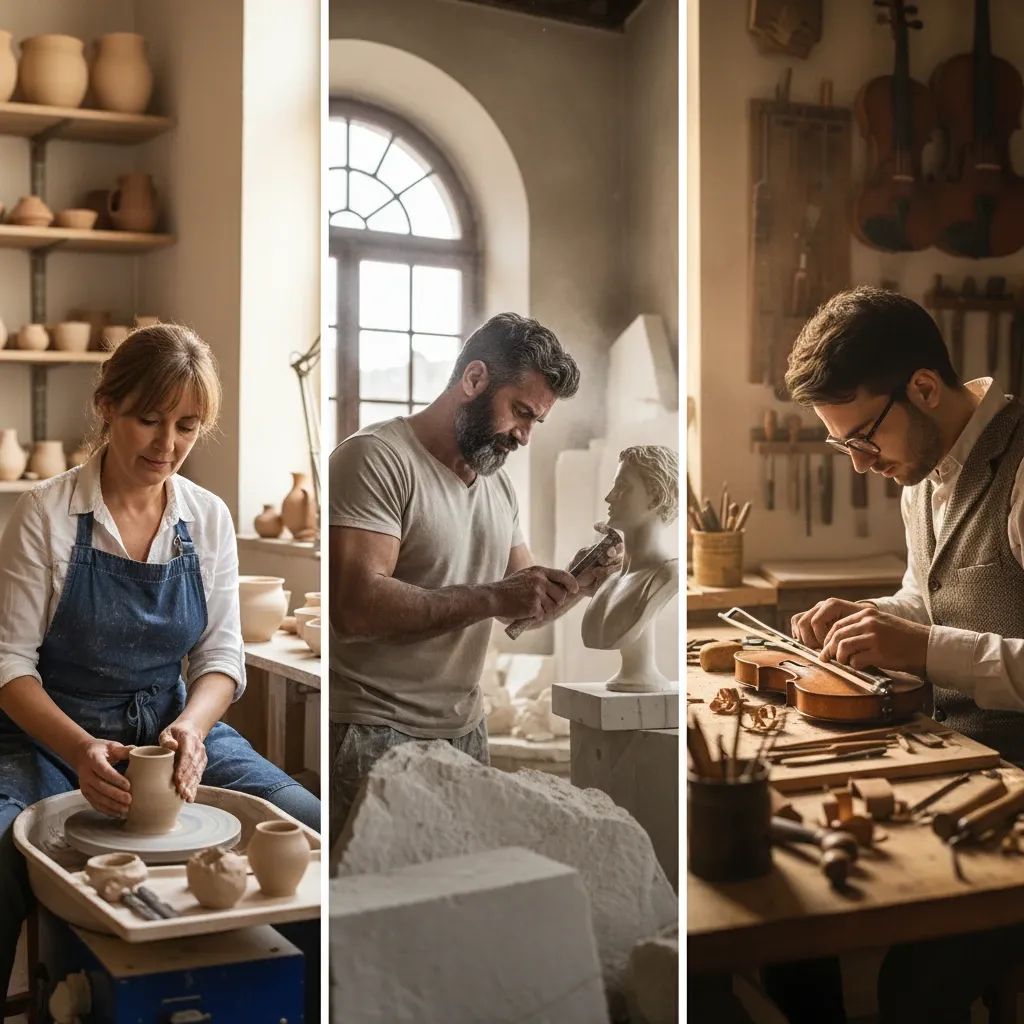
The neighborhood cobbler who repaired your favorite shoes for 30 years has closed. The carpenter who built your kitchen shelves retired without a successor. Across Italy, the artisan businesses that once defined local life are vanishing—and the numbers are staggering. The Italy artisan sector now accounts for 21.5% of all active businesses nationwide, but faces a profound identity crisis as it struggles to survive in an economy that increasingly favors scale over craft. While the sector has stabilized in 2026 after a decade-long hemorrhage, the data reveals a country split between artisan strongholds and metropolitan voids—and raises urgent questions about the future of traditional craftsmanship in Italian economic life.
Why This Matters
• Geographic divide: Artisan businesses represent nearly 1 in 3 companies in Nuoro, Cuneo, and Fermo, but just 10% in Naples and 12% in Rome.
• Employment gap widening: In Prato, 31.6% of all workers are employed by artisan firms; in Milan, that figure drops to 4.7%.
• Decade of decline: Italy lost 400,000 artisan workers between 2015 and 2025—a 25% contraction—though the sector added 5,201 businesses in Q2 2026.
• Southern resilience: The Mezzogiorno shed only 20% of its artisan workforce over ten years, compared to losses exceeding 28% in Marche, Umbria, and Emilia-Romagna.
What This Means for You
For Italians living outside the artisan heartlands, the contraction has tangible consequences:
• Service scarcity: Finding a qualified plumber, electrician, or metalworker is increasingly difficult and expensive, especially in cities and depopulated rural areas.
• Higher costs: With fewer artisans competing, hourly rates and wait times have risen.
• Cultural loss: The closure of neighborhood workshops and botteghe erodes local identity, community ties, and intergenerational skill transmission.
• Economic opportunity: For young people willing to learn a craft, there is a clear labor shortage and potential for stable, well-paid work—yet vocational training remains underfunded and stigmatized.
Finding help: If you need artisan services, local Chambers of Commerce (Camere di Commercio) maintain directories of registered craftspeople. The CNA website also offers a service finder. For young people interested in apprenticeships, regional Centri Servizi per l'Apprendistato provide free guidance and placement services.
The Geography of Craft: Where Artisans Thrive and Where They Vanish
Italy's artisan landscape is anything but uniform. Analysis by the CNA (Confederazione Nazionale dell'Artigianato e della Piccola e Media Impresa) based on Istat data shows that provincial economies differ wildly in their reliance on craft businesses.
Nuoro, the Sardinian province, leads the nation with 31.7% of all active businesses registered in the artisan registry. Close behind are Cuneo (31.5%), Fermo (31.3%), Asti (31.1%), and Reggio Emilia (30.7%). In these territories, artisan work is not a relic but the backbone of the local economy, supporting supply chains, employment, and community identity.
By contrast, Italy's major metropolitan areas show radically lower concentrations. Naples registers just 10.3% artisan businesses, Rome 12.2%, Caserta 12.8%, and Milan 15%. The pattern suggests that urbanization, commercial rent pressure, and the dominance of service and digital sectors have crowded out traditional craft.
The employment data tells a complementary story. Nationally, artisan firms employ 13.4% of all workers. But Prato—the textile and fashion hub—stands apart, with 31.6% of its workforce engaged in artisan production. Fermo, Nuoro, Macerata, and Arezzo also rank high. Meanwhile, Milan employs just 4.7% of its workers in artisan firms, Rome 5.1%, and Naples 6.5%.
A Decade of Erosion: What Happened to Italy's Artisans?
The stabilization of 2026 masks a brutal ten-year contraction. Between 2015 and 2025, the number of active artisan businesses fell from nearly 1.5M (a peak reached in 2008) to approximately 1.22M units—a loss of roughly 280,000 firms. More dramatically, the artisan workforce shrank from 1.7M to 1.3M, a decline of 25%, according to data from the CGIA (Associazione Artigiani e Piccole Imprese Mestre).
The national incidence of artisan firms among all active businesses dropped by 3.9 percentage points between 2014 and 2023, signaling not just closures but also a shift in Italy's economic structure away from craft-based production.
Regional Breakdown: The North-Center Collapse
The steepest losses occurred in central and northern regions traditionally known for skilled manufacturing:
• Marche: –31.3%
• Umbria: –29.3%
• Emilia-Romagna: –28.7%
• Piemonte: –28.4%
• Toscana: Lost nearly 40,000 artisans over the decade, a –26.8% contraction.
Between 2024 and 2025 alone, Pesaro-Urbino recorded the sharpest single-year drop at –8.3%, followed by Mantova (–7.9%) and Bologna (–7.5%).
Southern Resilience and the Role of Public Investment
The Mezzogiorno bucked the trend, posting a comparatively modest –20.2% decline. Several factors explain this relative resilience:
• PNRR funds and Superbonus 110%: National recovery investments and construction incentives buoyed demand for artisan services, particularly in building trades.
• Tradition and tourism synergy: Over 204,000 artisan firms—16.7% of the sector—are tied to tourism, employing 544,016 workers. In Campania, that share rises to 20.5%. Experiential tourism, including visits to artisan workshops, surged in summer 2026, chosen by 21.3% of vacationers.
• Regional policy support: Programs like Resto al Sud offer young entrepreneurs grants and zero-interest loans to start or take over artisan businesses. Sardegna provides the highest subsidy intensity in Italy: 40% grants up to €300,000 for investments.
In Q2 2026, Sardegna posted a +0.68% growth rate, second only to Valle d'Aosta (+0.97%), adding 230 new artisan firms.
Why Artisan Businesses Are Closing: The Structural Factors
The CGIA and CNA identify several interlocking causes behind the artisan exodus:
Competition and Consumption Shifts
• E-commerce and big-box retail: Online platforms and large chains undercut prices and convenience, especially for standardized goods and repairs.
• Changing consumer habits: Shoppers now favor fewer, larger purchases over frequent neighborhood transactions.
Fixed Cost Pressure
• Commercial rents, utilities, and local taxes weigh disproportionately on small operations.
• Public service withdrawal: In smaller towns, the closure of schools, post offices, and transit hubs reduces foot traffic and economic viability.
Generational Gap and Skills Crisis
• Youth disinterest: Vocational training is often seen as a fallback, not a career path. Schools steer students toward university rather than apprenticeships.
• Aging workforce: The average age of artisans is rising, and many lack successors.
• Training mismatch: Technical schools do not always align curricula with employer needs.
Access to Capital
• Credit is tighter and more expensive for micro and small artisan firms compared to larger enterprises.
Government Response: Incentives and Strategic Funds
Recognizing the crisis, Italy's Ministry of Enterprise and Made in Italy (MIMIT) established a new €50M Fondo per le Imprese Artigiane in 2026, divided into €20M for 2027 and €30M for 2028. The fund aims to improve credit access for investment programs and qualified development projects, though implementing decrees are still pending.
Other measures in force for 2025–2026 include:
• 5.07% INAIL premium reduction for artisan firms with no workplace accidents in 2023–2024.
• Nuova Sabatini refinancing (€650M for 2026–2027) for equipment and digital technology purchases.
• Piano Transizione 5.0: €12.7B over 2024–2025 for digital and energy transformation.
• Decontribuzione Sud: 30% cut in payroll contributions for businesses in southern regions, extended through December 2025.
• ZES Unica tax credit extension through 2028 for investments in the unified special economic zone.
• Regional programs: Lazio allocated €9M in its three-year artisan support plan; Toscana continues grants for green and productive investments.
The 2026 Budget Law also cut the IRPEF rate on the second income bracket (€28,000–€50,000) from 35% to 33%, benefiting many artisan owners and skilled workers.
Outlook: Stabilization, Not Recovery
After bottoming out in 2025 with 1.23M firms, the artisan sector added 5,201 businesses in Q2 2026, achieving a modest +0.43% growth rate and bringing the stock to 1,226,925 firms. The positive balance reflects fewer closures rather than a surge in startups.
Dario Costantini, president of CNA, framed the data as both reassuring and alarming: "This snapshot shows an Italy in which artisanship remains an essential component of the economy and the identity of territories. Where it is strongest, it sustains employment, communities, production chains, and the quality of Made in Italy. But the downsizing registered over the last decade represents a warning bell we cannot ignore."
For Italy, the question is no longer whether artisan businesses can survive, but whether the country will actively rebuild the social and economic infrastructure—training, credit, regulation, cultural valorization—necessary to make craft a viable and attractive livelihood for the next generation. Without that effort, artisan-rich provinces like Nuoro and Cuneo may become exceptions, and the botteghe that once defined Italian streetscapes will continue their slow fade into memory.


